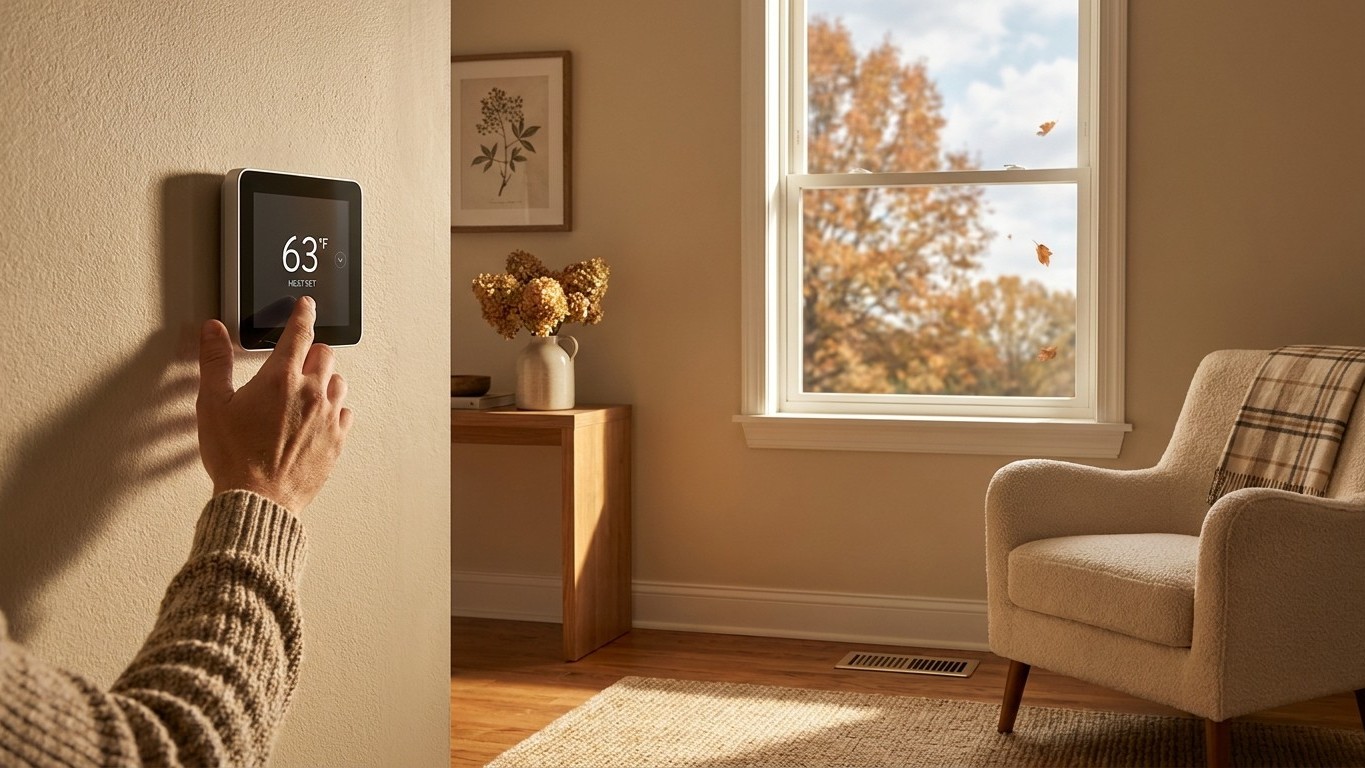

Heating season in Alabama opens in October, when average temperatures first drop below the 65°F mark that defines heating demand, and it runs through about seven months before spring pushes temperatures back up in May. Demand peaks in January. The month you actually flip the switch depends on where in the state you live and how your particular house holds heat.
When the heating season starts in Alabama

The number behind that October start date comes from a simple rule climatologists use everywhere: once the average temperature for a month drops below 65°F, heating degree days start accumulating, because that’s roughly the point where most buildings need supplemental heat to stay comfortable. At Huntsville International Airport, the reference station for this data, October’s normal mean temperature sits at 63.9°F, just under that line. That’s what marks the start of the season, not a date on a calendar and certainly not a specific cold morning. A monthly normal is an average pulled from thirty years of records, and the first real cold snap of any given year almost always lands before that average would suggest.
From there, demand builds through the fall, peaks in January, and tapers off as spring approaches, with the mean climbing back above 65°F by May. That’s the shape of a Southern heating season: it opens gradually, spikes hard in the dead of winter, and closes out fast.
Here’s what that looks like month by month, in heating degree days, at the Huntsville station:
| Month | Heating Degree Days |
|---|---|
| January | 692 |
| February | 513 |
| March | 349 |
| April | 132 |
| May | 23 |
| September | 8 |
| October | 122 |
| November | 383 |
| December | 609 |
Notice the gap in that table. June, July, and August don’t appear at all, because heating has nothing to do during those months in this climate. The table jumps straight from May to September for a reason: there’s no measurable heating demand in between.
How hard the winter works here
Alabama’s heating load, measured across the full year at Huntsville, comes to about 2,831 heating degree days. That figure is the proxy insurance companies and energy analysts use to estimate fuel use, and the relationship is roughly linear: a house that sees twice the degree days of another will burn roughly twice the fuel to stay just as warm, all else being equal.
What that 2,831 number doesn’t tell you on its own is whether the season is long and gentle or short and severe, and that’s exactly where the monthly table above earns its keep. Two places can post the same annual total while feeling completely different to live through, one stretching a mild chill across eight months, the other cramming the same total heat demand into a brutal ten-week stretch. Alabama’s pattern, with January and December carrying the bulk of the load and a long shoulder season on either side, leans toward the moderate end of that spectrum.
It’s also worth noting that this same station logs about 2,107 cooling degree days a year, which puts Alabama in a climate where air conditioning and heating both do real work, just in different seasons. Neither number should be compared against a different climate zone measured on a different base or period. It stands on its own, tied to the Huntsville station specifically.
What most homes in Alabama actually heat with
According to the U.S. Energy Information Administration’s Residential Energy Consumption Survey, here’s how heating equipment breaks down across Alabama households:
| Equipment | Share of homes |
|---|---|
| Furnace | 45% |
| Central heat pump | 39% |
| Steam or hot-water boiler | none reported |
On the fuel side, electricity powers 64% of Alabama homes for heating, natural gas covers 28%, and propane accounts for 5%. Fuel oil and kerosene came back as none reported in the survey, which means too few households in the sample used it to publish a reliable figure, not that nobody in the state does.
The furnace-and-heat-pump split reflects what was cheap and available when these houses were built, not what’s necessarily right for any one household today. A widely installed system isn’t a recommendation, it’s a historical snapshot.
What that split means day to day
Heat pumps, which cover nearly four in ten Alabama homes, work well in a climate like this because they don’t have to fight extreme cold for long stretches. Their weak point shows up on the coldest January mornings, when efficiency drops and some units lean on backup electric resistance heat, which costs more to run. Furnaces, still the single most common setup at 45%, heat a house faster and hold up fine in cold snaps, but they depend entirely on airflow. A furnace pushing warm air through ducts that leak, or vents blocked by furniture and rugs, will run longer and harder than it should. The one maintenance item people skip most often on either system is the filter, and skipping it strains the blower motor and cuts efficiency on both furnaces and heat pumps alike.
Run it once before you need it
Systems don’t fail in July. They fail on the first genuinely cold night, which in Alabama usually lands sometime in October or November, right when every HVAC technician in the region is suddenly booked solid. Testing the system in September or early October, before that rush, is the whole point of this section. Work through it in order.
- Turn the thermostat down, then back up to trigger a heating cycle, and just listen. Rattling, grinding, or a burner that won’t catch on the first try are signs worth noting before the cold sets in.
- Expect a faint burnt-dust smell the first time the system fires after months of sitting idle. That’s normal, it’s just dust burning off the heat exchanger or coils, and it should clear within a few minutes.
- Check the filter and replace it if it’s visibly gray or clogged. A dirty filter is the single cheapest fix that prevents the most breakdowns.
- Clear the space around vents, registers, radiators, or the outdoor heat pump unit. Furniture pushed against a vent or leaves packed around a heat pump coil both force the system to work harder for less output.
- Test every carbon monoxide alarm in the house by pressing the test button, and replace batteries if needed. Fuel-burning furnaces produce carbon monoxide, and a working alarm is the one safeguard that matters most once the system runs regularly.
- If the system won’t start, trips a breaker, or you smell gas rather than dust, stop and call a licensed technician instead of troubleshooting further yourself.
Even a system that passes every one of these checks can still be losing heat before it reaches you. According to the U.S. Department of Energy, “In a typical house, about 20%-30% of the air that moves through the duct system is lost due to leaks, holes, and poorly connected ducts.” That’s air escaping into an attic or crawl space rather than warming the room it was meant for, and it’s a separate problem from anything a filter change or thermostat cycle will fix.
What turning it down is actually worth
The Department of Energy puts a real number on the value of a thermostat setback: “You can save as much as 10% a year on heating and cooling by simply turning your thermostat back 7-10°F for 8 hours a day from its normal setting.” That figure covers both heating and cooling combined over a full year, not a single winter month, and it’s tied to that specific setback range and time window, not to some smaller adjustment held for a shorter stretch.
In a state where the heating season runs about seven months, from October through April, that setback has plenty of hours to work with each winter, particularly overnight or during a workday when nobody’s home to notice the drop. Pair it with a working thermostat schedule rather than manual adjustments, and the savings the DOE describes apply across the whole season, not just the coldest weeks in January.