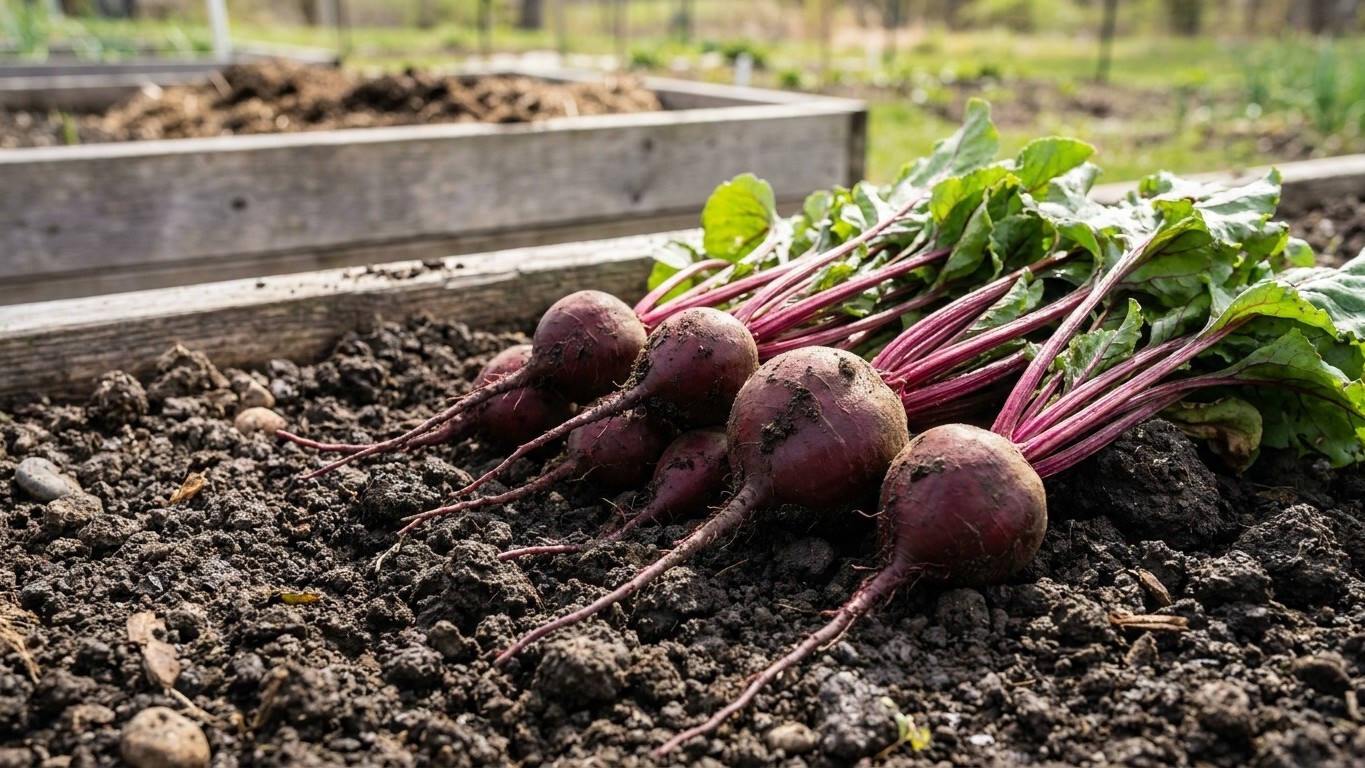

Pull beets 60 to 80 days after seeding, counted from the day the seed went into the ground, since beets are sown in place and never transplanted. In Arkansas, a sowing made two to three weeks before the last frost comes ready from late April into early June, before heat and dry spells turn the root woody. Top them at harvest. If they go into storage, aim for 33 to 36 F, not the coldest setting you can find.
The short answer
What the state soil tells a beet
Arkansas’s official state soil is the Stuttgart series, an Alfisol, which is a forest soil of moderate fertility that holds nutrients reasonably well. USDA’s representative surface values for it read 30 percent sand, 16 percent clay and 54 percent silt, a loam to silt texture, with organic matter around 1.8 percent and a pH of about 5.6, slightly acid. The drainage class is somewhat poorly drained. Those numbers describe the mapped surface of the series, not a worked garden bed, and certainly not yours.
For a beet, the silt is the number to notice. Utah State University Extension says beets want deep, sandy, well-drained soil rich in organic matter. A soil more than half silt with little sand, and slow to shed water, is close to the opposite of that picture. It holds moisture for a long time after rain, then can set up firm at the surface once it dries. A root swelling through that has to do more work than one in loose sandy ground. The same Extension source caps amendment at no more than 1 inch of composted organic matter per 100 sq ft, so the fix is a modest layer worked in, not a heavy dump of compost.
Treat all of this as a starting point. Arkansas spans hundreds of soil series, and river bottoms, hill country and any ground a builder has scraped or filled will behave differently from Stuttgart. A soil test gives your own pH and texture. The Beet Soil in Arkansas: What the Root Will Meet page goes deeper on what to do with the result.
Heat, woodiness and the pulling window
The second number is the count of days a year the reference city passes 90 F. It is not published here, and I would rather say so than guess at one. What the source does give is the threshold that matters: heat above 85 F combined with water stress makes the root woody. That is a later-season failure, separate from the early thirst that causes bolting (covered below). It means the pulling window has a back edge set by warm weather, and a root left in the ground into a hot, dry stretch pays for it in texture.
So the practical answer is to pull on schedule, between day 60 and day 80 from seeding, and not to let a row sit because the roots are “still growing.” If you want the full picture of how the crop fits into the year, Growing Beets in Arkansas covers it from seed to table.
Once the roots are out, the cold-is-better instinct that works for carrots and potatoes works against you. USDA Agricultural Handbook 66 says topped beets keep best at 33 to 36 F and 98% relative humidity, and that at 32 to 34 F more black spot and rot occur than at higher temperatures. Colder is not better here. Take the tops off first, since bunched beets with leaves hold only about 10 to 14 days at 32 F.
The six weeks that decide it here
Where the six weeks fall
NOAA’s 1991-2020 climate normals put the last spring freeze (32 F, in the 30 to 70 percent probability band) between March 12 and March 28 for the Arkansas reference station. Sowing two to three weeks ahead of that points to a window of roughly February 19 to March 14. The first six weeks of a seedling’s life then run from early April at the earliest to about April 25 at the latest. Those dates are simple arithmetic on the frost range, not a published planting calendar, and a given year can run earlier or later.
That puts the critical stretch squarely inside an Arkansas spring, which tends to swing. Warm spells arrive and are followed by cool, wet ones, and a stretch of heavy rain can give way to a dry week with strong sun. I do not have rainfall figures for this page, so I will not put a number on the swings. The pattern itself is what matters for a beet.
Where the bolting risk sits
Utah State University Extension is specific: water stress in the first 6 weeks causes premature flowering. A bolted beet puts its energy into a flower stalk, and the root stops being worth eating. In Arkansas, the risk is not a long drought. It is the dry week that follows a wet one, on silt-heavy ground that stayed soggy and then tightened at the surface. Seedlings that rooted shallowly in the wet stretch have little reserve when the top inch dries out.
Even watering across those six weeks is the point. A soaking every few days, adjusted to what the weather has done, beats a fixed schedule. A mulch of light organic material over the row slows the swing between wet and dry, and a quick finger test an inch or two down tells you more than the calendar.
The two failures sit at opposite ends of the crop’s life. Early thirst causes bolting in weeks one through six. Heat above 85 F with water stress causes woody roots later, as the crop approaches day 60 to 80. One watering habit does not cure both: the early weeks need steady moisture to keep the plant vegetative, and the late weeks need you to pull on time. For the pests that go after the tops during this same stretch, see What Eats Beet in Arkansas, and When.
What goes wrong here
Most beet trouble in this state traces back to either the soil’s habit of holding water or the way spring and early summer swing. Here are the failures worth planning for, each with its remedy.
- Bolting in the first six weeks. Water stress early in the crop’s life triggers premature flowering. Keep moisture even from seeding through about week six, and check an inch or two down after any dry, sunny spell. Mulch helps buffer the swings.
- Woody roots later on. Heat above 85 F combined with water stress makes the root tough. Pull between 60 and 80 days from seeding rather than waiting, and keep watering steady as the weather warms. This is a separate problem from bolting and has a different cause and timing.
- Heavy, slow-draining ground. A silty soil that is somewhat poorly drained holds water longer than a beet likes. Loosen the bed deeply before sowing, work in no more than 1 inch of composted organic matter per 100 sq ft, and consider a raised bed if your own soil behaves like the state soil’s description.
- Surface that tightens after rain. Silt-rich ground can firm up as it dries, which makes it harder for seedlings and swelling roots to push through. Loosen the top layer lightly after heavy rain, and keep the seedbed evenly moist rather than letting it bake and then flooding it.
- Storing too cold. The USDA handbook records more black spot and rot at 32 to 34 F than a little warmer. Hold topped roots at 33 to 36 F and 98% humidity. In a pit or cellar, keep temperatures between 31 F and 41 F, never below or above.
- Storing the wrong roots, or storing them with leaves on. Bunched beets last only 10 to 14 days. Top them first, and keep the large roots for storage because large roots lose water and shrivel more slowly. Eat the small ones first.
Check your own ground first
Every item above depends on how your garden differs from the state soil, which is why the soil test comes before the seed order. If a test shows your bed is sandier, drainage problems drop down the list, and the watering worries move up. If it shows more clay, the loosening and the raised bed matter more. The Stuttgart numbers describe what the region’s ground tends to do, nothing more.
Common questions
How do I know when a beet is ready to pull?
Count from seeding. The source range is 60 to 80 days, and because beets are sown in place, that count never starts from a transplant. Begin checking at the early end and pull as roots reach a size you like. This page does not carry size data for any variety, so your seed packet is the better guide to what full size looks like.
Can I leave beets in the ground through an Arkansas summer?
It is a gamble you will usually lose. Heat above 85 F with water stress makes the root woody, and the count of days a year the reference city passes 90 F is not published here. A root past its window gains toughness, not sweetness. Pull on schedule and move the harvest to storage or the kitchen.
Why not store beets at the coldest setting I have?
USDA Agricultural Handbook 66 reports that more black spot and rot occur at 32 to 34 F than at higher temperatures. Topped roots do best at 33 to 36 F and 98% relative humidity. A degree or two of margin matters more than it seems, and every other root crop’s “colder is better” rule fails here.
Should I store the big beets or the small ones?
Store the big ones. The handbook says large roots keep much better than small ones because they lose water and shrivel more slowly. Eat the small roots first, and top everything before it goes in, since leaves on bunched beets limit storage to about 10 to 14 days.