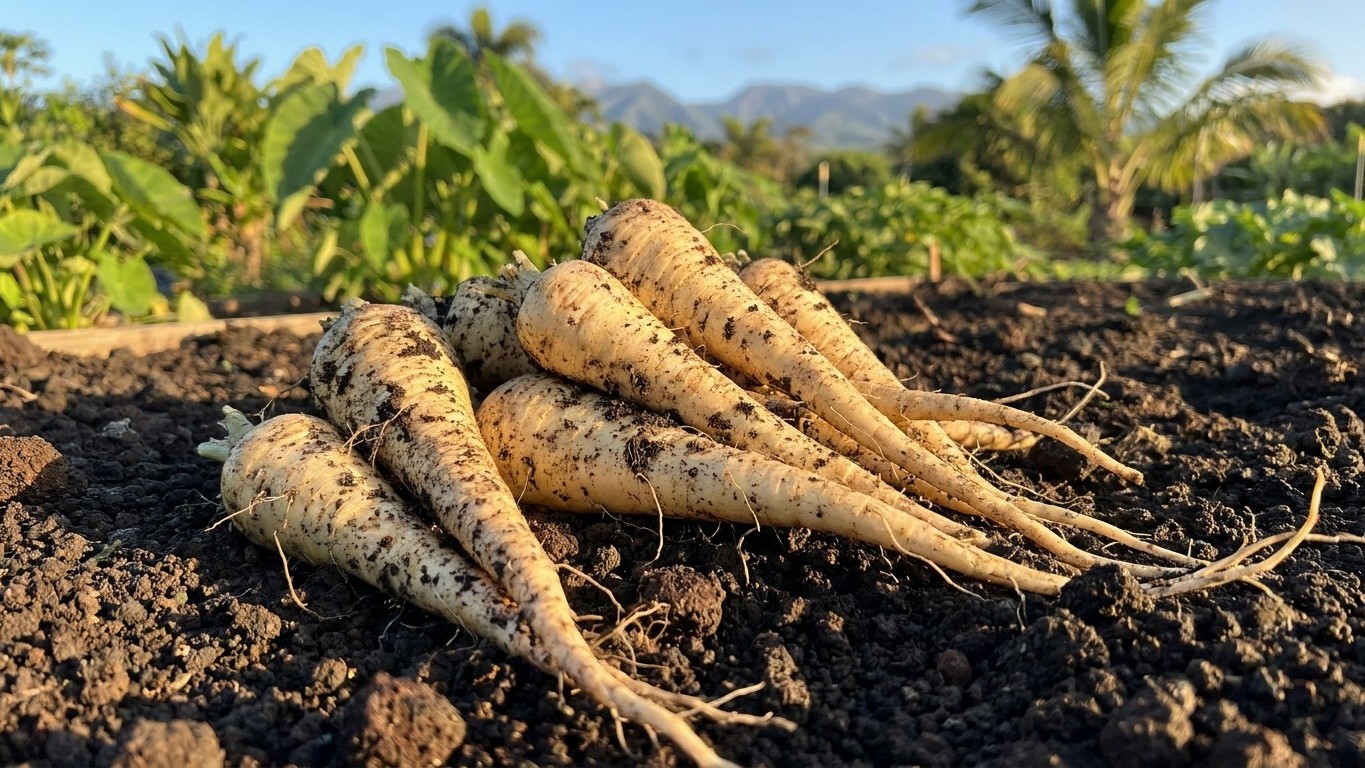

Lift Arkansas parsnips after several weeks of frosty weather, which means December at the earliest. NOAA’s climate normals put the first fall freeze at Little Rock between November 7 and November 20, and the sweetening comes after that, not before. Once dug, the roots keep four to six months only in a cold room held at 32 to 34 °F and 98% humidity, and only away from apples. This guide covers the arithmetic and the failures behind those numbers. For the full crop, see Growing Parsnips in Arkansas.
The short answer
Does Arkansas deliver several frosty weeks? That question decides whether you get a sweet parsnip or merely a big one. The mean daily minimum of the coldest month at the Little Rock reference station is 30.9 °F (NOAA NCEI Climate Normals). The average night in the deepest part of winter, then, dips only about one degree below freezing. That is a thin margin. Some winters stack up hard frosts one after another, and others hover just above the line for weeks.
So the plain verdict: a parsnip grown here will sweeten, but modestly and not reliably. Utah State University Extension says the roots taste best after several weeks of cool, frosty weather, which converts stored starch to sugar. In a mild winter you still get a sound, edible root that simply never turns sweet. Other parts of the state run colder or milder than Little Rock, and this page has no published figure for them. For the mechanism in detail, read Will Parsnips Sweeten in Arkansas?
One warning about shortcuts. Hardiness zone tells you whether a plant survives the cold, and a parsnip survives easily. Sweetening depends on frost exposure, meaning how many frosty weeks the roots actually sit through. A comfortable zone is not the same thing as several frosty weeks, and mixing them up is the most common wrong turn.
When to start digging
Start counting after the first freeze. With that freeze landing between November 7 and November 20, several weeks of frost pushes the first worthwhile digging into December. From there the roots can wait in the ground through winter. Pull the rest before spring warmth restarts growth. The last spring freeze falls between March 12 and March 28 on the same normals, and that is when winter’s work is done.
How long they keep, and the apple problem
USDA Agricultural Handbook 66 says parsnip roots can be stored 4 to 6 months at 32 to 34 °F with 98% relative humidity. Four to six months is a long keeper by any standard. But the figure assumes those conditions held steady, which almost no house does, so treat it as a ceiling.
Cold is not the danger, because parsnips are not chilling sensitive. Ethylene is. Parsnips produce almost none themselves, yet even low levels in cold storage make them bitter, likely through a compound called xanthotoxin. Apples and other ripening fruit give off ethylene, so a parsnip stored beside them turns bitter even at the right temperature. Keep roots in their own bag or drawer. Top them after harvest, but do not trim into the crown.
Does the season fit?
Parsnips need 100 to 120 days from seeding, and they are sown in place, so the count starts the day the seed goes in. The usual sowing runs 2 to 3 weeks before the last spring frost. Here is the arithmetic against the Arkansas frost window, using the NOAA NCEI normals for Little Rock.
- The last spring freeze falls between March 12 and March 28, the band where a 32 °F freeze is neither unlikely nor certain.
- Sowing 2 to 3 weeks earlier gives a window from about February 19 to March 14.
- Germination takes 14 to 21 days. Seedlings therefore appear anywhere from early March to early April, and weeks of bare soil are normal. Do not dig it up and re-sow.
- Add 100 to 120 days. The earliest sowing reaches size around May 30, and the latest around July 12.
- The first fall freeze falls between November 7 and November 20. From a July 12 finish to November 7 is 118 days, and from a May 30 finish to November 20 is 174 days. That is roughly 17 to 25 weeks of slack.
The season fits comfortably, and loosely at that. Days are not the constraint in Arkansas. The roots finish early and then sit through the long summer waiting for cold. The clock that matters runs after the first freeze, in the weeks of frost that follow. A late-spring sowing eats into the slack but still finishes before frost. Counting back from November 7 at the full 120 days puts the last possible sowing date around July 10, and that is a stretch, not a plan.
What goes wrong here
Most Arkansas parsnip failures come from the ground, the water and the weather. Each has its own fix.
- Forked roots from heavy or stony ground. Parsnips want deep sandy soil, and Utah State University Extension says heavy soil must be double dug. Much Arkansas ground is far from sandy. The state soil is only a starting point, not a diagnosis of your bed. Push a spade down 12 inches and see what you hit. Remove stones, loosen the full depth and break up clods before sowing.
- Forked roots from overwatering. This is a separate cause and needs a separate fix. A bed kept constantly soggy can fork roots even in good soil. Water deeply and less often, and let the surface dry between waterings.
- Bare soil and a premature re-sow. Germination takes 14 to 21 days. If you dig up or reseed at day ten, you waste seed and disturb what has already sprouted. Mark the rows and wait three weeks.
- A season that runs out. It happens only if sowing slips deep into summer. At 120 days, the last workable sowing date is around July 10. Sow in the February-to-March window and the days take care of themselves. Root-eating pests are another matter, covered in What Eats Parsnip in Arkansas, and When.
- A winter too mild to sweeten. With a coldest-month mean minimum of 30.9 °F, some winters will not deliver enough frost. Wait for a real run of frosty nights before digging, and leave roots in the ground as long as winter lasts. If the winter never turns, you still have a good roasting parsnip, just a less sweet one.
Common questions
Can I leave parsnips in the ground all winter in Arkansas?
Yes, through the frosty weeks. They are not chilling sensitive, so cold is not the risk. The risk is spring: the last freeze falls between March 12 and March 28, and warming weather pushes the plant to regrow. Lift before that.
How long do harvested parsnips keep?
USDA Handbook 66 gives 4 to 6 months at 32 to 34 °F and 98% relative humidity. A home refrigerator rarely holds those conditions steadily, so expect less. Keep the roots in a closed bag or drawer so they do not dry out.
Why do my stored parsnips taste bitter?
Ethylene is the likely cause. Even low levels in cold storage make parsnips bitter, and apples and other ripening fruit are the usual source. Store the roots in a separate drawer or container.
Should I cut the tops off before storing?
Yes, top them after harvest. Do not trim into the crown, the part where the leaves joined the root. The USDA handbook says parsnips should be topped but not trimmed into the crown.