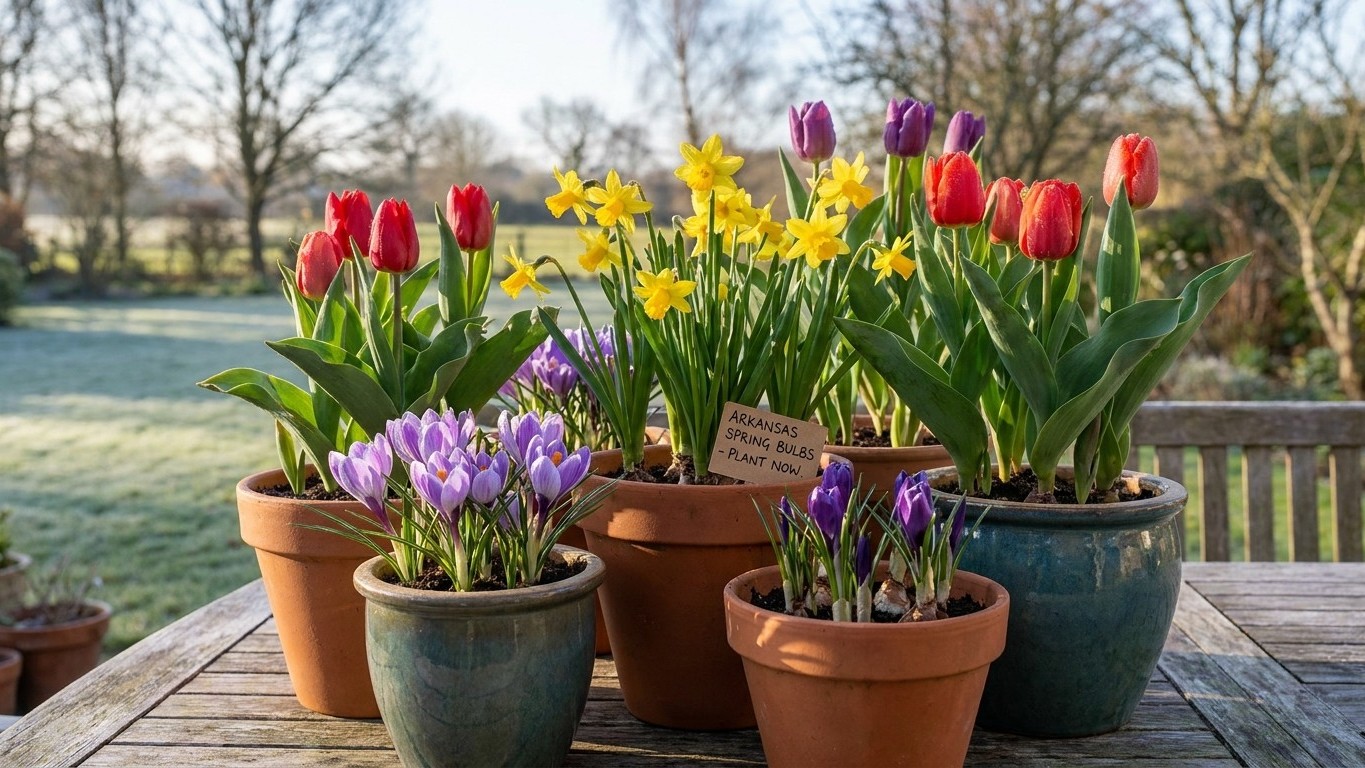

Arkansas doesn’t need forcing to get spring bulbs into bloom outdoors. The coldest month here averages a low of 30.9°F, more than enough to satisfy the 12 to 14 weeks below 45°F that tulips, daffodils, and crocus require. The real risk in this state is the pot itself: a container freezes solid, roots and all, in conditions where the ground next to it barely freezes an inch down.
Why this matters in Arkansas

Little Rock’s coldest-month average minimum sits at 30.9°F, according to NOAA’s 1991-2020 Climate Normals. That single figure answers the question most gardeners ask before they’ve even framed it: does winter here provide enough chill for spring bulbs to bloom on schedule without help? It does. A mean minimum below freezing for an entire month, stacked against the two or three months of cold that bracket it, comfortably covers the chilling window most spring-flowering bulbs need. Forcing, the practice of manufacturing that cold artificially in a refrigerator or unheated garage, is a technique for controlling bloom timing indoors here, not a rescue for a climate that can’t deliver winter on its own.
Containers change the math entirely. Arkansas spans USDA hardiness zones 6b to 8a, a range built on the average annual extreme minimum temperature and wide enough that a bulb rated hardy in Fayetteville can behave differently in El Dorado. That zone rating, though, was measured for bulbs planted in the ground, where soil mass buffers roots from the worst of the air temperature. A terracotta or plastic pot sitting on a deck or patio has no such buffer. Cold air surrounds it on every side, and the soil inside can drop to something closer to two zones colder than the ground beneath it. A daffodil bulb rated hardy to zone 7, planted in a bed anywhere near Little Rock, sails through winter. The same bulb in an unprotected pot on that same property can freeze solid enough to kill the bud inside.
So the situation in Arkansas isn’t a forcing problem. It’s a container problem. The state’s winters supply the chill spring bulbs need without any intervention, but the moment those bulbs go into a container instead of a bed, the hardiness math that worked in the ground stops applying. Anyone growing bulbs in pots here needs to treat the container as a colder microclimate than the address it sits at, not as a smaller version of the yard.
How to do it here
Two separate tracks apply, depending on whether the goal is bulbs blooming outdoors in a pot on the porch, or bulbs blooming indoors ahead of the outdoor season. Both start with the same chilling requirement and diverge at the point where cold ends and warmth begins.
- Check the chilling requirement on the bag or catalog listing. Most tulips, hyacinths, and crocus need 12 to 14 weeks below 45°F. Paperwhite narcissus need none. Confirm the number before assuming a bulb needs the full treatment.
- Choose a cold source that stays consistently below 45°F but doesn’t freeze. An unheated garage in Little Rock typically works for this window since the coldest-month average minimum sits at 30.9°F, above the point of a hard, sustained freeze inside a structure. A refrigerator drawer works year-round and doesn’t depend on the weather cooperating.
- Keep chilling bulbs away from ripening fruit. Apples, pears, and bananas release ethylene gas, and ethylene damages the flower bud developing inside a chilling bulb. A refrigerator crisper drawer shared with produce is the one place forcing quietly fails without any visible cause.
- For bulbs going into outdoor containers, match the pot’s exposure to a colder zone than the address suggests. If the property sits in zone 7b, choose bulbs rated hardy to zone 5 or 6, effectively two zones colder, since the container will run colder than the ground around it.
- If the bulb’s hardiness doesn’t clear that two-zone margin, move the pot instead. Shift it against a house foundation, into an unheated garage, or onto a porch out of direct wind, and mulch the soil surface with several inches of straw or shredded leaves to slow heat loss further.
- Bring chilled bulbs into warmth gradually once the cold period is complete. A few days in a cool, dim room before moving to full light and warmth lets the stem and root system catch up to the flower bud instead of forcing bloom on a plant that isn’t ready to support it.
Which bulbs are worth it
Not every bulb pays back the effort of chilling and containers. The ones that force reliably tend to have short chilling requirements and sturdy, compact stems that don’t need a trellis to stay upright indoors. The ones that sulk usually have the opposite problem: either a long cold requirement that’s hard to hit exactly, or a tall, top-heavy stem that flops the moment it’s out of a garden bed’s wind protection.
Bulbs that force reliably here
- Paperwhite narcissus, which need no chilling period at all and bloom within weeks of potting
- Hyacinth, sturdy-stemmed and one of the most forgiving bulbs for indoor forcing
- Crocus, short enough that a leggy stem is never a problem
- Grape hyacinth (muscari), compact and reliable in shallow containers
Bulbs that tend to sulk
- Tall trumpet daffodils, which often need staking indoors once the stem stretches toward available light
- Giant allium, whose heavy globe flower head is too top-heavy for most container setups
- Single late tulips, bred for garden height rather than the shorter, sturdier profile of forcing-specific tulip varieties
Worth noting: bulbs bought specifically for forcing, like paperwhites, are usually a one-season purchase anyway. They rarely rebloom well indoors the following year, so there’s no long-term cost to forcing them hard and discarding the spent bulb once the flowers fade.
What goes wrong, and when you can still fix it
Leaves come up, but no flower appears
This means the chilling period ran short, either too few weeks or a fridge and garage that didn’t stay reliably below 45°F. The flower bud inside the bulb never fully developed. There’s no fix this season: the bulb will produce foliage and nothing else. Replant it and give it the full 12 to 14 weeks next winter with a thermometer confirming the temperature range.
A flower stem too short to see over the pot’s rim
This happens when a bulb is moved from cold into warmth too fast, before the stem has had time to elongate. The flower opens, but it’s buried near the soil line instead of standing up where it can be seen. Nothing rescues that stem once it’s set. The lesson carries forward: transition gradually through a cool, dim room next time rather than moving straight from refrigerator to windowsill.
Rot at the base of the bulb in a pot
This is a drainage failure, almost always a pot without adequate drainage holes or a soil mix that stayed soggy through the chilling period. Caught early, before the rot has spread past the root plate, repotting immediately in fresh, well-draining mix can sometimes save the bulb. Once the rot has reached the bulb’s core, though, it’s lost for the season, and the container itself should be cleaned before reuse.