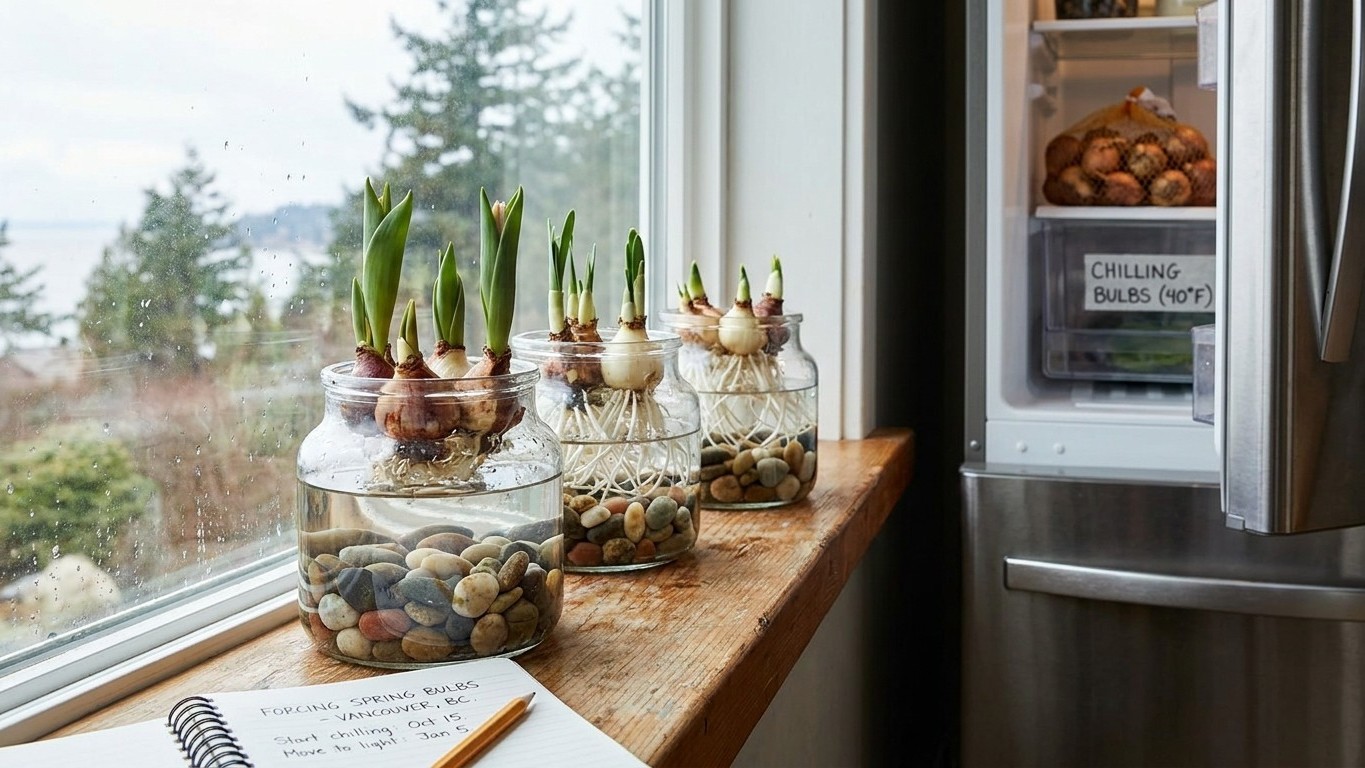

Vancouver’s coldest month averages a nightly low of just 33.5°F, and that single number explains why so many gardeners here end up chilling tulip and daffodil bulbs in a refrigerator instead of just planting them in a bed. Forcing bulbs indoors is not a decorative extra in this climate. It is the workaround for a winter that rarely holds still long enough to do the job on its own.
Why this matters in British Columbia

A spring bulb needs somewhere between twelve and fourteen weeks of temperatures below 45°F to complete the internal process that turns a stored bulb into a flower stem. That’s not a preference, it’s biochemistry: the cold breaks down growth inhibitors inside the bulb and lets the flower bud form before the shoot ever breaks the surface. In much of Canada, the ground supplies that cold reliably from November through February. Coastal British Columbia doesn’t.
The reference figure for this region, drawn from Environment and Climate Change Canada’s 1981-2010 normals for the Vancouver station, puts the mean daily minimum of the coldest month at 33.5°F. That’s barely below freezing, and it’s an average across the coldest thirty-day stretch of the year, not a sustained condition. Outside that window, temperatures climb well above 45°F for long spells, often within the same week thanks to the Pacific weather systems that keep this coast mild and wet rather than cold and dry. The ground here simply doesn’t hold a steady chill long enough for a bulb to complete its cycle unaided.
Natural Resources Canada’s Plant Hardiness Zone map, using 1991-2020 normals, places Vancouver in Canadian zone 9a. That’s a mild rating by Canadian standards, built from seven climate variables rather than the single winter-low measurement the American system uses (the two scales are not interchangeable, and NRCan itself warns that one Canadian zone can span nine different USDA zones). What zone 9a confirms here is the same story as the temperature figure: this is a region where winter is gentle enough that outdoor beds and Containers rarely freeze solid, but that same gentleness is exactly why bulbs left to their own devices often skip flowering or bloom weeks behind schedule.
This is the insufficient-cold scenario, not the frozen-pot scenario. A container in a climate with a harder winter faces a different risk: the soil in a pot freezes clear through, roots included, while the same ground in a bed only freezes at the surface. That’s not the primary threat in coastal British Columbia. Here, the problem runs the other way. Bulbs don’t get cold enough, for long enough, so the gardener has to manufacture that chill indoors.
How to do it here
Forcing is mechanical once you understand what the bulb is waiting for. The sequence below assumes you’re working with a bulb that needs the full twelve to fourteen weeks of chilling, which covers most tulips, daffodils, and hyacinths.
- Choose firm, disease-free bulbs sized for forcing (larger bulbs of a given species generally push a sturdier flower stem).
- Pot them in a shallow container with drainage holes, using a well-draining potting mix, and set the bulbs with their noses just above the soil surface, close together but not touching.
- Water once, thoroughly, until it drains from the bottom.
- Label the pot with the variety and the potting date. You will need that date to count the weeks.
- Move the pot to a cold, dark space and hold it there for twelve to fourteen weeks, checking a thermometer rather than guessing.
- An unheated garage works if it stays consistently above freezing but below 45°F, which is common through a coastal British Columbia winter, though a sunny afternoon can push a garage warmer than that on mild days, so check periodically rather than assuming it holds steady.
- A refrigerator crisper drawer is the more reliable option, since it holds a constant temperature, but keep it away from ripening apples, pears, or other fruit. Fruit releases ethylene gas, and ethylene can kill the flower bud forming inside the bulb before it ever emerges.
- If you’re chilling potted bulbs outdoors rather than in a fridge or garage, the pot needs to sit somewhere at least two Canadian hardiness zones hardier than the bulb’s own rating, or be moved into an unheated structure and mulched heavily around the sides once temperatures near freezing.
- Check soil moisture every few weeks during chilling. The mix should stay lightly damp, never soggy and never bone dry.
- Once the chilling period is complete and you see roots at the drainage holes and pale shoots an inch or two tall, move the pot to a cool, bright room (around 55 to 60°F) for a week before moving it into full warmth and light to flower.
Which bulbs are worth it
Not every bulb rewards the effort equally, and the reasons come down to two things: how long a chill the species demands, and how the flower stem behaves once it’s up. A bulb with a short cold requirement forces faster and with less risk of a missed window. A bulb that naturally grows tall in the garden tends to grow just as tall in a shallow indoor pot, and without the wind and structural support of an outdoor bed, that stem often flops before the flower opens.
Bulbs that force reliably here
- Crocus (short chill requirement, short stem, low risk of toppling)
- Muscari, grape hyacinth (short stem, forgiving of an imperfect chill period)
- Hyacinths (dependable bloom, strong fragrance, moderate stem height)
- Standard daffodils and narcissus (reliable once the chill period is met)
- Paperwhite narcissus (needs no cold period at all, making it the easiest option for a mild coastal winter)
Bulbs that sulk
- Fritillaria (long chill requirement, tall and top-heavy indoors)
- Large Darwin hybrid tulips (tall stems that often bend or snap in a shallow pot)
- Alliums (long chill period, height that overwhelms most indoor containers)
There’s also a cost argument worth making plainly. Most tulips forced indoors are spent after that one bloom and rarely worth replanting outside afterward. Since a forced tulip was never going to come back reliably in a garden bed anyway, using it up indoors for one season of color costs nothing you weren’t already going to lose.
What goes wrong, and when you can still fix it
Leaves come up, but no flower ever forms
This means the chilling period ran short, either in weeks or in temperature. The bulb produced foliage because that part of its growth doesn’t depend on the cold, but the flower bud never finished developing. There’s no fix for this season. Plant the bulb out in a bed if the species can survive there, or discard it and start a new one with a full, tracked chilling period next time.
The flower opens on a stem too short to see over the leaves
This is what happens when a pot moves from cold storage straight into a warm, bright room. The stem needs a transitional week or two in a cool, bright space to elongate before full warmth triggers the flower to open. Skip that step and you get a bloom sitting low in the foliage instead of rising above it. This season’s flower can’t be lengthened after the fact. Next round, build in that cool intermediate stage.
The bulb turns soft and rots in the pot
Rot in a container almost always traces back to standing water, either from a pot without drainage holes or one left sitting in a saucer full of water during the chilling weeks. Once a bulb goes soft and smells sour, it’s finished, there’s no reviving it. For the next batch, confirm the pot actually drains freely and never let it sit in accumulated water at the base during storage.