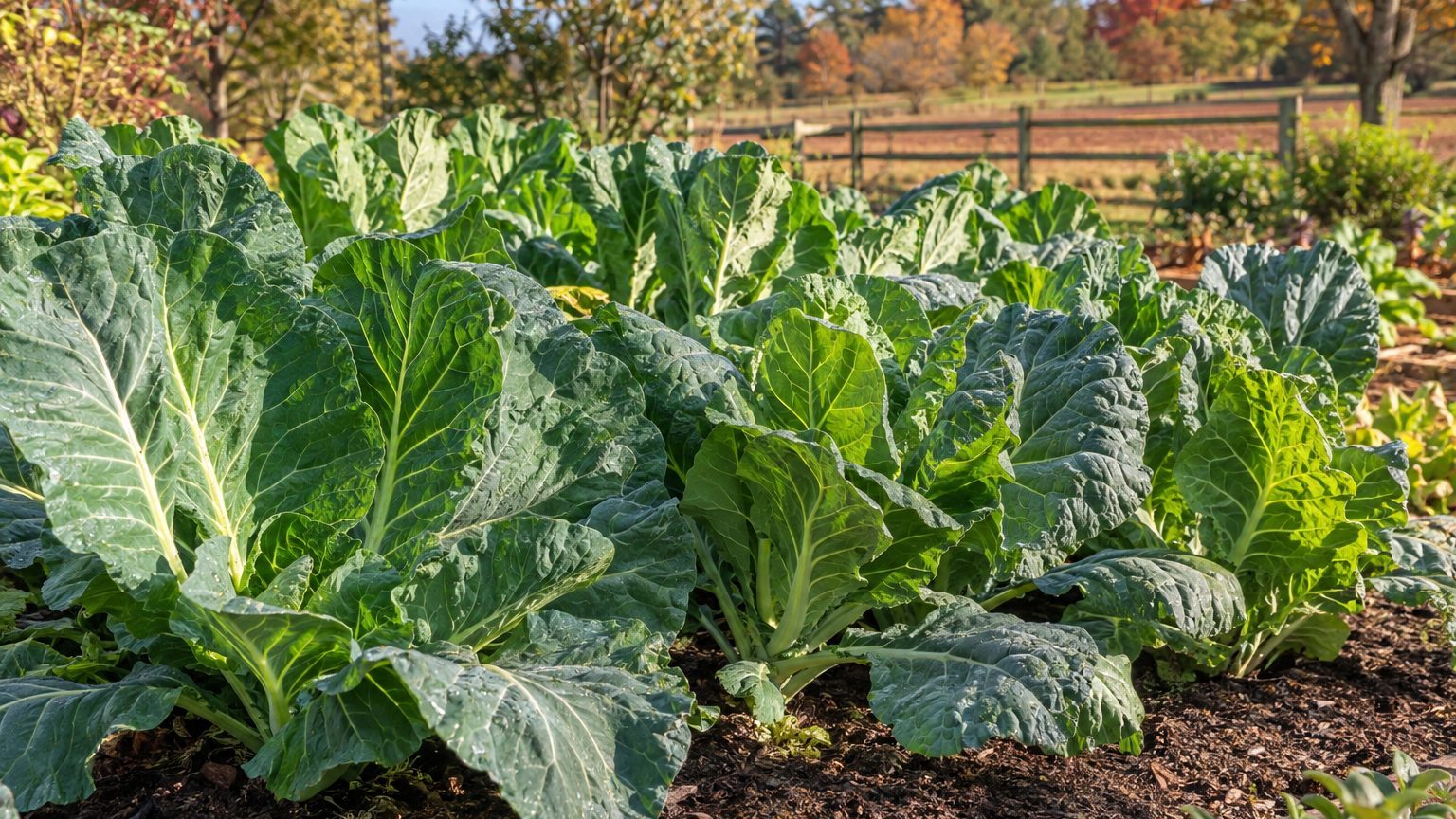

Fast-maturing, heat-tolerant collards like Georgia Southern or Champion beat slow heirloom types across almost all of Arkansas. The state’s frost dates give a long enough season for two plantings, but the gap between them is a brutal summer that punishes anything that lingers too long in the ground waiting to mature.
The short answer for Arkansas
Start with the numbers, because they explain the recommendation instead of just stating it. Little Rock’s station data puts the last spring freeze (32°F) somewhere between March 12 and March 28, and the first fall freeze between November 7 and November 20. Stack the earliest last-frost year against the latest first-frost year and you get a season stretching 224 to 253 days from frost to frost. That’s a long window by national standards. It’s also misleading if you read it as one uninterrupted growing period.
The catch is what happens in the middle. Arkansas summers push well past what collards tolerate gracefully for weeks at a stretch, and that heat arrives fast after the last frost date, not gradually. A collard variety bred for a cool, drawn-out spring in a northern state doesn’t get that here. It gets a short cool ramp-up, then a wall of heat that triggers bolting and bitter leaves before the plant reaches full size. That’s why the practical move in Arkansas isn’t picking one variety and running it all season. It’s splitting the calendar: a quick spring crop planted as soon as soil allows, harvested before peak heat, then a second planting in mid-to-late summer timed to mature as temperatures ease toward that November frost window, when cold actually sweetens the leaves.
Quick standard types (35 to 55 days from transplant) fit the spring slot because they get harvestable weight before the heat spike. For fall, growers lean on the same quick types or on classic open-pollinated collards like Vates or Champion, which tolerate the light frosts common in late October and November without turning to mush. Slow, large-framed heirlooms such as Morris Heading can work, but only in the fall slot, where their longer timeline lines up with cooling weather instead of fighting it.
| Planting slot | Variety type | Why it fits |
|---|---|---|
| Spring (as soon as soil works) | Quick standard, 35-55 days | Matures before summer heat spike |
| Late summer / fall | Vates, Champion, or slower heirlooms | Timeline lines up with cooling weather and light frost sweetening |
What will not work here

The clearest failure mode is planting one slow-maturing heirloom collard in spring and expecting it to hold through summer without bolting. Given a last-frost window that closes by late March at the earliest, and daytime heat climbing fast in the weeks after, a variety needing 80-plus days from seed simply runs its clock into the hottest stretch of the year. The plant reads that heat as a signal to flower, not to keep producing tender leaves. Once it bolts, the leaves toughen and turn bitter, and there’s no reversing it.
Watering schedules fail the same way. A once-a-week soak might carry a cool-climate garden through spring, but Arkansas summer heat pulls moisture out of topsoil fast, especially in the sandier soils of the Delta counties. Collards with shallow, spreading root systems stress quickly under that kind of gap, and stressed plants bolt sooner and get tougher leaves even if they don’t outright wilt. The fix isn’t complicated, just more frequent, shorter watering through the hottest six to eight weeks rather than a deep weekly drench and a shrug.
Spacing is the other quiet killer, and it cuts the opposite direction from what a lot of gardeners assume. Arkansas summers run humid as well as hot, and collards planted too tight trap moisture around their lower leaves. That moisture is exactly what fungal problems like black rot and leaf spot need to spread through a bed. Crowded plantings that might get away with it in a drier climate turn into disease incubators here. Give plants 18 to 24 inches apart and keep air moving between rows, especially for the summer-to-fall planting, when humidity and heat overlap the most.
Direct-seeding tender transplants too early is the last common misstep. The 32°F frost dates matter for hardened, established collards, but small seedlings are more like tender plants, and NWS Little Rock’s tighter 36°F window (April 3 to October 31) is the one that actually protects them from a late cold snap.
What changes across Arkansas
Arkansas is not one climate wearing a single state line. The USDA Plant Hardiness Zone Map places the state across a spread of 6b to 8a, which is two full zones of difference in average extreme winter minimum, built on that one variable alone. That’s the gap between the Ozark highlands in the north and the Delta lowlands in the south and east, and it shows up directly in how long a fall crop can stay in the ground.
In the cooler, higher-elevation north, winter arrives with more bite and earlier certainty, which means a fall collard planting has a tighter margin before hard freezes end the harvest for good. Growers there generally do better timing their fall crop a little earlier and choosing quicker varieties for that second planting, so there’s less risk of an early hard freeze catching an unfinished crop. In the warmer south and east, that same fall planting can often ride later into November and even into early winter, since the zone’s milder minimums give collards more chances at that flavor-improving light frost without a killing freeze right behind it.
None of this means picking a single zone number off the state map and building a calendar around it. A reference city figure like Little Rock’s 30.9°F coldest-month average minimum describes a mid-state, mid-elevation location, not a hollow in the Ozarks or a low spot in the Delta bottomlands, both of which can run noticeably colder or milder than that reference point on any given winter night. The honest answer for “what zone am I in” isn’t a paragraph, it’s a map. Arkansas gardeners should check their own county placement on the current USDA Plant Hardiness Zone Map rather than borrowing a number from a location that may sit a full zone away from their own yard.
Where to check this for your own county
Everything above is a state-level answer, and a state-level answer is a starting point, not a final one. The county your garden sits in has its own microclimate, its own soil history, and often its own trial data on which collard varieties actually held up there over multiple seasons. That’s information a statewide page like this one simply can’t carry.
The University of Arkansas System Division of Agriculture Cooperative Extension Service keeps that information, and it’s worth a direct visit rather than a guess. Find your county’s office through uaex.uada.edu and look specifically for two things once you’re there: the local vegetable planting calendar, which will translate the frost-date ranges above into county-specific spring and fall sowing windows, and any list of collard or Southern greens varieties the office has trialled or recommends for growers in that county. A county extension office that’s watched collards through a decade of local summers and winters has a better read on what survives there than any statewide frost-date range can offer.
This matters more in Arkansas than in a flatter, more uniform state, given the zone spread already discussed. A county recommendation coming out of the Ozark highlands is answering a different growing reality than one coming out of the Delta, even though both counties are technically “Arkansas.” Treat this page as the broad framework and the county office as the fine print that actually applies to your soil and your winter.
Checking this against your own garden
Frost-date ranges and hardiness zones describe averages built from decades of station data. Your own garden this season is not an average, and three simple observations will tell you more about your actual microclimate than any date on this page.
Start with the soil itself. Before spring transplanting, press two fingers into the bed at a couple inches deep. If it still feels cold and heavy rather than loose and mild, the ground hasn’t caught up to the calendar yet, whatever the frost-date range says, and setting out transplants into cold soil just stalls them instead of getting them growing.
Second, watch for the first flush of male flowers, or bolting, on any collard left in the ground too long. That’s the plant telling you the heat has arrived at levels it can’t tolerate anymore, and it’s a far more reliable signal than a fixed date for deciding when the spring crop is done and the bed needs to be cleared for the summer planting.
Third, track how fast seedlings push out their first true leaves after the initial seed leaves. A quick, vigorous push means your particular spot, with its own drainage, sun exposure, and soil warmth, is running ahead of the county average. A sluggish, slow emergence means it’s running behind, and the fall planting date might need nudging earlier the following year. None of that requires a thermometer or a soil probe, just a season of paying attention to what your own dirt is actually doing.