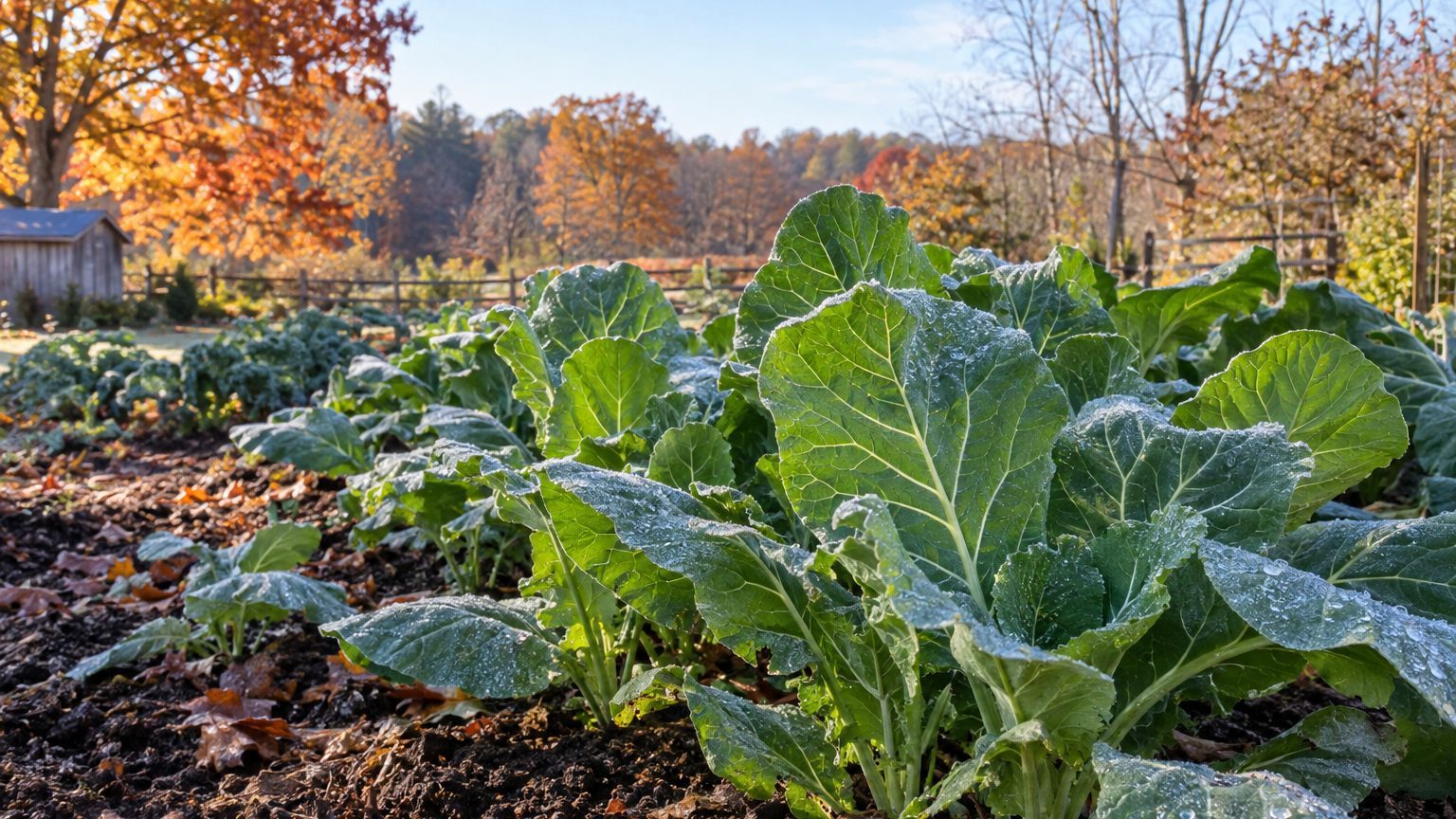

Collards go into Arkansas soil twice a year: a small spring planting in late winter, and the main event in mid to late summer for a fall harvest that sweetens after frost. The state’s frost dates set both windows, but they’re probabilities, not promises, and the difference matters for what you plant and when.
The short answer for Arkansas
Fall is the collard season that matters most here. NOAA’s 1991-2020 Climate Normals for station USW00013963 put Arkansas’s first fall freeze (32°F) somewhere between November 7 and November 20, a 30-to-70% probability band rather than a fixed calendar date. Count backward from that window using the 75 to 85 days most collard varieties need to size up, and the sowing target for a fall crop lands in mid-August. Plant later than that inside a cold fall, and heads won’t fill out before the first hard freeze locks growth down.
Spring is the smaller window, and a riskier one. The same station’s last spring freeze (32°F) falls between March 12 and March 28, but tender growth actually needs the 36°F light-frost threshold, which NWS Little Rock sets at April 3. That gap between the two thresholds is the trap: a gardener who reads only the 32°F date and transplants in early March can still watch a mid-March cold snap knock back young plants that would have shrugged off frost as mature leaves but not as seedlings.
Why the two dates aren’t interchangeable
The 32°F figure describes a hard freeze, the kind that collards, once established, tolerate and even benefit from since cold converts starches to sugars in the leaves. The 36°F figure describes the last morning cold enough to stunt a young transplant. Direct-seeded spring collards planted right after the 32°F date but before April 3 are gambling on a mild March, and Arkansas Marches aren’t reliably mild.
Practically, that means most Arkansas gardeners treat spring collards as a bonus crop for baby greens, sown as soon as soil can be worked in February, and treat the mid-August fall sowing as the crop they actually plan a harvest around.
What will not work here

Betting on a full-size spring harvest is the first mistake. The gap between the last frost risk (into late March) and the arrival of real Arkansas summer heat is short, and collards bolt fast once daytime temperatures climb into the 80s. A spring sowing timed for mature heads instead of baby leaves runs into flowering stalks before it runs into a harvest basket.
The second failure sits inside the fall sowing window itself. Mid-August in Arkansas is still deep summer, and germinating collard seed in dry surface soil at that time of year needs consistent moisture, not the once-a-week soak that works once plants are established. Gardeners who water on a weekly schedule during that August germination stretch typically see spotty, uneven stands, because the top inch of soil dries out between waterings and seedlings that do sprout stall. Watering lightly every day for the first ten days after sowing, rather than deeply once a week, is what actually gets a fall stand up.
Spacing and the state’s humidity
Arkansas’s humid summers also punish tight spacing. Collards packed close together trap moisture in the canopy, and that’s exactly the condition that favors black rot and downy mildew, two diseases that spread fast in still, damp air. Rows set too close for airflow can look fine in July and be visibly diseased by September, right when the crop should be filling out for harvest.
Finally, the coldest-month mean daily minimum for the reference station sits at 30.9°F, a mild average that some gardeners take as license to skip row cover entirely through winter. That figure is an average, not the extreme low, and it says nothing about the occasional hard freeze that drops well below it in a bad week. Leaving a late fall crop fully exposed on the strength of that average number is a bet the average doesn’t actually back up.
What changes across Arkansas
Arkansas isn’t one garden, and the USDA Plant Hardiness Zone Map (2023, built on 1991-2020 normals) makes that concrete: the state spans zones 6b to 8a, a two-zone range built entirely on average annual extreme minimum temperatures. That’s a wide spread for one state, and it means the sowing calendar above, anchored to a Little Rock-area station, shifts depending on where in Arkansas a garden actually sits.
Higher elevations in the Ozark and Ouachita regions of the north and west run closer to zone 6b, with colder extreme lows and an earlier arrival of hard freeze. A fall collard crop there needs to go in earlier than mid-August to finish sizing before winter closes the growing window, and any late-season planting benefits from row cover sooner rather than later.
The Delta and southern lowlands lean toward zone 8a, milder winters, and a later effective frost. Gardeners in those areas generally have more slack on the back end of the fall planting window, and some can push a second, smaller fall sowing later into August without the same freeze risk that a northern county faces.
None of this tells an individual reader which zone their own yard falls into, since zone boundaries in Arkansas run through counties, not around them. The USDA’s map is the tool for that, not a state-level estimate.
Where to check this for your own county
Everything above comes from statewide climate normals, useful for a general sense of timing but not built for any one county’s microclimate. The University of Arkansas Cooperative Extension Service, at https://www.uaex.uada.edu/, publishes the county-level detail this page can’t: a local planting calendar adjusted for that county’s typical frost pattern, and lists of collard varieties actually trialled in Arkansas conditions rather than generic seed-catalog recommendations.
Two things are worth pulling from that site specifically. First, the county extension office’s planting calendar, which usually narrows the mid-August fall window down to a tighter range for that specific location, sometimes by two or three weeks either direction depending on local elevation and typical first-freeze timing. Second, any variety trial results or recommended cultivar lists, since collard performance under Arkansas humidity and heat varies enough between varieties that a state extension trial carries more weight than a seed packet’s national-average maturity date.
A county recommendation beats a state one every time, because it’s built on local station data and, often, on actual field trials run in that county’s soil and climate rather than a statewide average blended across zones 6b through 8a. This page is the state-level starting point. The county extension office is where that starting point gets corrected for the specific patch of ground a reader is actually planting.
If you follow the almanac, here is when to plant collard greens by the moon. It is a tradition, not a proven method.
Checking this against your own garden
Calendar dates are a starting estimate, and a reader’s own soil and plants will confirm or correct it faster than any normal-year average can. Three checks are worth doing by hand, no thermometer or gauge required.
Feel the soil before an August sowing rather than trusting the calendar alone. Collard seed germinates unevenly in soil that still feels hot and dry two inches down, even if the date on the calendar says it’s time. Soil that feels warm but not hot, and holds a little dampness after watering, is telling you germination conditions are actually right, regardless of what the date says.
Watch for the first true leaves, the second set that appears after the rounded seed leaves. Their timing after sowing is a rough gauge of how favorable that specific week’s conditions were, since true leaves that show up on schedule confirm the soil and moisture were doing their job, while a long delay suggests the garden ran cooler or drier than the regional average that week.
Watch, too, for a flowering stalk starting to rise from the center of a spring planting. That’s the plant’s own signal that heat has arrived, and it usually shows up before daytime highs feel consistently hot to a person standing in the garden. A stalk appearing earlier than expected is the plant reporting that this particular yard runs warmer, faster, than the regional frost-date averages would suggest, which is exactly the kind of local correction no state page can hand you in advance.