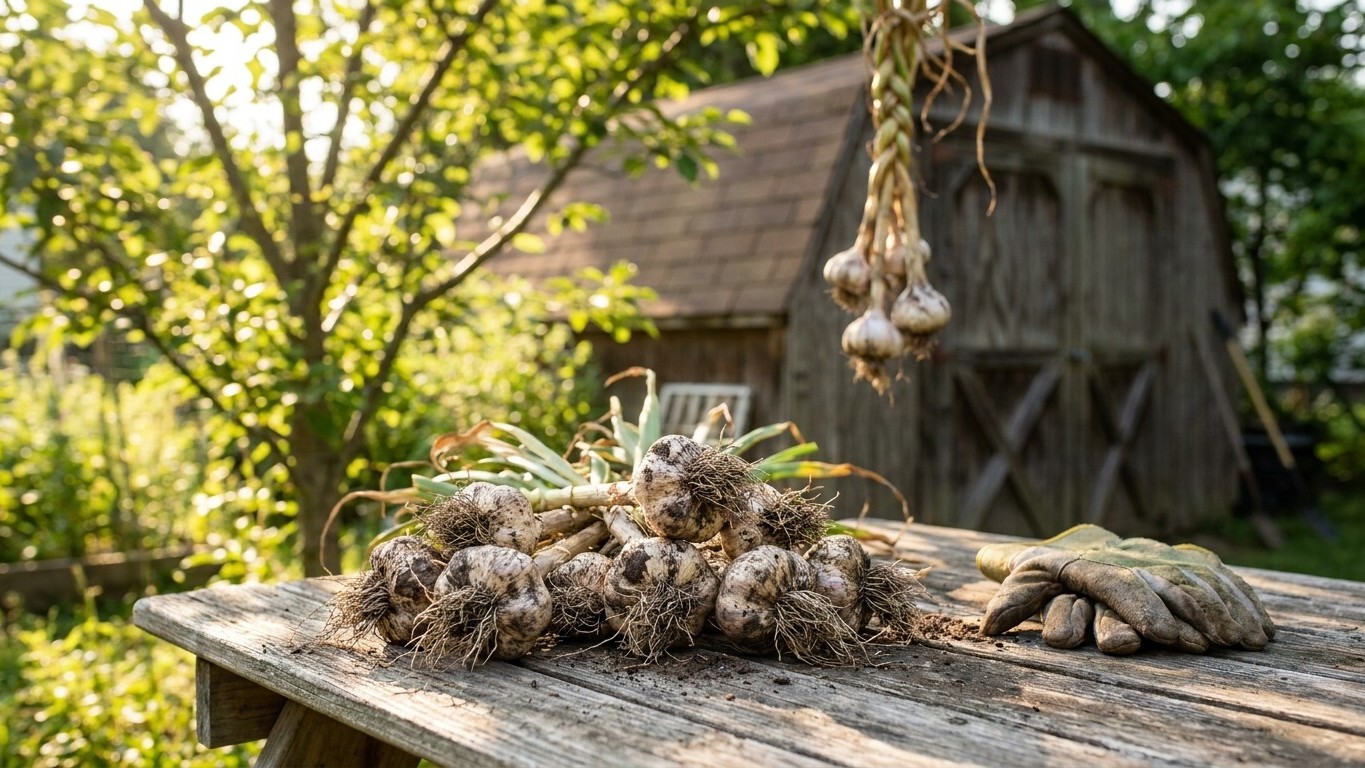

Garlic in Arkansas comes out of the ground when the lower third to half of the leaves have browned while the top leaves are still green, usually in late May through June depending on when it went in the ground the previous fall. Pull too early and the wrappers won’t have formed; wait too long and the bulb splits open in the humid soil. Curing takes two to four weeks in a shaded, airy spot before it ever sees a pantry shelf.
When garlic is ready to lift in Arkansas
The leaf-count rule is the same everywhere garlic grows: each green leaf on the plant corresponds to a wrapper layer around the bulb below ground. Once five or six leaves have died back and turned brown from the bottom up, while four or five up top stay green, the bulb has stopped sizing up and started sealing itself for storage. Pull one test plant, brush off the soil, and slice it in half. If the cloves fill the skin with no gaps and the wrappers are distinct, the rest of the row is ready.
Arkansas summers arrive fast and hot, and that changes the calculus compared to cooler states. Heat pushes garlic toward maturity earlier and compresses the harvest window; a crop that would linger in the ground for another two weeks up north can be done and drying out in Arkansas clay in a matter of days once the weather turns. Humidity adds another wrinkle. Wet soil right before harvest stains the wrappers and invites rot at the base of the bulb, so growers here often stop watering ten to fourteen days ahead of the expected pull date to let the ground firm up.
Don’t go by the calendar alone
Because planting dates, soil type, and variety all shift the timeline, a fixed date on the calendar is a poor substitute for walking the row and checking the leaves. Softneck types often finish a bit earlier than hardneck types planted the same week. For guidance tailored to a specific county and soil, the University of Arkansas Division of Agriculture Cooperative Extension is the right first call, since local agents track how the season is running in real time.
One more practical note: dig, don’t pull. Garlic roots hold on stubbornly in Arkansas’s clay-heavy soils, and yanking by the stalk snaps the neck before the bulb comes free. A garden fork slid in six inches from the row, lifted gently, does the job without tearing wrappers that are supposed to protect the bulb through months of storage.
Curing it, and where to hang it here
Curing is what turns a freshly dug bulb, still full of moisture, into something that will keep for months. The process is simple in principle: get the plant out of direct sun and let air move around it until the outer skins dry into papery layers and the neck tightens down to a dry, wiry stem. In practice, Arkansas’s humidity makes this the step where the most bulbs are lost.
Shade and airflow matter more here than in a dry climate. A covered porch, an open-sided shed, or a garage with the door cracked and a box fan running works better than a closed room, because still, damp air is exactly what mold needs. Bundle plants loosely in small groups of four or five, tied by the stems, and hang them so air passes on all sides rather than stacking bulbs on a table where the bottom layer never dries. Spacing them out, even if it means using more hooks or more line, cuts the risk of a moldy patch spreading to healthy bulbs sitting right next to it.
Watch for the warning signs
Check the hanging bundles every few days during the first two weeks. A bulb that feels soft, smells sour, or shows a fuzzy gray patch at the neck should come out of the group immediately rather than stay in contact with the others. Arkansas’s stretch of humid days in June and early July means a batch that would cure cleanly in a dry western state can mildew here if it’s crowded or hung somewhere without cross-breeze.
Curing is finished when the outer wrappers rustle like paper and the neck above the bulb has gone from green and pliable to dry and stiff, generally three to four weeks after the bulbs come out of the ground. At that point they’re ready to have roots and excess stem trimmed and to move into longer-term storage.
Storing it through a Arkansas winter
Cured garlic wants three things: cool temperatures, low light, and moderate humidity, roughly 45 to 65 percent, not the soaking humidity of a summer cure shed. A pantry shelf, an interior closet, or an unheated but insulated room in the 55 to 65 degree range all work. What doesn’t work is the refrigerator; the cold and damp there trigger sprouting far faster than a dry cupboard does, and a fridge-stored bulb often turns rubbery within weeks.
Arkansas winters run milder than the Upper Midwest but still bring enough cold and enough humidity swings that storage spots need checking more than once. A garage that stays above freezing but below 65 degrees through December and January is often the best unheated option in the state, provided it isn’t so damp that moisture collects on the bulbs. Mesh bags, loose baskets, or braided bunches hung out of direct light all beat sealed plastic containers, which trap the small amount of moisture bulbs still release even after curing.
Saving cloves for next year’s planting
Part of storage planning in Arkansas is setting aside the biggest, cleanest bulbs for replanting rather than eating them. Garlic here goes into the ground in fall, meaning the bulbs harvested this summer are also the seed stock for the crop that will be lifted next year. That planting window closes around the first fall frost, which in this part of the state lands, on average, between November 7 and November 20 (NOAA NCEI 1991-2020 Climate Normals, station USW00013963). That date is a midpoint from three decades of records, not a guarantee; in roughly half of those years the first frost actually arrived later than the range suggests, so treat it as a planning anchor rather than a deadline carved in stone.
Softneck varieties generally store longer in a home pantry than hardneck types, sometimes by several months, which is worth factoring in if a household eats through garlic slowly. Checking the stored bulbs monthly and pulling any that have started to soften keeps one bad bulb from taking down a whole basket.
What goes wrong here
Most garlic failures in Arkansas trace back to timing or moisture rather than disease. Harvesting late, especially after a heavy rain, is the single biggest cause of split bulbs and stained wrappers; once the papery covering breaks, that bulb won’t store past a few weeks no matter how well it’s cured afterward. Curing in a closed, humid space is the second major culprit, producing the soft necks and mold patches described above.
On the pest side, the University of Arkansas Division of Agriculture Cooperative Extension documents aphids, Japanese beetles, scale insects, squash bugs (Anasa tristis), squash vine borer, stink bugs, and whiteflies as active in Arkansas gardens. Garlic itself isn’t a preferred host for most of these; they’re far more associated with squash, beans, and other vegetables commonly grown in the same beds. Gardeners rotating garlic through a mixed vegetable plot should still watch for them nearby, since heavy populations on neighboring crops can spread into a garlic bed, particularly aphids, which will colonize almost anything green in reach.
A less obvious failure is storing garlic where onions or potatoes are also kept. Onions release moisture and ethylene gas that can shorten garlic’s storage life, and potatoes give off humidity that works against the dry conditions garlic needs. Keeping the two apart, even by a few feet in the same pantry, avoids a slow decline in bulbs that were otherwise cured correctly.
Common questions
How long does cured garlic last in Arkansas storage?
Softneck varieties commonly hold for several months in a cool, dry spot; hardneck types tend to soften and sprout sooner. Checking bulbs monthly and removing any that feel soft extends the useful life of the rest of the batch.
Can garlic be harvested if some leaves are still fully green?
It’s better to wait until the lower leaves have browned. Pulling while most leaves are green means the wrappers haven’t finished forming, and the bulb will be more prone to bruising and won’t store as well.
Why did my garlic mold during curing?
Almost always it’s a lack of airflow combined with Arkansas humidity. Bulbs crowded together in a closed space trap moisture; spacing bundles out and running a fan cuts that risk substantially.
Is it safe to store garlic in the refrigerator?
No. The cold, humid environment of a refrigerator encourages sprouting and softens cloves far faster than a dry pantry or unheated closet kept between roughly 55 and 65 degrees.