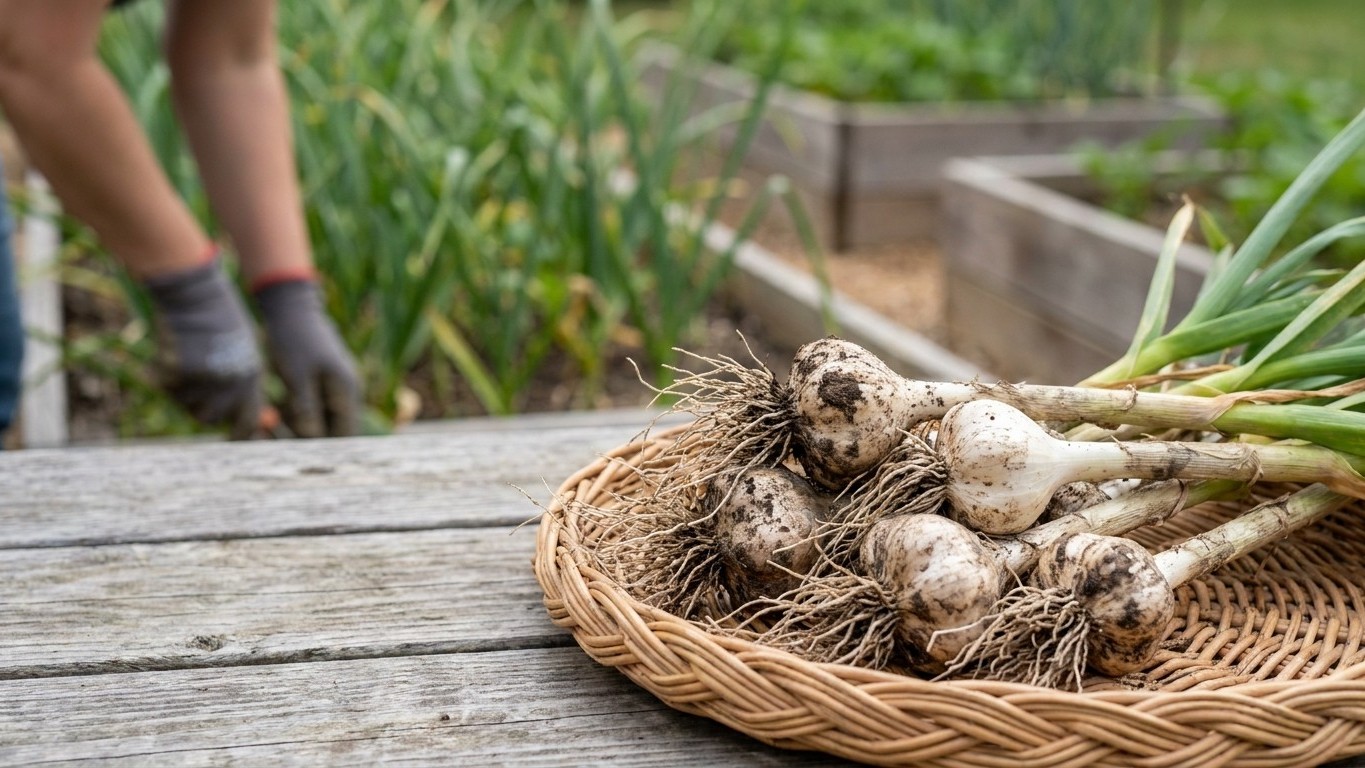

A single round bulb, no cloves to peel, no seed to save — that’s what you get when garlic misses its cold. Plant too late in the Delta, or through a mild winter down there, and the bulb never divides; it just sits underground as an onion-shaped disappointment. The Ozarks and River Valley rarely have this problem, since their winters run long and cold enough on their own. Further south, the six-to-eight-week chill window isn’t guaranteed, and that gap is what separates a real harvest from a wasted bed.
Will garlic get the cold it needs in Arkansas

Garlic clove division depends on a stretch of real cold after planting. Without it, the bulb never splits into cloves and you dig up something closer to a single round onion the following summer. University of Georgia Extension bulletin C854 sets that requirement at six to eight weeks of temperatures below 40°F, and that number is the one to hold Arkansas against.
NOAA’s 1991-2020 normals for the Little Rock station put the first fall freeze between November 7 and November 20. From that point, Arkansas winters typically run cold well into late winter, with repeated stretches below 40°F through December, January and February before spring warm-up. That span is far longer than the six to eight weeks the Georgia bulletin calls for, so most of the state clears the threshold in an ordinary winter, particularly the northern and western counties in the Ozarks and River Valley where elevation adds extra chill. The Delta counties in the southeast, which run milder and see frost arrive later within that same NOAA window, are the ones where a warm winter could fall short.
Refrigerate or go softneck
Where you are not confident the ground will deliver, two options actually work:
- Hold cloves in a paper bag in the refrigerator for four to six weeks before planting, simulating the cold they might not get from soil alone.
- Plant a softneck type instead, since softneck garlic tolerates a shorter or milder cold spell far better than hardneck does.
Neither is a reason to skip garlic altogether. Gardeners in the mildest pockets of the state have grown good crops with one of those two adjustments for as long as garlic has been grown south of the Mason-Dixon line, and checking Garlic Varieties That Suit Arkansas Winters can help narrow the choice between softneck and hardneck before planting.
When to put the cloves in
Garlic wants to root before the ground freezes hard, but you do not want several inches of green top growth heading into winter. That balance is set against the first fall frost, not against a calendar month, because the frost date itself moves around the state by two weeks or more.
NOAA’s 1991-2020 normals put that first freeze at the Little Rock station between November 7 and November 20, and the schedule outlined in When to Plant Garlic in Arkansas builds its timing directly off that window. Counting Back From the early edge of that range, planting roughly three to five weeks ahead of the first frost gives cloves time to push roots without much top growth showing above the soil line. That works out to mid to late October across most of central Arkansas, which is also the window the catalogue figures for the varieties below assume.
Elevation shifts this earlier. The Ozark Plateau and the Boston Mountains in the northwest cool down faster in fall than the Delta lowlands in the southeast, so a grower in Washington or Benton County is often planting at the front edge of that window while a grower near the Mississippi River line can wait into the back half of it. Arkansas has no large lake or coastline close enough to most gardens to shift the date the way it does in some other states, so elevation and latitude do almost all the work here. If your ground has stayed unusually warm into October, that is worth watching. Garlic planted into warm soil breaks dormancy fast and can put up too much leaf before frost, which then gets damaged over winter.
Which types suit Arkansas
Hardneck and softneck garlic are not interchangeable, and the difference that matters here is winter. Hardneck varieties need a real cold season to divide properly and produce the tall central seed stalk, called a scape, that gets cut before harvest. Softneck varieties tolerate a milder or shorter winter, braid well, and store for months longer in a pantry than most hardnecks do.
Given that most of Arkansas clears the cold threshold discussed above, hardneck garlic is a solid choice through the northern two-thirds of the state, closer to the winters that suit growers in British Columbia, where cold is never in question. Softneck is the steadier bet in the warmer Delta counties and in any year you are not confident the ground delivered enough chill, the same logic that pushes growers in New Mexico toward softneck in that state’s milder low-desert valleys.
All of the varieties below are set out mid October to late October in this territory and are first ready to lift in early July, based on catalogue days-to-maturity figures counted from planting, which shift by a week or two with the season.
Hardneck varieties for Arkansas
- German Red
- German White
- Chesnok Red
- Duganski
- Georgian Fire
- Georgian Crystal
- Bavarian Purple
- Blue Music
- Fall Festival
- Ivan
Softneck varieties for Arkansas
- Inchelium Red
- Early Red Italian
- Italian Late
- Lorz Italian
Soil and bed preparation
Garlic sits in the same patch of ground for eight or nine months, through every soaking rain the winter throws at it, so drainage decides more than any other single factor whether the crop survives to spring. A clove sitting in saturated soil rots before any disease organism gets involved. If your planting bed holds water after a heavy rain for more than a few hours, raise it. A bed lifted six to eight inches above the surrounding grade with loose, amended soil handles a wet Arkansas winter far better than flat ground does.
What to work into the bed
Work in a couple inches of finished compost before planting, since garlic is a long-season crop that draws steadily on soil fertility for most of a year rather than in one quick flush. Break up compacted clay if that is what you are working with. Arkansas soils range from sandy loam in parts of the Delta to heavy clay in the River Valley and Ozarks, and clay in particular needs the structure that compost and a season of loosening provide, or winter rain just sits on top of it.
Avoid planting garlic where onions, leeks or garlic itself grew within the past two or three years. That rotation gap matters more than it seems worth at planting time, and it becomes the difference between a clean bed and one carrying disease pressure into a crop that already spends the longest season of any allium in the garden.
What the climate here favours, and what it does not
Garlic disease pressure tracks temperature closely, and UC IPM’s published thresholds for onion and garlic pathogens (UC ANR Publication 3453) let you see which diseases actually get a favorable window in Arkansas’s growing season and which stay outside their range for the whole year. One caution applies to every number below: the published thresholds are soil temperatures, and the figures here are monthly mean air temperatures. Soil lags air by weeks and swings less, so a month with a mean air temperature inside a disease’s range does not mean soil sat there the whole time, and it never means the garden got infected. Infected planting stock carries every one of these pathogens regardless of climate.
| Disease | Published range | Months in range (Sept-July) | Note |
|---|---|---|---|
| Fusarium basal rot | 59-90°F | 6 (Sept, Oct, Apr, May, Jun, Jul) | 1 month sits at the published optimum |
| White rot | 50-75°F | 5 (Oct, Nov, Mar, Apr, May) | 2 months sit at the published optimum |
| Pink root | 75-85°F (optimum) | 3 (Sept, Jun, Jul) | All 3 sit at the published optimum |
| Southern blight | 86-95°F (optimum) | 0 | Less active outside this window, never absent |
Fusarium basal rot and white rot are the two to watch in this territory, since Arkansas’s spring and fall mean temperatures spend the most months inside their published ranges. Pink root gets three months at its optimum, which lines up with the hottest parts of early fall and the harvest window in June and July. Southern blight is the one piece of good news here: no month of Arkansas’s growing season reaches its 86-95°F optimum on average, so it runs less active through the year than it does in a Deep South garden further south, though a hot, humid stretch during any given week can still push it toward activity even when the monthly mean does not.
Getting it through the winter
A layer of mulch does two jobs for garlic over an Arkansas winter: it buffers the soil against the freeze-thaw cycles that heave shallow-planted cloves right out of the ground, and it slows moisture loss through a dry cold snap. Lay it once the ground has cooled but before the hardest freezes set in, generally a few weeks after planting once the cloves have had a chance to root. A generous layer, commonly four to six inches of straw or shredded leaves, settles down to about half that depth over winter and still does the job.
Planting depth matters here as much as mulch does. A clove set too shallow, with less than two inches of soil above the tip, is the one most likely to heave when a hard freeze follows a warm spell, a pattern that shows up often in Arkansas winters where a 60°F day can sit right next to a hard freeze two days later. Once heaved, a clove sitting on top of the soil with roots exposed rarely recovers on its own, so check the bed after any sharp cold snap and push exposed cloves back down and re-cover them.
Pull mulch back partway in late winter once new growth starts pushing up, but do not strip the bed bare. A thinner layer left in place through the rest of spring keeps weed pressure down and holds soil moisture through the dry stretches that show up before harvest.
Harvest and curing here
Lift garlic by reading the plant, not the calendar. The signal to watch is the lower leaves: once the bottom third to half have browned and dried back while four or five upper leaves are still green, the bulb has sized up and the wrappers are still intact enough to protect it in storage. Pull too early and cloves are underdeveloped. Wait too long, past the point where most leaves have died back, and the wrappers split, leaving bulbs that will not keep.
Curing in a humid summer
Arkansas summers run humid, and that is the part of growing garlic here that trips people up more than planting date or variety choice ever does. Good curing needs airflow more than it needs heat, so hang or lay bulbs in a shaded, well-ventilated spot out of direct sun, not a closed shed that traps humid air. A box fan running on low in that space for the first week or two of curing makes a real difference in a wet Arkansas July, cutting down the risk of mold setting in on the outer wrappers before the bulb has finished drying down. Plan on three to four weeks of curing before you trim, clean and store the crop, and check a few bulbs partway through for any soft spots or mold rather than waiting until the whole batch is supposedly done.
Local help
County-level frost dates, soil test results and current disease reports vary across Arkansas more than any single reference station can capture. The University of Arkansas Division of Agriculture Cooperative Extension Service is the place to get a soil test read for your own ground and to check whether your county extension office has more specific planting guidance than the statewide figures used here. A soil test before planting is worth the small cost, especially on ground that has never grown garlic or onions before.
Common questions
Can I plant garlic in spring in Arkansas instead of fall?
No, garlic planted in spring skips the cold period it needs to divide into cloves and usually produces a small, undivided round bulb instead of a full head. Arkansas garlic is planted in fall and lifted the following summer.
What if I miss the mid to late October planting window?
Get cloves in the ground as soon as you can into November, since some root growth before a hard freeze is still better than none. A late-planted clove is more likely to heave over winter, so mulch it a little heavier and check the bed after any sharp cold snap.
Do softneck varieties still need cold, or can I skip the refrigerator step?
Softneck garlic tolerates a milder or shorter cold spell than hardneck does, and in most of Arkansas the natural winter is enough on its own. The refrigerator pre-chill is mainly insurance for hardneck types planted in the state’s warmest pockets.
Can I just plant garlic from the grocery store?
You can, but grocery store garlic is often treated to slow sprouting, which can also slow or block the rooting you need before winter, and it carries an unknown disease history. Named cultivars sold as seed garlic are a more reliable start.
Why did I end up with one big clove instead of a full head?
That round, undivided bulb usually means the cold period was too short or came too late, a common result of planting too late in fall or growing a hardneck variety in a winter that came in mild. Save it and replant it the following fall rather than eating it, since it will often divide properly the second time around.