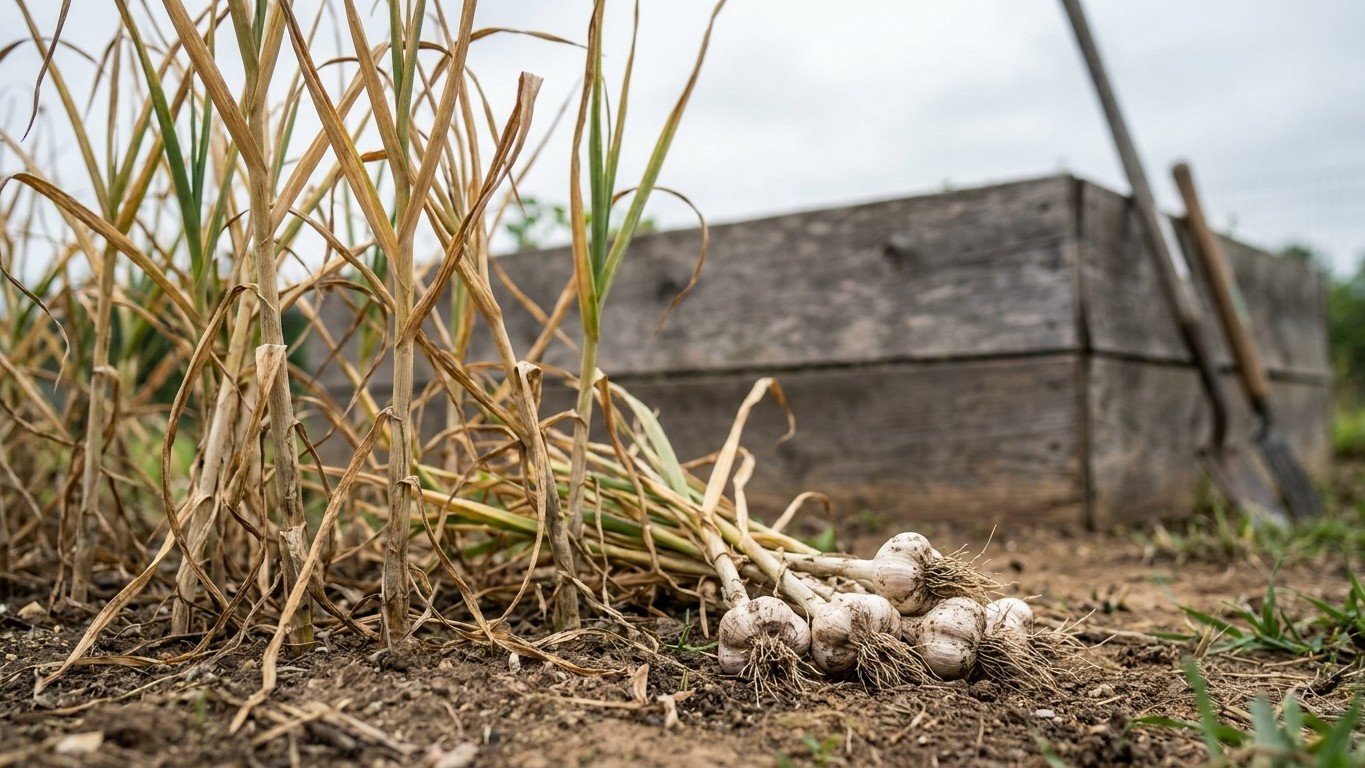

Inchelium Red, Georgian Crystal, whatever clove you’re holding — the planting window is the same, because Arkansas soil sets the calendar, not the variety. That window runs mid-October to late October, anchored to a first fall freeze that lands anywhere between November 7 and November 20 depending where in the state you’re standing. Count back three to four weeks from either end of that spread and you land in the same stretch of October, which is why the date matters less than the counting.
The short answer for Arkansas

Plant Garlic in Arkansas between mid October and late October. That’s the window every cultivar in the state’s seed catalog is built around, from the softneck Inchelium Red to the hardneck Georgian Crystal, and it holds regardless of which variety you choose because the timing is set by the ground, not the bulb.
The anchor for that window is the state’s average first fall freeze. NOAA’s NCEI 1991-2020 Climate Normals put that 32°F freeze at the Little Rock station between November 7 and November 20 in the middle band of years on record, with plenty of years falling outside it in both directions. That’s already a 13-day spread at a single station, which is the first sign that no single date works for the whole state.
Garlic needs a run of active root growth in soil that is still workable before winter dormancy sets in, without so much time before the freeze that lush top growth forms and then gets caught by the first hard cold. Count back three to four weeks from the earlier end of the freeze window, November 7, and you land in the first half of October. Count back the same three to four weeks from the later end, November 20, and you land closer to the last week of October. That’s why the mid-to-late October range, not a single day, is the honest answer.
The catalog window
Every variety sold for Arkansas planting carries the same recommended window, whether it’s a softneck built to store through winter or a hardneck grown for a bigger, easier-to-peel clove.
| Variety | Type | Planting window |
|---|---|---|
| Inchelium Red | Softneck | Mid to late October |
| Early Red Italian | Softneck | Mid to late October |
| Italian Late | Softneck | Mid to late October |
| Lorz Italian | Softneck | Mid to late October |
| Bavarian Purple | Hardneck | Mid to late October |
| Blue Music | Hardneck | Mid to late October |
| Chesnok Red | Hardneck | Mid to late October |
| Duganski | Hardneck | Mid to late October |
| Fall Festival | Hardneck | Mid to late October |
| Georgian Crystal | Hardneck | Mid to late October |
| Georgian Fire | Hardneck | Mid to late October |
| German Red | Hardneck | Mid to late October |
| German White | Hardneck | Mid to late October |
| Ivan | Hardneck | Mid to late October |
For the differences that actually matter between these, including clove size, storage life and how many cloves each head sets, see Garlic Varieties That Suit Arkansas Winters.
Working it out for your own garden
The mid-to-late October figure above is built for the reference station near Little Rock. If you garden somewhere else in Arkansas, you can run the same arithmetic with your own numbers rather than borrowing Little Rock’s.
The three-step calculation
- Find your area’s average first fall freeze date, ideally from a NOAA station near you or from the state extension service.
- Count back three to four weeks from that date.
- Shift a few days earlier if you’re at higher elevation or in a known frost pocket, and a few days later if your soil tends to stay warm into fall.
One caution worth flagging: NOAA’s Little Rock normals also sit alongside a lighter 36°F frost threshold, separate from the 32°F hard freeze used above. NWS Little Rock puts that light-frost window at April 3 in spring and October 31 in fall. That 36°F figure matters for tender crops like tomatoes and peppers, which die back at the first light frost. Garlic cloves don’t work that way. They’re dormant planting stock going into cold soil, not standing foliage, so the 32°F hard-freeze window is the one to count back from, not the lighter 36°F date.
Elevation is the biggest single variable once you leave the Little Rock area. Ground that sits several hundred feet higher, or a valley that pools cold air overnight, tends to cool off earlier in the fall than the flatter land the reference station sits on. A large reservoir works the other way, holding stored summer heat and releasing it into the surrounding air through October and November, which can push the same freeze date later by a comparable margin nearby. Neither effect has a published figure for every county in the NOAA normals cited here, which is exactly why the extension service’s county-level guidance, not a single statewide figure, is the source to check before you commit to a date.
What changes across Arkansas
Little Rock’s frost normals describe the middle of the state, and Arkansas’s terrain is not uniform enough for one figure to travel far in either direction.
Higher, colder ground
The Ozark Plateau in the north and the Ouachita Mountains in the west-central part of the state sit well above the elevation of the Little Rock reference station. Cold air also drains into the valleys between those ridges overnight, so a garden tucked into a hollow can see frost before a garden on the slope just above it. If you’re gardening in either range, treat the Little Rock window as a later bound, not a target, and lean toward the earlier half of mid October.
The Delta and the warmer lowlands
The Mississippi Delta lowlands in the eastern part of the state run flatter and generally hold heat longer into fall than the higher country to the west. Growers there often have a little more room to push toward the later end of the October window, though the same NOAA normals that apply to Little Rock still describe a wide range, not a guaranteed date, for that region too.
Near the big reservoirs
Large bodies of water like Beaver Lake, Greers Ferry Lake, Norfork Lake and Bull Shoals Lake hold summer heat and release it slowly through the fall, which can delay the first freeze for gardens close to the shoreline compared with gardens a few miles inland at the same latitude. None of this is broken out county by county in the NOAA normals cited here, so treat it as a direction to lean in, not a number to plug into the calculation.
The mistakes this climate punishes
Arkansas’s mild, wide freeze window creates its own particular ways to lose a garlic crop, distinct from the mistakes made in a harder northern climate.
Planting too early into warm, wet soil
UC IPM’s Pest Management Guidelines for Onion and Garlic (UC ANR Publication 3453) list published temperature ranges for two of the most damaging garlic diseases, Fusarium basal rot and white rot. Those are soil-temperature thresholds from California research, not Arkansas air-temperature forecasts, and a monthly average hides plenty of day-to-day swing underneath it, but they’re worth knowing anyway. October and November, the exact months Arkansas cloves go into the ground, both fall inside white rot’s published 50-75°F range, with two months of the growing season landing at its optimum. October also falls inside Fusarium basal rot’s 59-90°F range. Neither fact means either disease is guaranteed, and a cooler month doesn’t mean either one is absent: infected planting stock carries both pathogens regardless of the weather. What it does mean is that a heavy, waterlogged bed in October is the wrong place to plant, whatever the calendar says.
Choosing the wrong neck type for a mild winter
Hardneck varieties such as Blue Music, Chesnok Red, Duganski and the German Red and German White pair generally want a more pronounced stretch of winter cold than softnecks like Inchelium Red, Lorz Italian and Early Red Italian. In the milder, southern reaches of the state a softneck is often the more forgiving choice, while further north in the Ozarks a hardneck is less likely to come up short on cold. This is a catalog-level distinction printed on the variety description, not a figure tied to any Arkansas station, so treat it as a general lean rather than a hard rule.
Planting too shallow or mulching too late
Because the hard freeze can arrive as early as November 7 or as late as November 20 in the same reference record, a clove planted at the last minute and left unmulched can still be sitting shallow in loose soil when the ground locks up. Set cloves at a consistent planting depth and get mulch down before the freeze window opens, not after the first cold snap forces the issue.
Checking this against your county
Everything above is anchored to one NOAA station near Little Rock, and Arkansas extends well beyond it in every direction. Before you commit to a date, check your own county’s frost data and planting guidance against the University of Arkansas System Division of Agriculture’s Cooperative Extension Service at uaex.uada.edu. The county office can also flag which garlic problems, disease or otherwise, are showing up locally that season, which a statewide article can’t.
If you’re still working through the earlier steps, like breaking seed stock into cloves or prepping the bed, Growing Garlic in Arkansas covers the groundwork this planting-date guidance assumes you’ve already handled.
Common questions
Can I Plant Garlic in November in Arkansas?
You can, but you’re cutting it close. NOAA’s Little Rock normals put the first 32°F freeze between November 7 and November 20, so a November planting risks going into cold ground before the clove has rooted. If you miss the October window, plant as soon as you can and mulch heavily rather than waiting for a better-looking week.
What happens if I plant garlic too early?
Cloves planted too early often push top growth well before winter, and that growth gets damaged when the hard freeze finally arrives, which can reduce bulb size the following summer. Aim for the back half of the mid-to-late October window if your soil is still warm.
Does the frost date really matter for a dormant clove?
It matters less than it does for a tender seedling, but it still marks the point after which root growth effectively slows for the season. Remember that the freeze date is a midpoint, not a hard cutoff: in roughly half the years on record frost arrives after November 20, and in the other half it arrives before November 7. Treat the whole range as real rather than picking one day out of it.
Is hardneck or softneck garlic better for Arkansas?
Neither is universally better. Softnecks like Inchelium Red and Lorz Italian tend to tolerate a milder winter more easily, while hardnecks like Georgian Crystal and Bavarian Purple generally want more sustained cold. Where you fall in the state, from the Delta lowlands to the Ozark Plateau, matters more than any blanket rule.
Some gardeners also time this by the Moon: when to plant garlic by the moon, as almanac tradition rather than fact.