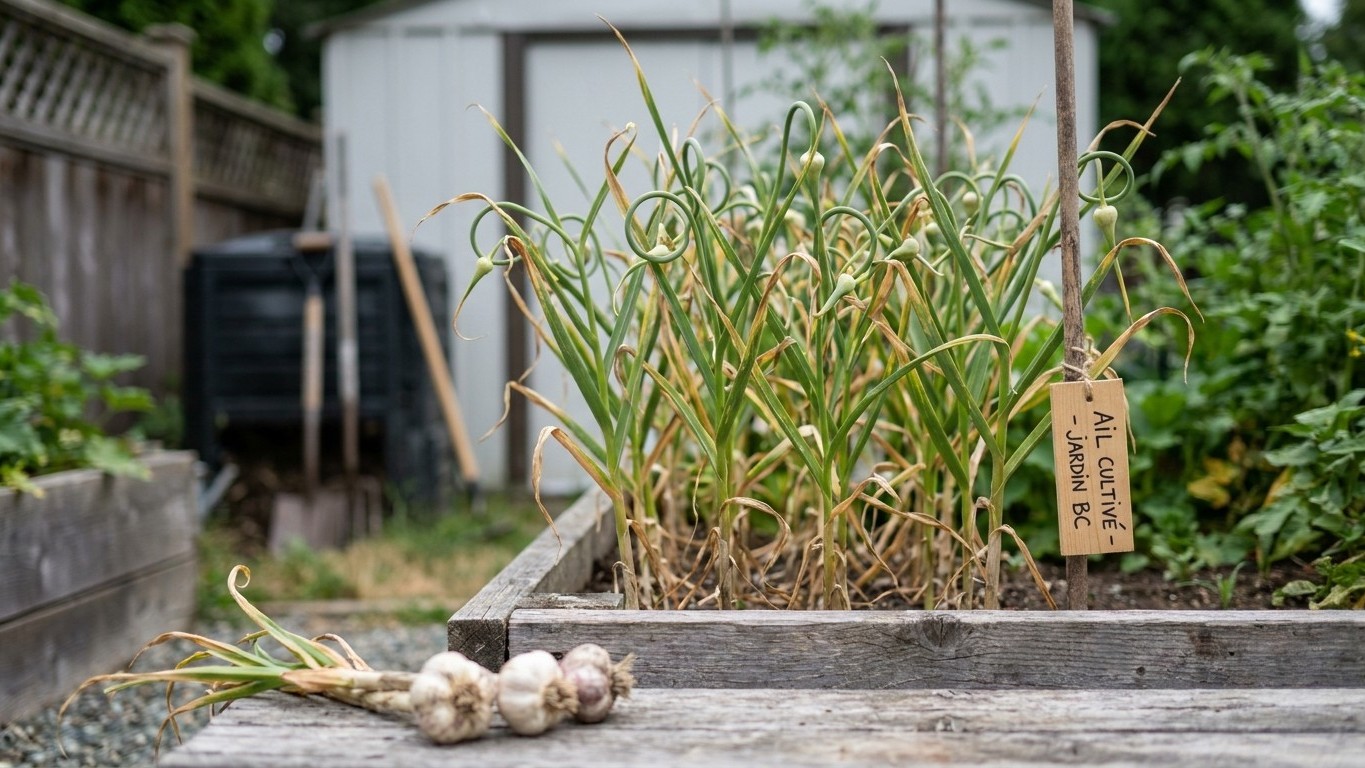

British Columbia’s coastal winters call for garlic cloves that can root before the ground locks up, and that means paying attention to timing as much as variety. Environment and Climate Change Canada’s 1981-2010 climate normals put the average first fall frost at the Vancouver Int’l A station at November 10, though that date arrives later than average in roughly half the years on record. Set cloves into the ground in mid-October so the roots have time to establish before real cold sets in, and treat any planting date pushed toward November as a gamble rather than a plan.
The short answer for British Columbia

For most of the milder, wetter parts of British Columbia, both hardneck and softneck garlic overwinter fine once cloves are in the ground early enough to root properly. Hardneck types such as Fall Festival and Ivan tend to handle a hard freeze with less trouble, since they descend from stock bred in colder continental climates. Softneck varieties like Early Red Italian and Italian Late store longer after harvest, but their growth habit means they can suffer if planting is delayed and an early cold snap catches them before they’ve rooted.
All fourteen of the varieties in this territory’s catalogue call for setting cloves out in mid-October, regardless of neck type. That timing is anchored to Environment and Climate Change Canada’s Vancouver Int’l A normal of November 10 for the first fall frost. Because that figure is a mean drawn from 1981-2010 records rather than a guaranteed date, the frost lands earlier than November 10 in roughly half of years and later in the other half. Mid-October planting banks a few weeks of root growth before that midpoint, whichever way a given season swings.
| Variety | Type | Set-out window |
|---|---|---|
| Early Red Italian | Softneck | Mid-October |
| Inchelium Red | Softneck | Mid-October |
| Italian Late | Softneck | Mid-October |
| Lorz Italian | Softneck | Mid-October |
| Bavarian Purple | Hardneck | Mid-October |
| Blue Music | Hardneck | Mid-October |
| Chesnok Red | Hardneck | Mid-October |
| Duganski | Hardneck | Mid-October |
| Fall Festival | Hardneck | Mid-October |
| Georgian Crystal | Hardneck | Mid-October |
| Georgian Fire | Hardneck | Mid-October |
| German Red | Hardneck | Mid-October |
| German White | Hardneck | Mid-October |
| Ivan | Hardneck | Mid-October |
The station behind this figure sits at sea level near Vancouver. Gardens further from the coast, at elevation, or well north of the Lower Mainland run on their own frost timing, so this figure works as a reference point for the whole crop covered in Growing Garlic in British Columbia, not as a rule for every district.
Working it out for your own garden
Counting back from the frost date
The arithmetic here is straightforward once the frost figure is in hand. Garlic cloves need several weeks of active root growth before soil turns cold enough to stop them, and counting backward from Environment and Climate Change Canada’s November 10 average first frost at Vancouver Int’l A lands that window in mid-October. That’s why every variety on this list, from Bavarian Purple to Georgian Crystal, carries the same set-out guidance no matter how long each takes to mature underground. The number that decides planting isn’t when the bulb finishes, it’s when the roots need to start.
Local factors that shift the window
To redo this calculation for a specific garden, start with local frost history rather than borrowing Vancouver’s figure outright. Environment and Climate Change Canada publishes normals for stations across the province, and a garden even a short drive from the coast can sit on a meaningfully different date. Elevation is the single biggest factor: cold air sinks, so a valley bottom or a bench above a river can see frost weeks apart from a plot only a few kilometres away. Large bodies of water pull in the other direction, holding warmth into the evening and pushing the first frost later for gardens close to their shore.
Coastal exposure changes the picture again. A garden that catches the full sweep of a Pacific-facing slope through the fall sees more marine influence than one tucked behind a ridge, even at the same latitude. None of these local shifts show up in a single provincial average, which is exactly why the Vancouver figure has to be adjusted for your own site rather than copied onto it directly. Details on how this arithmetic feeds into a full planting schedule are laid out in When to Plant Garlic in British Columbia: Counting Back From the First Frost.
If a plot has run late or early relative to the coast in past seasons, note that pattern and shift the window accordingly: earlier for a known frost pocket or valley bottom, later for a site with strong water moderation. The safer habit is to plant on the early side of mid-October rather than the late side, since an unrooted clove caught by an early freeze is a far worse outcome than a rooted one sitting in slightly warm soil for an extra week.
What changes across British Columbia
Coast versus interior
The Lower Mainland and the south coast of Vancouver Island run the mildest and latest into frost of any part of the province, moderated by the Pacific and by the relatively shallow waters of the Strait of Georgia. Gardens in this belt can lean on the Vancouver Int’l A figure fairly directly, since the station sits inside the same coastal air mass.
Move east over the Coast Mountains into the Southern Interior and the climate turns continental fast. The Okanagan and Thompson valleys lose the ocean’s moderating effect and see colder nights arrive earlier in the fall, even though their summer days run hotter than the coast’s. A garden in Kelowna or Kamloops should track its own frost record rather than borrow Vancouver’s, since a coastal normal cannot describe a continental valley two mountain ranges away.
Further north and inland, the Cariboo, the Peace River region and the higher valleys of the Kootenays run behind the coast by a wider margin still, both from latitude and from continental air settling in earlier and harder. Elevation compounds this further: a garden at altitude in any of these regions loses growing season from both ends, reaching its own first frost sooner than a valley-bottom plot nearby.
None of this changes which garlic varieties will grow, since hardneck types especially are bred for cold climates to begin with. What changes is the calendar. A gardener working from the coastal mid-October figure while gardening in the Peace region risks planting weeks too late for local conditions, and should pull local frost records instead of a Lower Mainland average.
The mistakes this climate punishes
Planting too late or too early
In this climate, the costliest mistake is a planting date, not a variety choice. Cloves set into cold, waterlogged ground too late in October or into November don’t have time to build the root system they need before frost. A hardneck like Georgian Fire or Ivan is bred to shrug off deep cold once established, but an unrooted clove doesn’t get the benefit of that hardiness. Waiting past mid-October because the calendar still shows time until November 10 misreads the figure: that date is only the average, and in a colder-than-normal year, pushing planting toward it leaves cloves with no head start at all.
The opposite mistake shows up in mild years and mild coastal micro-sites: planting so early that top growth pushes through the surface before real winter arrives, leaving green shoots exposed to whatever cold does eventually land. This risk falls harder on softneck varieties like Italian Late and Early Red Italian, which sprout readily once soil warms even a little during a mild fall.
Shallow planting and disease pressure
Shallow planting is the other error this region punishes hard, because British Columbia’s wet fall and winter soils don’t insulate the way a drier continental soil does. A clove set at the depth suited to a drier climate can sit in saturated ground all winter, raising the risk of rot regardless of variety.
- Planting after mid-October and betting on the frost date rather than the frost window
- Setting softneck cloves early enough that shoots emerge before winter arrives
- Planting at a shallow depth suited to a drier climate than this one
- Sourcing seed stock without knowing whether it’s certified clean
Soil-borne disease adds a layer worth planning around through sourcing and rotation rather than variety choice. UC ANR’s Pest Management Guidelines for onion and garlic list white rot, caused by the fungus Sclerotium cepivorum, as favoured by soil temperatures in the 50 to 75°F range. This region’s mean air temperatures sit inside that band for five months of a typical growing season, including two months at the pathogen’s published optimum, though air and soil temperatures are not the same thing and soil lags well behind air swings. Fusarium basal rot, caused by Fusarium oxysporum f. sp. cepae, prefers warmer conditions and lines up with only two months of the local season by the same measure. Neither count means a crop is safe or doomed. Infected planting stock carries these pathogens into a garden regardless of the local climate, so sourcing clean, certified cloves matters more here than picking a variety for supposed disease resistance.
Checking this against your county
The Vancouver Int’l A figures are a useful anchor, but the provincial extension service is the right place to check conditions specific to your own regional district. A gardener in the Fraser Valley, on Vancouver Island, or in the Interior should confirm local frost history before locking in a planting date, since one Lower Mainland station cannot describe a province with this much variation in terrain and climate. Start with the Ministry of Agriculture and Food’s extension service for records and guidance closer to home.
Common questions
Can I still plant garlic in November if I missed mid-October?
You can, but you’re working against the odds by then. Environment and Climate Change Canada’s November 10 figure for Vancouver Int’l A is an average, so in a colder-than-normal year the ground may already be locking up, and cloves planted after that point may not root before real cold sets in. If you’re past mid-October, plant as soon as possible rather than waiting further.
Does hardneck garlic actually survive British Columbia winters better than softneck?
Once rooted, hardneck varieties bred in colder continental climates generally tolerate a hard freeze with less trouble. Softneck varieties like Inchelium Red do fine on the coast, where winters run milder, but they’re the type most likely to suffer if planting gets delayed into a cold snap.
Should I mulch my garlic bed over winter here?
A mulch layer helps buffer soil temperature swings and keeps saturated soil from freezing and thawing repeatedly, which is harder on roots than steady cold. Coastal gardens with milder, wetter winters benefit from mulch that also sheds excess moisture rather than holding it against the cloves.
Why is my garlic sprouting green shoots in the fall already?
Some top growth before winter is normal, especially for softneck varieties planted into a mild fall. It only becomes a real problem if a hard freeze lands directly on exposed young shoots, which is one reason planting right at mid-October, rather than several weeks earlier, matters more on the coast than it might seem.