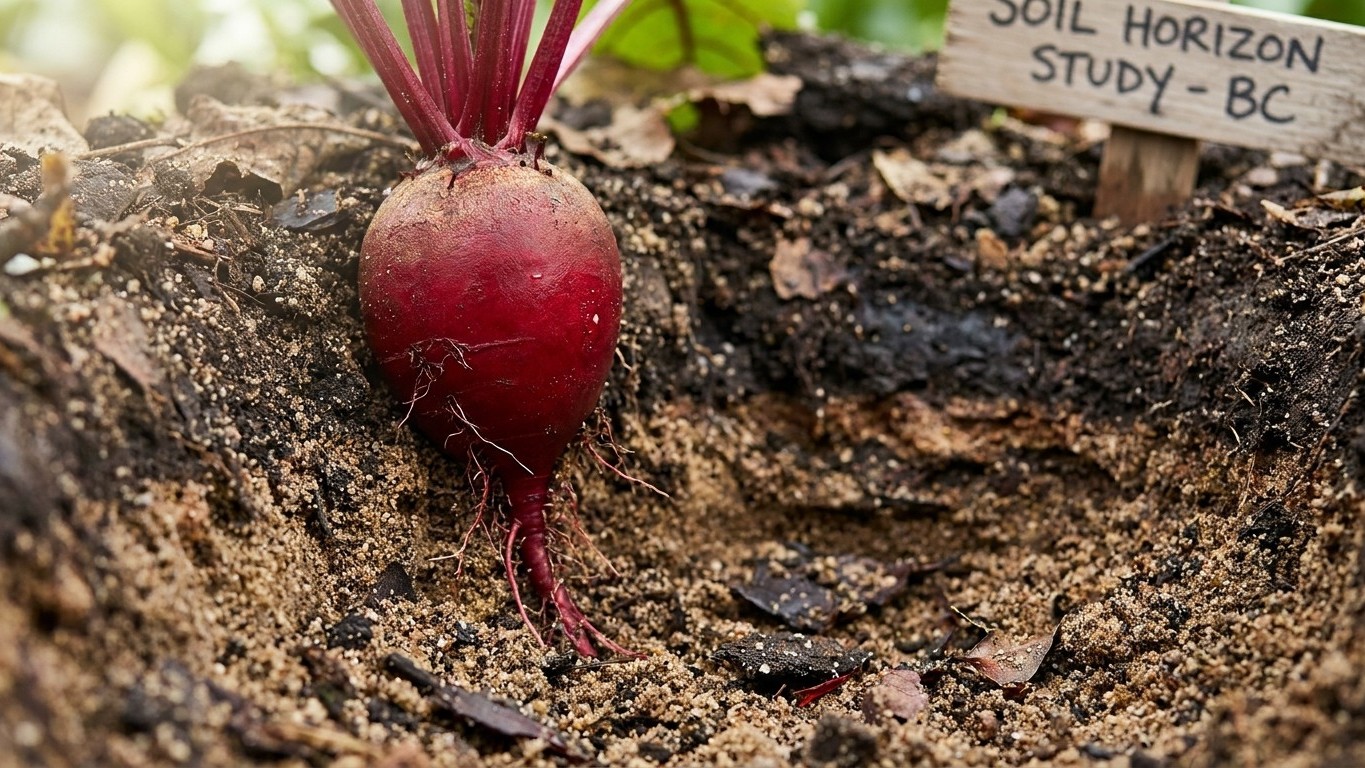

A beet root pushing into ground in British Columbia most often meets a young, sandy-leaning soil that drains fast, runs slightly acid, and carries a decent load of organic matter. That combination is workable for beets, but it sets up two separate risks: early bolting if the topsoil dries out before roots settle in, and woody flesh later if heat and thirst hit together. The average last frost lands March 18, and that date decides when the clock on the crop actually starts.
The short answer
The most common soil across the mapped agricultural surface of British Columbia is a Brunisol, a young soil order where the horizons have only started to separate from each other, typical of ground formed on recent or coarse parent material. It covers about 33 percent of the mapped surface, with Podzolic soils as the next most common group. The median surface layer runs 52 percent sand, 10 percent clay, and 38 percent silt, a loam-to-silt texture, with a median pH near 5.8 (slightly acid) and organic matter around 5.0 percent. Drainage is classed as well drained. That comes from Agriculture and Agri-Food Canada’s Canadian Soil Information Service, reading the Soil Name Table and Soil Layer Table for the surface horizons of 2,593 mapped soil components across the province.
For a beet, that profile is mixed news. The sand-heavy texture and well-drained class mean roots rarely sit in waterlogged ground, and a straight, unforked taproot has room to push down without fighting dense clay. The organic matter figure, close to 5 percent, sits in a favorable range for beets, which want ground rich in organic matter to begin with. The slightly acid pH is worth flagging rather than ignoring, since it varies by field and a home soil test is the only way to know where a particular garden actually sits.
What this page cannot tell you is how many days a year any one BC location crosses 90°F, because that figure isn’t part of the sourced data used here. What’s known instead is the mechanism: heat above 85°F combined with water stress is what turns a beet root woody, according to Utah State University Extension, so a stretch of hot, dry weather anywhere in the province deserves the same watering response regardless of the exact day count behind it.
None of this replaces a soil test. British Columbia’s agricultural land alone spans hundreds of mapped soil series, and the median figures above describe a dominant pattern, not any single garden. River bottoms, old floodplains, and any lot a builder has cut or filled will read differently from the province-wide median, sometimes drastically so.
The six weeks that decide it here
Beets go into the ground as seed, not as transplants, and Utah State University Extension’s guidance to sow 2 to 3 weeks ahead of the last frost puts the first six weeks of a BC beet crop on a fairly predictable calendar: starting somewhere close to late February through mid-March in a typical year, tied to that March 18 average last-frost date from Environment and Climate Change Canada’s Vancouver Int’l A station. That figure is a mean, not a guarantee. In roughly half the years on record, the last frost falls later than March 18, so a sowing date built off that average alone can still walk a young stand into a cold snap.
Those first six weeks in coastal and southern BC tend to run cool and wet rather than dry, which is the opposite failure mode from what a lot of home gardeners assume. A germinating beet seed in a well-drained, sand-leaning soil like the province’s dominant Brunisol profile doesn’t stay saturated for long after a rain, since the same drainage class that protects against rot also means the topsoil can flip from soggy to dry inside a few days once a rain-free stretch hits. That’s the window where bolting risk actually concentrates here: not during the wet spells, but in the dry gaps between them, when a gardener assumes the ground is still moist from last week’s rain and skips a watering.
Inland and upland districts run behind the coastal frost timing by a meaningful margin, since the March 18 figure comes from a single Vancouver-area station and the province is not one climate. A gardener working from a higher-elevation or northern location should treat that date as a rough coastal reference point, not a local calendar, and lean on local frost history where it exists rather than importing the coastal average wholesale.
What goes wrong here
- Bolting from a dry gap early on. The well-drained, sandy-leaning texture common across BC’s mapped soils sheds water quickly once rain stops, and if that dry stretch lands inside the first six weeks after seeding, the plant reads it as water stress and flowers prematurely instead of building a root. Water on a fixed schedule through that window rather than waiting for visible wilting, and check soil moisture an inch or two down rather than trusting the surface.
- Woody roots from a hot, dry stretch later. This is a separate failure from bolting, caused by heat above 85°F arriving at the same time as water stress, per Utah State University Extension. It shows up closer to harvest, after the root has already formed, and it ruins texture rather than stopping growth outright. Keep watering consistent through any hot spell and don’t let the bed dry out to “make up for” earlier rain.
- Over-amending a soil that’s already organic-matter rich. With median organic matter near 5.0 percent province-wide, some BC garden soils don’t need heavy additions. Utah State University Extension’s ceiling of 1 inch of composted organic matter per 100 square feet is a limit worth respecting rather than treating as a floor, since piling on more than that can loosen the soil past the point beets actually want.
- Assuming the median pH is your pH. A province-wide median of 5.8 doesn’t tell you what’s under your own beds. Acidity that runs lower than the median can limit nutrient availability in ways a fertilizer schedule won’t fix on its own. A soil test, not the provincial average, is the only way to know whether adjustment is worth doing.
- Trusting the frost average as a planting deadline. Because March 18 is a mean date from one Vancouver-area station, sowing strictly on that date still carries roughly even odds of a later frost. Watching short-range forecasts in the weeks around that date matters more than the calendar figure itself, especially away from the coast.
Common questions
Does British Columbia’s soil drain well enough for beets?
Generally yes. The province’s dominant mapped soil, a Brunisol, is classed as well drained, with a sand-heavy texture (52 percent sand against 10 percent clay) that moves water through fairly quickly. That favors straight root development, though it also means the topsoil can dry out faster than a gardener expects between rains, which is the real risk during the first six weeks after sowing.
Should I lime my soil before planting beets?
That depends on your own soil test result, not on the provincial median. The mapped median surface pH across British Columbia’s agricultural soils is about 5.8, slightly acid, but that figure covers thousands of individual fields with real variation between them. A soil test is the only way to know whether your specific bed needs lime and how much.
How many days do beets take from seeding to harvest in BC?
Utah State University Extension frames beet timelines from seeding, not from a transplant, since beets are sown directly in place. The exact days-to-maturity figure varies by variety, and the source material doesn’t attach a specific day count or season to any named variety, so it’s worth treating any packet claim as unproven for your own site until you’ve grown it there.
What actually causes a woody beet, and is it the same as bolting?
No, they’re two distinct failures. Bolting comes from water stress during the first six weeks after seeding, when the plant reacts to early drought by flowering instead of building a root. Woodiness comes later, when heat above 85°F combines with water stress after the root has already started forming. Fixing one doesn’t prevent the other, so watering has to stay consistent across the whole season, not just at the start.