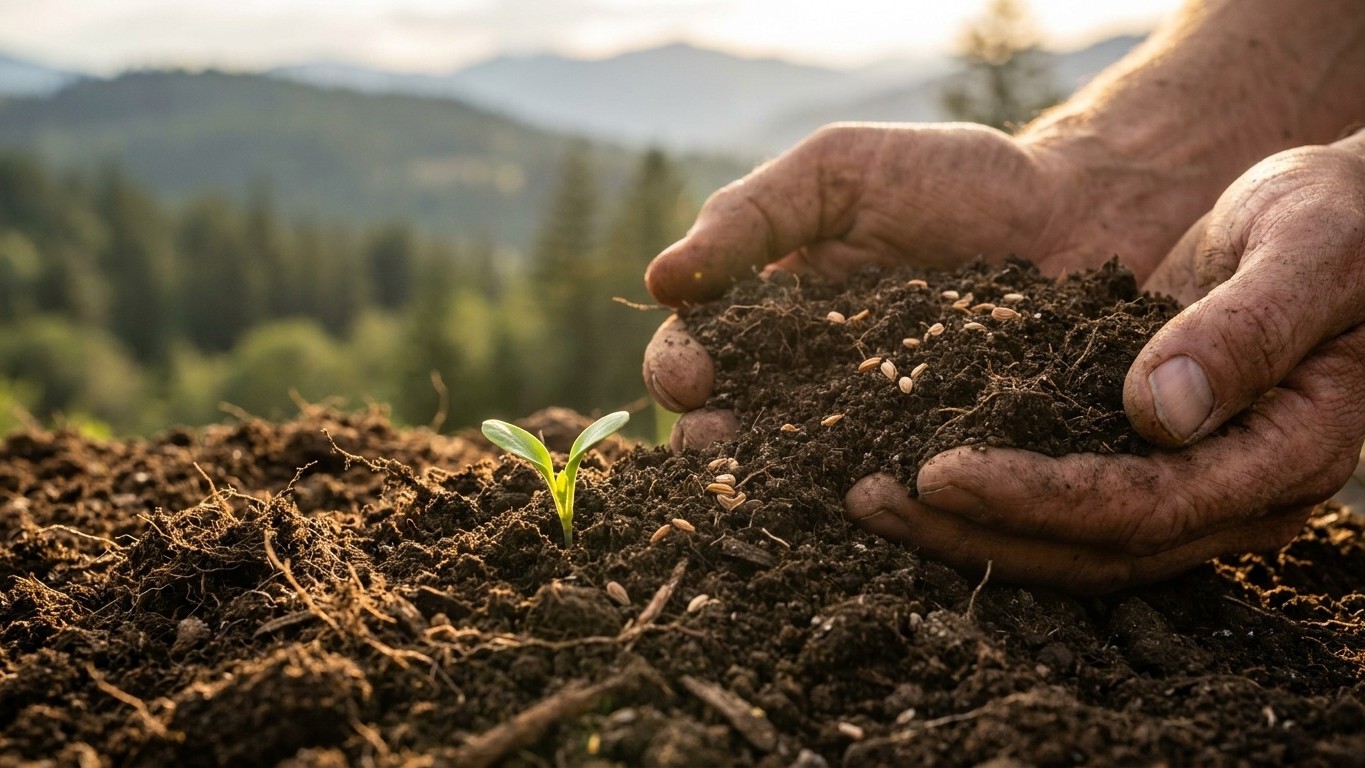

In British Columbia, the calendar answer to “when” always comes second to the soil answer. Carrot seed goes into the ground once the ground itself is workable and warm, but whether that seed grows into a straight, snappable root or a stubby, forked one depends far more on what’s under your boots than on the date circled on the wall. This page walks through BC’s dominant soil profile, how to check your own patch against it, and the specific ways this province’s ground and swings in weather trip carrots up.
The short answer
Across British Columbia’s mapped agricultural regions, the most common soil order is a Brunisol, a young soil whose horizons are only beginning to separate, typically found on recent or coarse parent material. It covers roughly 33 percent of the mapped surface, ahead of Podzolic soils in second place. The median surface layer runs slightly acid, with a pH around 5.8, and sits in the loam-to-silt range: about 52 percent sand, 38 percent silt, and only 10 percent clay. Organic matter averages close to 5.0 percent, and drainage is classed as well drained. That figure comes from Agriculture and Agri-Food Canada’s Canadian Soil Information Service, drawn from surface horizon data across 2,593 mapped soil components in the province.
Set against what a carrot actually wants, that profile leans favorable. Utah State University Extension is clear on the requirement: carrots need deep, sandy, well-drained soil rich in organic matter, and heavy or rocky ground makes the root fork. BC’s median texture, at just 10 percent clay and classed as well drained, isn’t the dense, sticky ground that typically bends a carrot sideways. The sand-heavy loam and decent organic matter level suggest a taproot has room to push straight down without much resistance, and a pH near 5.8 sits within a range most root vegetables tolerate without trouble.
That doesn’t mean every BC garden gets a free pass. A well-drained median doesn’t rule out a compacted clay pocket two lots over, a gravel bar left behind by an old riverbed, or a raised bed built on fill from a construction site. If your ground is heavier than that description, or has never grown a root crop before, the same fix applies everywhere: work in compost generously and double dig the bed to loosen the profile a spade’s depth down, or skip the guesswork and build a raised bed filled with a loose, sandy mix from the start.
British Columbia spans hundreds of individual soil series, from coastal alluvial flats to interior sagebrush country to northern muskeg, and this dominant profile is a starting point, not a diagnosis of your yard. It tells you what the province’s agricultural ground tends toward on the whole. It says nothing certain about the twenty feet behind your house. The only way to know that is to go dig.
The test that settles it in your own garden
The map data above describes the province in aggregate. Your garden bed is one data point, and it may not resemble the median at all. Before you commit a season of carrot seed to a plot, run through these checks yourself.
- Dig a test hole where you plan to sow. Go down as far as a standard spade will comfortably reach, and look at what comes up in layers. A carrot needs that whole depth open and loose, not blocked by a hard layer partway down.
- Check for rocks and rubble. Sift through the soil you just removed. Frequent stones, chunks of old concrete, or construction debris are common culprits behind forked and stunted roots, and no amount of compost fixes gravel in the taproot’s path.
- Feel the texture between your fingers. Rub a moist handful between thumb and fingers. Gritty and loose suggests sand-heavy ground close to the provincial median. Sticky, ribbon-forming soil that holds its shape means more clay than a carrot generally prefers.
- Watch how water moves through it. After a rain, or after you water the bed, come back and see how long standing water lingers on the surface. Ground that stays soggy long after a rain is telling you drainage is the limiting factor, whatever the texture test suggested.
- Compare a few spots in the same yard. Soil can change dramatically over a short distance, especially near foundations, old driveways, or graded fill. Test more than one corner before you decide the whole bed is fine, or the whole bed is hopeless.
What goes wrong here
The mismatch between BC’s soil tendencies and a carrot’s preferences shows up in a handful of predictable ways, and most have a fix that doesn’t involve giving up on the bed.
- Forking in heavier or rockier pockets. Even where the province’s median leans sandy, individual gardens with more clay, compaction, or buried debris will produce forked, twisted roots as the tip splits around resistance. Utah State University Extension’s remedy is to work compost in generously and double dig the bed, loosening the soil column the full depth a root will travel, or to switch to a raised bed filled with a looser mix.
- Poor germination during a hot, dry stretch. Carrot seed is small and sits near the surface, and it dries out fast once a warm spell sets in. The fix is keeping the top inch of soil consistently damp through germination, whether that means light daily watering, a floating row cover, or a thin mulch layer that shades the surface without smothering the emerging seedlings.
- Splitting roots from uneven watering. A carrot that goes dry for a stretch and then gets soaked, whether from a missed watering followed by a heavy rain or an inconsistent irrigation schedule, tends to split along the root as it rehydrates unevenly. Keeping a steady, even watering rhythm through the growing season, rather than long dry gaps followed by a flood, keeps the root growing at a consistent rate instead of stopping and lurching forward.
- Slow growth in more acidic pockets. Where a garden’s pH drifts more acidic than a carrot tolerates well, growth can stall even in otherwise loose, well-drained ground. A basic soil test remains the only way to confirm pH on your own plot rather than guessing from the province-wide median.
Common questions
Does British Columbia’s soil need lime for carrots?
The province’s median surface pH runs around 5.8, which is slightly acid but generally within a workable range for carrots. Whether your specific bed needs lime depends on your own soil test result, not the provincial median, since pH can swing well above or below that figure from one yard to the next.
Can I sow carrots directly in BC’s typical soil without amending it?
If your ground resembles the province’s dominant profile, a sandy loam that’s well drained with around 10 percent clay, it’s already close to what carrots want and heavy amending may not be necessary. If your test hole turns up more clay, stones, or standing water than that, compost and double digging, or a raised bed, become the more reliable route.
How deep should carrot soil be loosened?
The Utah State University Extension guidance points to double digging heavy soil rather than a fixed measurement, meaning the goal is a loosened column deep enough that the taproot never meets resistance before it stops growing on its own. A raised bed filled with loose, sandy soil achieves the same result without digging into native ground at all.
Are BC’s carrots more prone to forking than other crops in the same soil?
Root crops that push a single taproot straight down, like carrots, are more sensitive to compacted or rocky ground than crops with shallower or more branching root systems. That’s why the same BC garden that grows lettuce or beans without trouble can still produce forked carrots if the subsoil is heavier than the surface layer suggests.