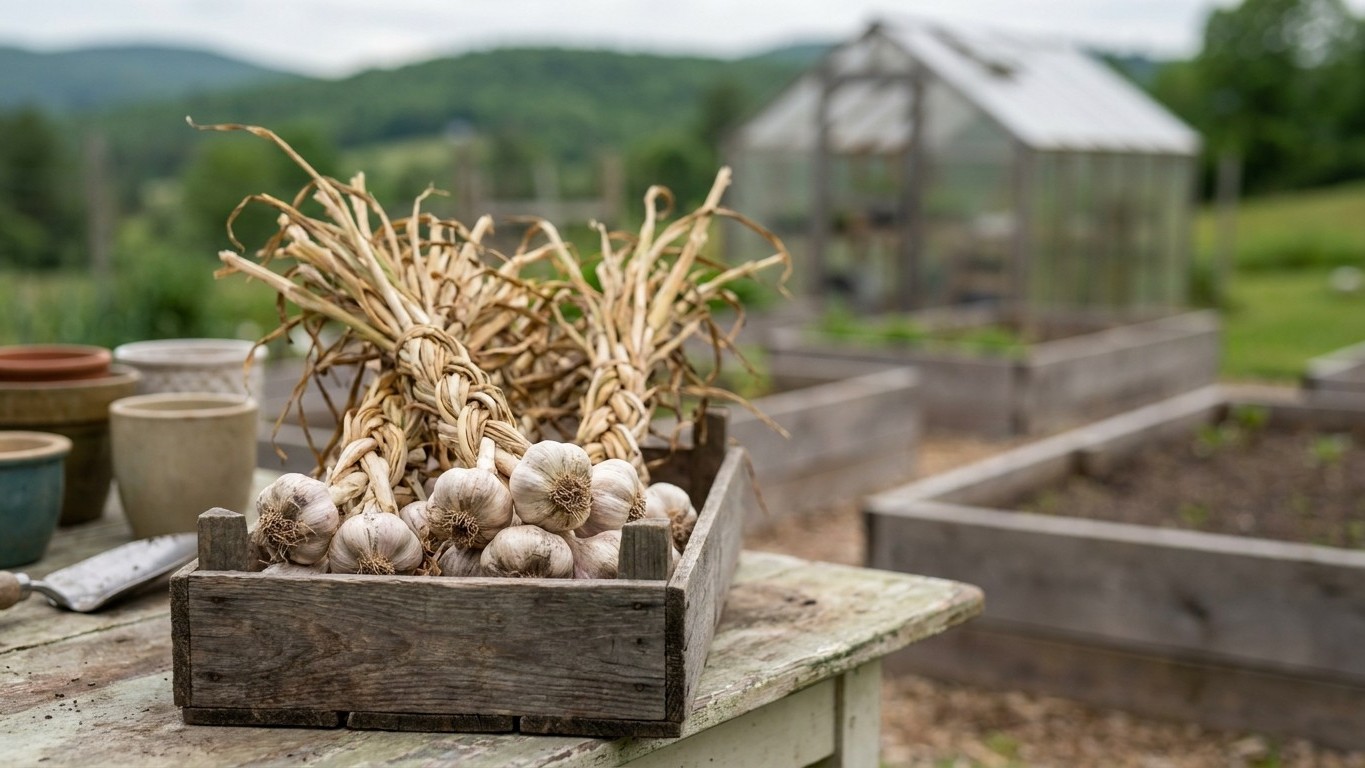

Garlic goes in the ground in British Columbia in the fall, roughly six weeks before the soil locks up, and comes out of the ground the following summer once the lower leaves have browned but several upper leaves are still green. That timing window, not a fixed calendar date, is what actually tells you when to lift a bulb here, and it shifts by weeks depending on whether you’re gardening on the coast or in the Interior.
When garlic is ready to lift in British Columbia
Garlic doesn’t ripen the way a tomato does, with color as the tell. It ripens from the bottom of the plant up, and the leaves are the calendar. Each leaf corresponds to a wrapper layer around the bulb, so when the bottom third to half of the leaves have turned brown and dried while the top four to six stay green, the bulb underneath has usually filled out its cloves and started tightening its skins. Pull one test bulb, brush off the soil, and look at the cloves: if they’re plump and distinct rather than fused into a single round mass, you’re close.
Fall planting sets the summer harvest date
Because garlic is planted in autumn and lifted the following summer, the planting window matters as much as the harvest window. Growers here typically plant cloves several weeks before the ground freezes hard, giving roots time to establish before winter without pushing top growth that frost would damage. Environment and Climate Change Canada’s Canadian Climate Normals for 1981-2010, recorded at the VANCOUVER INT’L A station, put the average first fall frost at November 10. That’s a mean date, not a guarantee. In one year out of two, frost actually arrives later than that, so treating November 10 as a safe cutoff is a mistake. It’s also worth remembering that a single Lower Mainland station doesn’t speak for the whole province. Interior valleys, northern districts, and higher elevations routinely see their first frost weeks earlier than the coast does, and gardeners in those zones need to plant earlier in the fall to give bulbs the same root-establishment window.
One more wrinkle for anyone comparing notes across the border: these Canadian normals cover 1981-2010, while comparable U.S. figures used elsewhere on this site cover 1991-2020. They’re not the same 30-year period, so treat any side-by-side comparison as approximate.
For province-specific planting and variety guidance beyond frost timing, the British Columbia Ministry of Agriculture and Food is the relevant provincial resource.
Curing it, and where to hang it here
Pulling the bulb is the easy part. Curing is what actually determines whether that garlic lasts through winter or turns to mush in a drawer by December. Curing means drying the whole plant, bulb, stalk, and roots together, so the outer wrapper leaves seal tight and the neck closes off. Skip this step or rush it, and the bulb stays vulnerable to rot no matter how carefully you store it afterward.
The process wants airflow, shade, and low humidity, and that last part is where British Columbia’s geography splits growers into two very different situations. On the coast, including the Lower Mainland and Vancouver Island, summer air can stay damp enough that garlic hung in an open shed or carport takes noticeably longer to cure, and mold on the outer wrappers becomes a real risk if the bulbs are stacked too close together. A box fan running for a few hours a day in that space makes a measurable difference. In the Interior, around the Okanagan and Thompson valleys, the drier summer air does a lot of that work on its own, and growers there often finish curing faster with nothing more than a shaded, breezy porch.
What “done” looks like
Curing is generally considered complete when the outer skins are papery and rustle rather than feel rubbery, and the neck just above the bulb has gone dry and firm rather than soft. At that point, trim the roots close to the base and cut the stalk down, leaving an inch or two above the bulb if you plan to store loose, or leave the stalks long if you’re braiding softneck varieties for hanging storage.
Storing it through a British Columbia winter
Once cured, garlic wants the opposite conditions from the ones that just cured it: cool, dry, and dark, with steady airflow. A pantry shelf, an unheated but frost-free porch, or a garage that doesn’t dip below freezing all work better than a kitchen counter, where warmth and light shorten storage life fast. The refrigerator is the one place to avoid outright. The cold and humidity in there push cloves toward early sprouting, which is the opposite of what you want from stored bulbs.
Softneck and hardneck types behave differently once bagged or braided, which matters when deciding how much of your harvest to eat first and what to hold back.
| Type | Typical storage behavior | Best use in storage |
|---|---|---|
| Softneck | Generally holds longer in cool, dry storage | Braiding, everyday cooking use through winter |
| Hardneck | Tends to soften and sprout sooner | Use earlier in the storage season |
Coastal humidity works against long storage the same way it slows curing, so growers in wetter parts of the province often check their stored bulbs every few weeks for soft spots or mold, pulling anything questionable before it spreads to its neighbors. Interior growers dealing with drier winter air generally get a longer stretch out of the same variety under the same conditions. Either way, storing bulbs loose in mesh bags or open baskets, rather than sealed plastic, keeps air moving around them and slows rot before it starts.
What goes wrong here
British Columbia’s own agriculture ministry doesn’t publish a dedicated garlic pest list, but growers working similar coastal and interior conditions just south of the border have documentation to lean on. University of Idaho Extension and WSU Extension both cover pests that affect allium crops like garlic under comparable Pacific Northwest and Interior growing conditions, including:
- Onion maggot
- Onion maggot and onion thrips
- Wireworms
- Cutworms
- Slugs
- Aphids
Onion maggot larvae tunnel into the base of the bulb and are one of the more common reasons a garlic patch that looked fine above ground turns up soft, chewed bulbs at harvest. Wireworms do similar underground damage, favoring soil that was recently in grass or pasture, which describes a fair number of newly converted garden beds in the province. Slugs are less a threat to the bulb itself than to young shoots in a wet spring, and coastal British Columbia’s damp shoulder seasons keep slug pressure higher there than in the drier Interior.
Beyond pests, most garlic failures in this province trace back to timing rather than bugs: bulbs lifted too early split their wrappers before they’ve hardened, and bulbs left too long in wet coastal soil start rotting from the root end before you ever get them onto a curing rack. Curing in a space with poor airflow is the other repeat offender, especially on the coast, where a stack of bulbs left in a closed garage can mold through before the wrappers ever dry.
Common questions
How long does garlic take to cure in British Columbia?
There’s no single published figure for the province, and coastal humidity versus Interior dryness changes the timeline enough that a fixed number would be misleading. The better measure is condition, not days: cure until outer skins are papery and the neck has dried firm.
Can I plant garlic in spring instead of fall in BC?
This guide covers the standard fall-planted, following-summer-harvest cycle, which is how garlic is grown across the province. Spring planting isn’t part of the timing described here.
Is the coast or the Interior easier for curing garlic?
The Interior generally has an edge, since its drier summer air does more of the drying work naturally, while coastal growers usually need active airflow from a fan to avoid mold on the wrappers.
Should I store garlic in the refrigerator over a BC winter?
No. Refrigeration encourages early sprouting. A cool, dry, dark space with airflow, like an unheated porch or pantry, stores garlic better through winter than a fridge does.