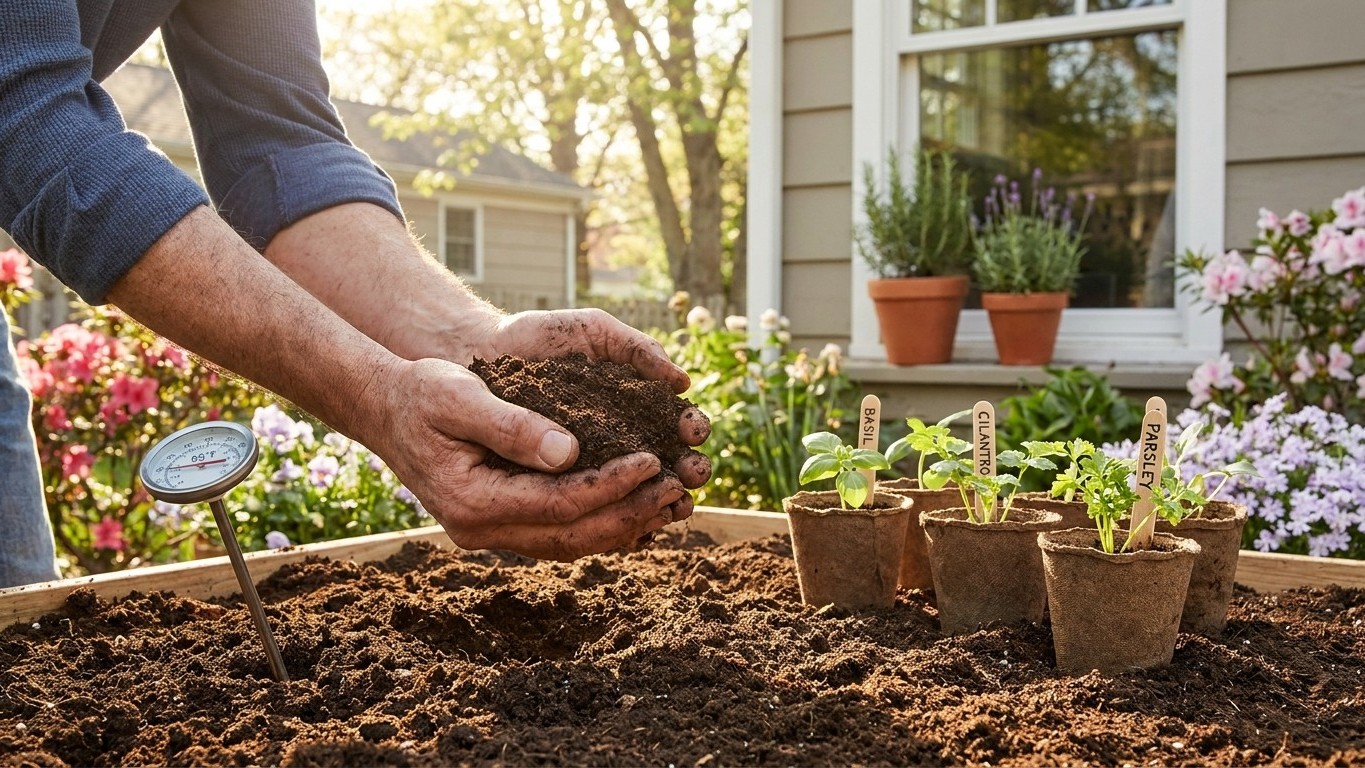

Herbs go into the ground outdoors in coastal British Columbia roughly from mid-March through early November, but that seven-and-a-half-month window is less about summer warmth than about what happens in January. Winter cold, not July heat, decides which herbs stay in the soil year-round here and which ones need a pot and a windowsill.
When the soil is warm enough in British Columbia

The average last spring frost at Vancouver Int’l A, the reference station for the region, falls on March 18, according to Environment and Climate Change Canada’s Climate Normals for 1981-2010. That date is a mean, not a guarantee. In one year out of two, frost actually arrives later than March 18, sometimes by a couple of weeks. Treat it as the midpoint of a window, not a green light.
Frost dates also answer the wrong question for herbs. What a tender basil or a young cilantro plant actually needs is warm soil, not just an absence of frost in the air. Soil lags behind air temperature by a few weeks, especially in a coastal climate where spring rain keeps the ground cool and wet well after the calendar says spring has arrived. So the practical move is to treat March 18 as the earliest you’d even think about it, and then wait for the soil itself to warm rather than counting days from a frost average.
This matters more for some herb types than others. Cold-tolerant leafy herbs in the parsley and cilantro family can go in earlier and shrug off a light frost. Heat-loving types like basil are a different story: they sulk, yellow, or simply stall if the soil is still cold, even if the air feels mild. Rather than naming specific varieties, the ones that do well in one nursery’s trial plot don’t always translate to a different microclimate a few miles away — it’s more useful to think in terms of these broad groups and match your planting date to the type’s cold tolerance rather than a single number on a calendar.
One more note on geography: Vancouver Int’l A is a single station, and British Columbia is not one climate. The Fraser Valley, the Southern Interior, Vancouver Island, and the northern parts of the province each run on their own schedule, sometimes weeks apart from the coastal readings. If you garden well outside the Lower Mainland, treat this date as a rough coastal reference and adjust for your own local conditions, especially elevation and distance from the ocean’s moderating effect.
How long the season lasts here
Between the average last spring frost of March 18 and the average first fall frost of November 10, coastal British Columbia gets about 237 frost-free days in a typical year. That’s a long growing window by Canadian standards, and it’s one of the more generous herb seasons in the country, courtesy of the ocean’s moderating influence on both ends of the year.
A season that long changes the math on what’s worth planting. With nearly eight months between frost dates, there’s real room for a second sowing of quick-cycling herbs like cilantro or dill after an early crop finishes or bolts in the summer heat. Gardeners in shorter-season parts of Canada often get exactly one shot at these crops; here, you get at least two, sometimes three, if you stagger plantings through spring and into midsummer. For the mechanics of spacing out those plantings so you’re not harvesting everything at once (or nothing at all), the succession sowing guide on this site walks through timing intervals in more detail.
What a long window changes about transplanting
A generous frost-free stretch also changes whether starting herbs from seed indoors is worth the trouble. With a short season, transplanting is often the only way to get a slow-growing herb like rosemary or oregano to a usable size before fall. With close to eight months to work with, direct-sowing becomes a realistic option for more herb types, since there’s enough time left even if germination is slow or a first attempt fails. That said, transplants still make sense for herbs that are notoriously slow from seed, it just isn’t the only path here the way it is in a four-month season.
It’s worth flagging that this 237-day figure is a coastal average built from a mean start and a mean end date, so the real range in any given year could run shorter or longer at either edge. Gardeners who push both ends of the season, starting a little early under cover and stretching the fall harvest with row cover, routinely get more out of the window than the raw average suggests.
Heat and water in British Columbia

This site doesn’t have verified figures for days above 90°F or summer rainfall totals for the British Columbia coast, so nothing here should be read as covering summer heat stress or drought risk in detail. What the region’s climate is well known for instead is the opposite pattern: cool, often damp summers rather than scorching, dry ones. For herbs, that reality points the conversation somewhere other than heat management.
The number that actually reorganizes an herb garden here is winter. The coldest month at the Vancouver reference station has a mean daily minimum of 33.5°F, according to ECCC’s 1981-2010 Climate Normals. That’s just above freezing on an average night in the coldest stretch of the year, which is mild by Canadian standards but still enough to kill herbs that have no frost tolerance at all if they’re left outdoors and unprotected.
The region sits in Canadian Plant Hardiness Zone 9a, based on Natural Resources Canada’s 1991-2020 normals for the reference city. That number needs a caution attached every time it’s used: the Canadian zone system is built from seven climate variables, not the single minimum-temperature measure the USDA system uses, and NRCan itself says there’s no clean conversion between the two. A Canadian zone number should never be read against a USDA zone map or treated as interchangeable with the hardiness numbers used elsewhere in the US.
What 9a and a 33.5°F coldest-month minimum together tell a gardener is which herbs can live outdoors as permanent plants and which ones need to come inside or be treated as a one-season crop. Woody, cold-hardy herbs can often ride out a winter like this in the ground, especially with some root protection. More tender perennial herbs, the kind that would die outright in a harder winter elsewhere in the province’s interior, have a real shot at surviving here if given a sheltered spot, but they’re still not bulletproof. And for the true tender types, this zone doesn’t offer year-round outdoor survival at all, no matter how mild the summer felt.
The cool, damp summer side of the equation matters too, even without hard numbers to cite. High humidity and lower light intensity than a hot interior climate favor slower ripening and can push up the risk of fungal problems on herbs planted too densely or without enough airflow. That’s a disease-management question more than a heat-stress one, and it should shape spacing decisions as much as any frost date does.
| Climate fact | Value | What it decides |
|---|---|---|
| Average last spring frost | March 18 | Earliest realistic outdoor start |
| Average first fall frost | November 10 | End of the frost-free window |
| Frost-free season length | ~237 days | Room for succession sowing |
| Coldest month, mean daily minimum | 33.5°F | Which herbs survive winter outdoors |
| Hardiness zone | 9a (Canadian system) | Perennial vs. potted herb decisions |
Which herbs suit British Columbia
None of this points to a specific variety, and that’s deliberate. The herbs that do best in a given garden here depend on trials run under local conditions, which is exactly what a provincial extension service tracks and this page can’t replicate. The right move is to think in types first, then check the British Columbia Ministry of Agriculture and Food for variety trial results suited to your specific district before buying seed or starts.
Reasoning by type still gets you most of the way there. Given the long frost-free window, herbs with a naturally short cycle, such as those in the cilantro and dill family, fit well into a succession-sowing plan rather than a single spring planting. Given the mild but cool and damp summer, disease resistance and airflow matter more here than they would in a hot, dry interior climate; dense, low-growing herb types benefit from wider spacing and a sunnier, better-drained spot than they’d need elsewhere.
Given the winter numbers, the sharpest dividing line in a British Columbia herb bed isn’t between herb families at all. It’s between herbs treated as permanent plantings in a sheltered bed and herbs treated as annuals or moved into pots for the colder months. Some woody, cold-hardy types can be left in place through a typical winter here. Tender types that have no frost tolerance need either a container that comes indoors or an annual replanting schedule, regardless of how well they perform all summer.
Several herbs common in home gardens carry long-standing reputations tied to traditional or medicinal use. This page doesn’t evaluate any of those claims one way or another, and readers looking for that kind of guidance should look elsewhere; what’s covered here is strictly what it takes to grow the plant itself in this climate. Skipping the variety names isn’t an oversight. The trial data that would make a specific recommendation meaningful sits with the provincial extension service, not with a general climate page, and pointing gardeners toward that source is the more useful answer than guessing at a name that might not even perform well two districts over.