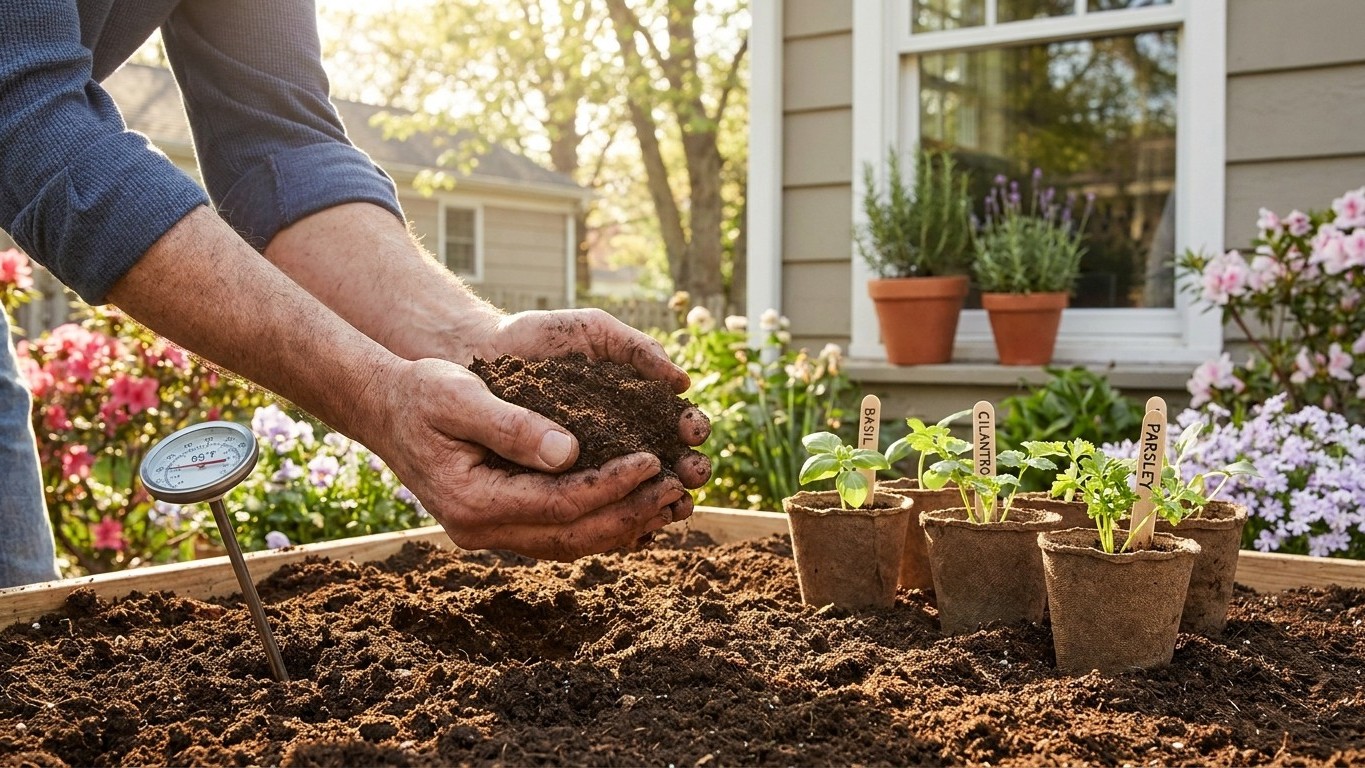

In New York City, herbs can go into the ground once the soil itself has warmed, typically a week or two after the last frost risk passes in spring, and they keep producing into a fall window that runs into mid-to-late November. Upstate and in the Adirondacks, that window starts later and closes sooner, so the calendar below is a Central Park reference, not a statewide rule.
When the soil is warm enough in New York

The frost date everyone asks for isn’t really the answer. According to NOAA NCEI’s 1991-2020 Climate Normals for the Central Park station, the last spring frost in New York City falls between March 23 and April 3, based on the 30-70% probability band for a 32°F freeze. That’s a real, sourced figure, and it’s tempting to treat it as a green light. It isn’t.
Frost date is a proxy. What actually matters for herbs is soil temperature, and soil warms up on its own schedule, days or even weeks after the air stops threatening to freeze. A patch of ground that gets full sun on a south-facing wall might be workable before the window even opens; a shaded, clay-heavy bed can stay cold and slow well past it. Basil, in particular, sulks and yellows if it’s set out into cold, wet soil, no matter what the frost date says.
Say it plainly: a frost date is a probability, not a promise. The March 23 to April 3 range means frost still has a real chance of showing up on either side of it, especially in a low-lying yard or an open exposure without the city’s heat-island buffer. Gardeners who wait for soil to feel consistently warm to the touch, rather than circling a date on a calendar, lose fewer transplants.
Upstate readers should treat that Central Park range as an urban best case. Dense city blocks hold heat longer than open countryside, so the Hudson Valley, the Finger Lakes, and especially the Adirondacks will see their soil ready later in spring and their frost risk return earlier in fall than what’s cited here. Nothing in this section applies evenly across the whole state.
Worth noting: several herbs carry long-standing medicinal reputations, from mint to sage to rosemary. This page doesn’t evaluate those claims one way or the other. It’s a garden and kitchen guide, and that’s where the discussion stops.
How long the season lasts here
Run the two Central Park dates together and the outdoor herb season stretches from roughly late March to late November, a window that can span anywhere from about 225 to 249 days depending on where within each range the actual frost lands that year. Either way, that’s a long season by national standards, and it changes what’s worth planning for.
A window that long allows more than one round of planting. Fast-growing annual herbs like dill or cilantro tend to bolt and lose leaf quality once they hit their internal clock, regardless of how much season is left. In a shorter-season territory, gardeners get one shot and have to make it count. Here, there’s room to pull a spent planting in midsummer and put in a second one for fall, stretching harvest well past what a single spring sowing would give.
That’s a different decision than most first-time herb gardeners expect to make, and it’s worth planning for rather than discovering by accident in July when the first round of cilantro has already gone to seed.
The length of the window also affects how seriously to take the leap from seed-starting indoors to transplanting outside. With a long season on the calendar, there’s less pressure to rush a transplant before its roots are established, since a slightly later start still leaves plenty of growing time on the back end. In a short-season state, that same delay could cost a real chunk of the only sowing window available.
For the mechanics of staggering plantings through a season this long, this site’s guide to succession sowing lays out how to time a second or third round without crowding out the first.
Heat and water in New York

Summer heat isn’t the variable that reorganizes an herb bed in New York. The bigger question, and the one that actually decides what stays in the ground year-round versus what needs to come inside for winter, is cold.
Start with the numbers that are actually documented for this territory. The USDA Plant Hardiness Zone Map (2023 edition, built on 1991-2020 normals) places New York State across zones 3b through 7b, a wide range that reflects everything from the relatively mild city and Long Island to the much colder northern counties and high country. That’s a statewide spread, not a single number, and it’s worth citing the reference city rather than the range whenever a specific planting decision depends on it.
For New York City specifically, NOAA’s Climate Normals put the mean daily minimum temperature of the coldest month at 27.9°F. That’s not a record low and not a monthly average; it’s the typical overnight floor during the coldest stretch of a normal winter, and it’s the figure that decides whether a woody perennial herb actually survives outdoors here or just looks like it might.
That 27.9°F floor is cold enough to kill a lot of the Mediterranean herbs gardeners want to treat as permanent fixtures. Rosemary is the clearest case: it’s borderline to non-hardy in most of New York and commonly gets grown as a container plant that spends winter indoors or in an unheated but frost-free space, rather than left in the ground. Bay laurel faces the same problem. Herbs native to cooler, damper climates, on the other hand, tend to handle that winter floor without complaint.
Where specific heat and rainfall data for the state aren’t part of the verified record here, the honest move is to not invent them. What’s certain is that New York’s humid summers, whatever the exact rainfall totals in a given year, create real disease pressure on herbs with dense foliage. Powdery mildew on bee balm or basil, and slow, soft growth from too much shade or too little airflow, are more common headaches in this climate than anything drought-related. Good spacing and morning sun to dry the leaves matter more here than shade cloth ever will.
Which herbs suit New York
Reasoning from the territory’s own facts, not from what grows easily somewhere else, narrows the field by type rather than by variety.
Cold-hardy perennial types, the ones built to shrug off a winter floor in the high 20s, are the backbone of a New York herb bed that doesn’t need to be replanted every spring. Species like chives, mint, oregano, thyme, and sage generally tolerate the coldest-month minimum of 27.9°F recorded for the city, and they hold up across most of the state’s 3b-7b hardiness range, though the coldest counties will still see more winter dieback than the city or Long Island.
Mediterranean natives that expect drier, milder winters are the ones to treat as seasonal or container plants instead. Rosemary and bay are the standouts here: both are commonly grown in pots that get moved to an unheated garage, porch, or bright indoor spot once temperatures drop, rather than trusted to survive a New York winter in open ground.
For the short side of the season, and for anything grown as a true annual, earliness matters more than any other trait. Basil, dill, and cilantro all move through their lifecycle fast, and in a humid summer, resistance to fungal disease is a more useful trait to look for than heat tolerance, since the real risk here is dampness sitting on leaves, not scorching sun.
What this page won’t do is name a specific variety. Seed catalogs list dozens of cultivars for every one of these herb types, and which ones actually perform well against local disease pressure, local humidity, and a given county’s exact frost pattern is a question that only gets a real answer from trials run in this state, on this soil, in these summers. That’s exactly the work Cornell Cooperative Extension does, and its county-based extension offices can point to the varieties that have actually been tested here, something a general guide like this one has no way to source responsibly.