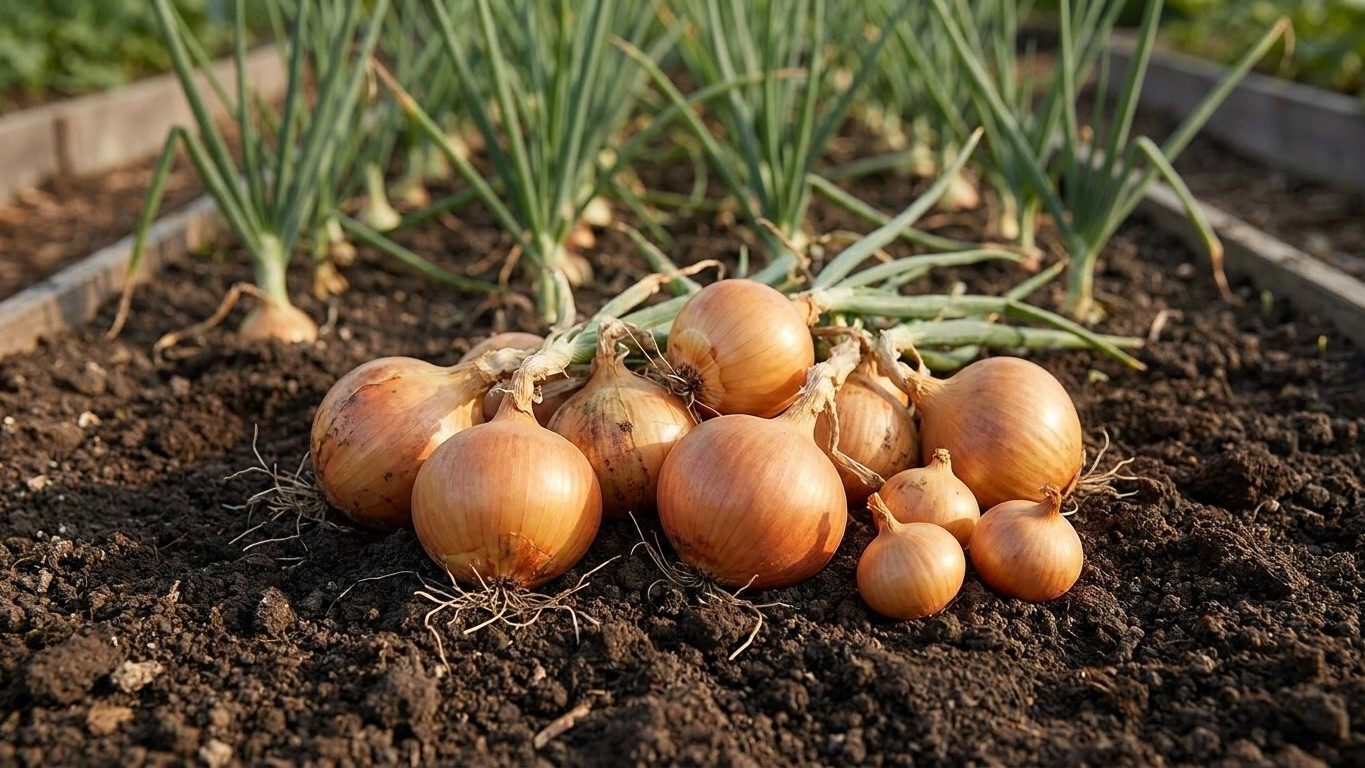

Only a handful of species out of a much longer regional pest list ever bother an onion crop in British Columbia’s Pacific Northwest growing conditions. Onion maggot and onion thrips do the steadiest damage, arriving within weeks of transplanting and building through the season. Wireworms and cutworms strike earlier, at the root and stem, while aphids and spider mites show up later, once the weather turns warm and dry. None of this overlaps much with what damages tomatoes, squash, or cabbage nearby, which is exactly why sorting the list matters before treating anything.
Which pests attack onion in British Columbia

University of Idaho Extension and WSU Extension document twenty pest species across vegetable crops in this shared growing region, and only a small group of them ever touch an onion bed: Onion maggot, Onion maggot and onion thrips, Cutworms, Cutworms and armyworms, Wireworms, Aphids, Spider mites, and Grasshoppers.
The rest of that documented list belongs to other crops entirely, and putting them on an onion problem sheet sends a gardener chasing the wrong insect. Cabbage maggot, Imported cabbageworm, and Imported cabbageworm and loopers feed on brassica leaves, not onion bulbs or foliage. Carrot rust fly targets carrots and other umbellifers, whose foliage chemistry has nothing in common with an allium. Colorado potato beetle and Tomato hornworm are nightshade specialists built to strip potato and tomato leaves. Squash bug and Western spotted cucumber beetle stay on cucurbit vines. Pea leaf weevil needs legumes to complete its life cycle. Corn earworm and earwigs, Brown marmorated stink bug, and Flea beetles round out a list built for a whole vegetable garden, not a bed of onions specifically.
The rule that sorts the list: if a species needs brassica, nightshade, cucurbit, or legume foliage to complete its life cycle, it has no business on an onion plant. Onions defend themselves chemically with sulfur compounds that many general feeders avoid, which is part of why the onion-specific list stays short even in a region with twenty documented garden pests.
Among the pests that do belong on this list, onion maggot and onion thrips cause the most consistent damage to bulb crops in this region, one boring into stems, the other rasping leaf tissue. Wireworms and cutworms work underground and at the soil line, chewing roots and young stems before a plant shows any stress above ground. Aphids and spider mites are sap feeders that build up on stressed or crowded plants, while grasshoppers cause damage that is more opportunistic, chewing leaf margins whenever populations spike in a dry year.
Slugs deserve a separate word, since they’re common in coastal British Columbia gardens and do damage seedlings of many crops. They are not, however, part of the documented pest set carried by these two extension services for this region, so this page does not attribute onion damage to them.
When each one shows up, and what it does first
Onion pests here don’t follow a fixed calendar so much as they follow the plant’s growth stage, and in a growing season built around this region’s long summer days, that stage shifts more with day length than with the thermometer. Bulbing itself only starts once day length closes in on the range that long-day onions need, and near Vancouver the summer solstice supplies 16 hours and 1 minute of daylight, the longest day the region gets. Most of what follows happens either before or during that bulbing window.
Wireworms and cutworms show up first, often before a gardener sees any leaf trouble at all. Wireworm larvae live in the soil for multiple years and chew into roots and the base of young bulbs from below, so the first visible sign is a wilted or collapsed seedling with no obvious leaf damage. Cutworms work right at the soil line soon after transplanting, severing stems clean through overnight, which is why a bed can look fine one evening and show gaps the next morning.
Onion maggot follows close behind, laying eggs at the base of young plants; the larvae tunnel upward into the stem and developing bulb, and the first sign above ground is a yellowing, wilting seedling that pulls out of the soil with a soft, rotting base rather than a firm root system. Onion thrips build up as the canopy fills in, rasping the surface of leaves to feed on plant sap, which leaves narrow silvery or white streaks running along the leaf blade well before any bulb symptom appears.
Aphids cluster on new growth once plants are established, curling leaf tips and leaving a sticky residue before any leaf drop occurs. Spider mites tend to show up later, in the hottest, driest stretch of summer, producing a fine stippling or bronzing on leaves that can be mistaken for heat stress until a hand lens shows the mites themselves. Grasshoppers are the latest and least predictable of the group, chewing ragged notches out of leaf margins whenever a dry year pushes their numbers up, rather than on any fixed schedule tied to the onion’s own growth.
Telling the damage apart from everything else
Onion problems that look identical at first glance often have nothing to do with insects. Nutrient shortages, uneven watering, fungal disease, and simple transplant shock all produce yellowing, wilting, or streaked foliage, and treating a nutrient problem as a pest problem wastes both time and money.
| Symptom | Possible cause | What tells them apart |
|---|---|---|
| Seedling wilts, pulls out with a soft, rotting base | Onion maggot larvae | Larvae or tunneling visible at the stem base; transplant shock leaves the base firm |
| Narrow silvery streaks on leaves | Onion thrips | Tiny insects near the leaf base or neck; sun scorch streaks lack any insect presence |
| Stem severed cleanly at soil line overnight | Cutworms | A clean cut versus the ragged tearing left by wind or frost damage |
| Patchy stand, no visible leaf symptom | Wireworms | Digging near roots turns up larvae; poor drainage shows uniform stunting instead |
| Sticky residue, curled leaf tips | Aphids | Clusters of insects present; viral mottling has no stickiness and no insects |
| Bronzing or stippling in hot, dry weather | Spider mites | Fine webbing under a hand lens; drought stress alone rolls leaves evenly |
One rule cuts through most of this confusion: insect damage almost always leaves the insect, larva, or a physical trace such as tunneling, webbing, or a clean cut, while environmental stress spreads evenly across the whole bed instead of showing up in patches. A neighbor’s bed showing the same yellowing at the same time points toward soil or watering, not insects. When the pattern doesn’t fit either description cleanly, that’s the point to bring a sample or a clear photo to a local extension office rather than guess.
What actually works here, and what is a waste of time
Physical prevention beats reaction on a short-season alliums crop, because by the time onion maggot or wireworm damage is visible above ground, the larvae are already inside the plant or below the soil line, out of reach of anything applied afterward.
The single move that changes outcomes more than anything else is installing a floating row cover over the bed at transplanting, before adult flies locate the rows, then keeping the edges buried in soil so nothing crawls underneath. Because onions don’t need pollinator access to form a bulb, the cover can stay on for the whole vulnerable early period without costing anything in yield. Removing and destroying cull onions and stem debris right after harvest matters almost as much, since it takes away the material where maggot pupae overwinter close to next year’s bed.
Rotating out of the same ground for more than a single season reduces buildup of both onion maggot and wireworm, particularly on soil that was sod or lawn recently, since wireworms favor grassy ground and take years to decline once established. Reducing water stress through the hottest, driest stretch of summer also cuts down spider mite buildup, since dusty, drought-stressed foliage is what mites prefer.
What doesn’t work: treating a bed after wilting seedlings already show a soft, rotten stem base. The larvae are inside the plant by then, and the damage is done regardless of what gets applied. Broad, untimed treatments applied without knowing which pest is active, and at what stage, waste effort and often kill the predatory insects that would otherwise keep aphids and mites in check. Specific product choices and any chemical control aren’t covered here, since only a state or provincial extension service can say what’s currently registered for use in a home garden.
Where to check this for your own county
University of Idaho Extension and WSU Extension are the sources behind the pest list on this page, and both operate through county-by-county offices that track what’s actually active locally rather than what’s simply possible region-wide. A pest documented across a whole state doesn’t mean it’s present in every garden within it, and the reverse is just as true: a species can be locally common in one valley and nearly absent thirty miles away, depending on soil, past cropping, and microclimate.
Gardeners in British Columbia sit in the same broad Pacific Northwest climate that these two extension services describe, which makes their documented timing and behavior a useful reference point. But a local check still matters more than any regional list, since day length, soil temperature, and pest pressure all shift with elevation and distance from the coast even within a single province.
The next step, if a symptom doesn’t match cleanly onto what’s described here, is a direct one: bring a sample, or a clear close-up photo, to a local extension or agricultural office and ask what’s been reported nearby this season. That single check settles more diagnostic guesswork than any general list can.