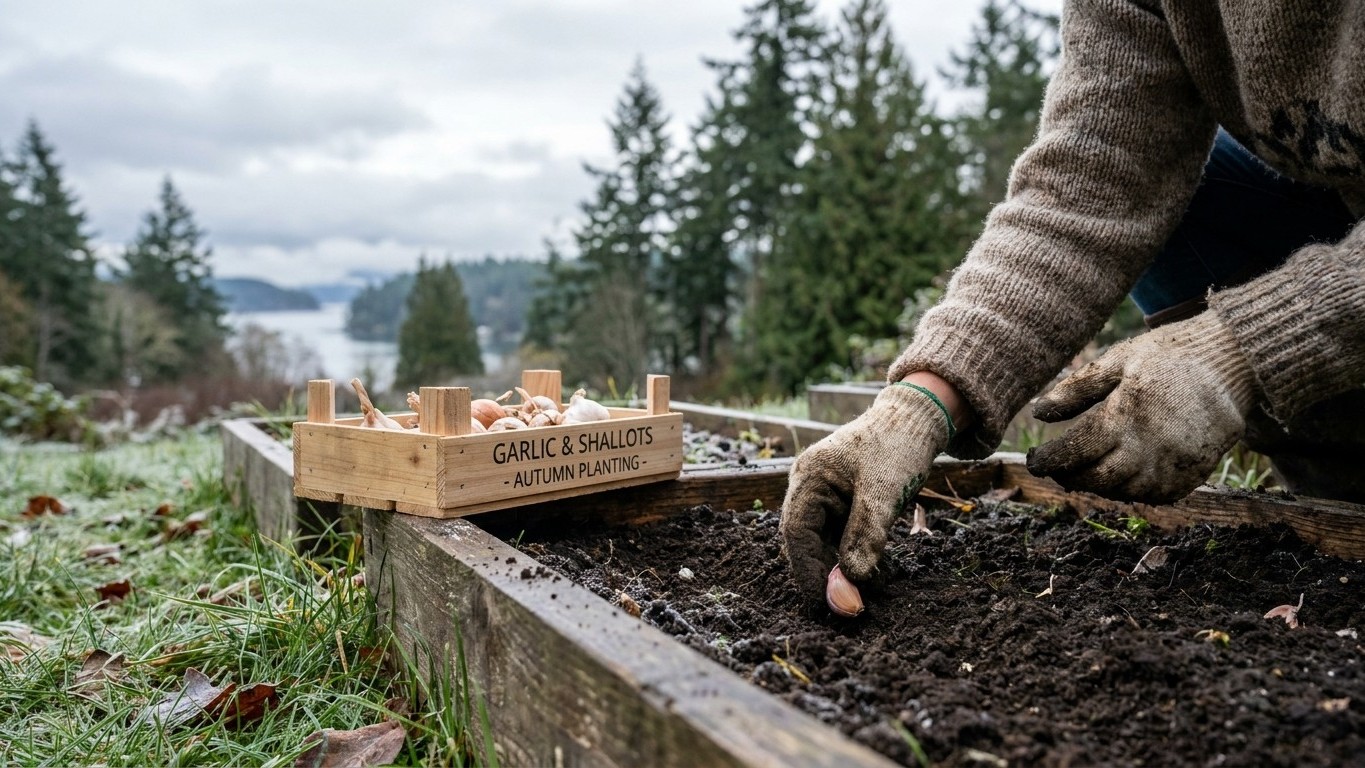

By November, the coastal reference climate used for British Columbia has usually already crossed its average first fall frost. That means direct-sown tender crops are off the table almost everywhere in the province. What still works: garlic and shallots going into workable ground, bare-root and dormant plantings, cold frames, and forcing crops indoors. The exact window shifts hard between the coast and the Interior.
What goes in the ground in November

The number that matters here is the average first fall frost for the Vancouver Int’l A station: November 10, per Environment and Climate Change Canada’s 1981-2010 Climate Normals. That’s a mean, not a guarantee. In roughly half the years on record, frost at that station actually arrived later than November 10, and in the other half it came earlier. So by the time November opens, frost has often already touched the coast, and it’s a near-certainty by mid-month. Treat any warm stretch as borrowed time, not a green light.
The province sits at Canadian hardiness zone 9a for the reference city, based on Natural Resources Canada’s 1991-2020 normals. That’s the Canadian rating system, built on seven climate variables, and it does not translate into a USDA zone. Don’t compare it directly to zone numbers used elsewhere on this site for US states.
Given that frost timing, this is not a month for lettuce transplants or bean seed in open soil. What does still make sense outdoors:
- Garlic and shallots, pressed into workable, well-drained beds while soil hasn’t locked up
- Bare-root fruit trees, cane fruit and roses, planted while dormant
- Perennial divisions and hardy bulbs in milder coastal pockets
- Rhubarb crowns, where ground can still be worked
- Cold frames and low tunnels holding hardy greens already established
Anything tender goes into containers you can shelter, not the open ground. If soil is already frozen or waterlogged where you garden, skip the shovel entirely and move to the indoor tasks below.
What to start under cover
Working backward from the average last spring frost of March 18 at the reference station, November sits roughly four and a half months out from that date. That’s too early for most spring transplants; starting them now just means leggy, rootbound seedlings sulking on a windowsill for months before the ground is even close to ready. The arithmetic that matters for spring starts (counting back the weeks a crop needs before transplant) doesn’t really apply yet this month.
What does fit the calendar now is different: fava beans and broad beans sown into pots or a cold frame for an early spring head start, onion seed for long-day varieties started under lights for growers who like a long runway before spring transplanting, and hardy lettuce or spinach kept going in a cold frame where light still reaches them. Forcing rhubarb or chicory indoors in the dark also belongs here, not as a spring-start exercise but as a way to pull a harvest out of the dead months.
The two failure modes to watch: starting spring crops far too early, which produces weak, overgrown seedlings with nowhere to go before the ground warms; and neglecting cold-frame crops on the assumption they’ll coast through winter with no attention, when shrinking daylight alone can stall growth even without hard freezes. Check cold frames for condensation and mold rather than treating them as fully self-sufficient.
What is ready to pick
Outdoor harvest is thin by this point, and that’s expected once the average frost date has passed. What’s realistic:
- Kale, leeks and overwintering cabbage, all of which taste better after a touch of cold
- Parsnips and Jerusalem artichokes, best left in the ground until frost sweetens them
- Brussels sprouts, picked from the bottom of the stalk upward as they firm
- Cold-frame greens such as spinach, mâche and arugula on milder coastal ground
Indoors, sprouts and microgreens can keep a household in fresh greens through the darkest weeks with no outdoor garden involved at all. For anything already in storage, go through squash, potatoes and onions by hand. A single soft squash or a sprouting onion left in a bin can take down its neighbors within days, so pull anything with a soft spot, a sweet smell or visible mold the moment you spot it, rather than waiting for the next check.
The jobs that matter this month
This is the month where the work is less about planting and more about protecting what’s already there and setting up the season that follows. Skipping it now costs real ground come spring.
Protect and prune
Dormant pruning of fruit trees and cane fruit can begin once leaves have dropped, cutting when the plant’s energy has already retreated to the roots. Mulch garlic beds and any exposed perennial crowns heavily before a hard freeze locks in, especially away from the coast where the ground drops much colder. Drain and store hoses and irrigation lines before a freeze splits them.
Plan and maintain
Seed catalogs move fast, and the varieties gardeners actually want tend to sell out well before spring, so ordering now beats scrambling later. Sketch next season’s crop rotation while this year’s layout is still fresh in mind. Pull a soil test or at least work compost and any needed amendments into beds that will sit fallow over winter, since amendments need time to break down before planting resumes. Turn the compost pile, clean and sharpen tools before they sit idle, and patch fencing or raised-bed edges now rather than in a spring rush.
None of this is filler work. A tool left dull all winter, a rotation never planned, or mulch skipped on garlic are the kind of small misses that show up as real losses months later.
What not to do in November
A mild stretch of weather is the classic trap. A few days of sun doesn’t undo the fact that frost has typically already arrived at the reference station by this point, and soil temperature lags well behind air temperature anyway. Planting anything warm-season into ground that’s already been chilled for weeks is a guaranteed loss, no matter how pleasant the afternoon feels.
The same mild spell tempts gardeners to pull mulch or open cold frames early, thinking winter has eased off. It hasn’t. Uncovering garlic beds or cold-frame crops during a warm week only to have a cold snap follow days later undoes the protection those covers were doing in the first place. Leave them closed until the season has genuinely turned.
Nitrogen is the other common misstep. Feeding beds or overwintering crops nitrogen now pushes soft new growth right when the plant should be hardening off for cold, and that soft growth is exactly what frost damages first. Save nitrogen applications for active spring growth, and if beds need feeding now, lean on compost or slow-release organic matter instead, which won’t force a growth spurt at the wrong moment.
Checking this against your own county
Everything above is anchored to a single coastal weather station, and British Columbia is not one climate. Elevation, distance from the coast and how far north you are can shift these frost windows by weeks in either direction.
| Region | General pattern |
|---|---|
| Coastal (Lower Mainland, Vancouver Island) | Milder, closest to the reference station’s dates, mildest hardiness zone |
| Southern Interior (Okanagan and similar valleys) | Colder nights, earlier hard frost than the coast |
| Northern BC and high elevation areas | Frost arrives well before the coastal average, much shorter growing season |
Check your own municipality against Natural Resources Canada’s hardiness zone map, and use the BC Ministry of Agriculture and Food resources for guidance tuned to your part of the province rather than a single Lower Mainland station.
Common questions
Can I still plant garlic in November in British Columbia?
Yes, on ground that’s still workable. Garlic wants to go in before the soil locks up, and a heavy mulch layer afterward protects cloves through the colder months, particularly away from the coast.
What hardiness zone is British Columbia for gardening?
The reference city sits at Canadian zone 9a, based on Natural Resources Canada’s 1991-2020 normals. That’s the Canadian system, not USDA, and it varies sharply across the province between the coast and the Interior.
Is it too late to plant bulbs in November?
On the mild coast, many hardy bulbs can still go in if the ground hasn’t frozen. Further inland or at elevation, where the ground firms up earlier, it’s safer to hold bulbs in cold storage rather than risk them in unworkable soil.
What vegetables can survive winter in BC gardens?
Kale, leeks, overwintering cabbage, parsnips and Brussels sprouts handle cold well outdoors, especially on the coast. A cold frame extends that list further to include hardy greens like spinach and mâche.