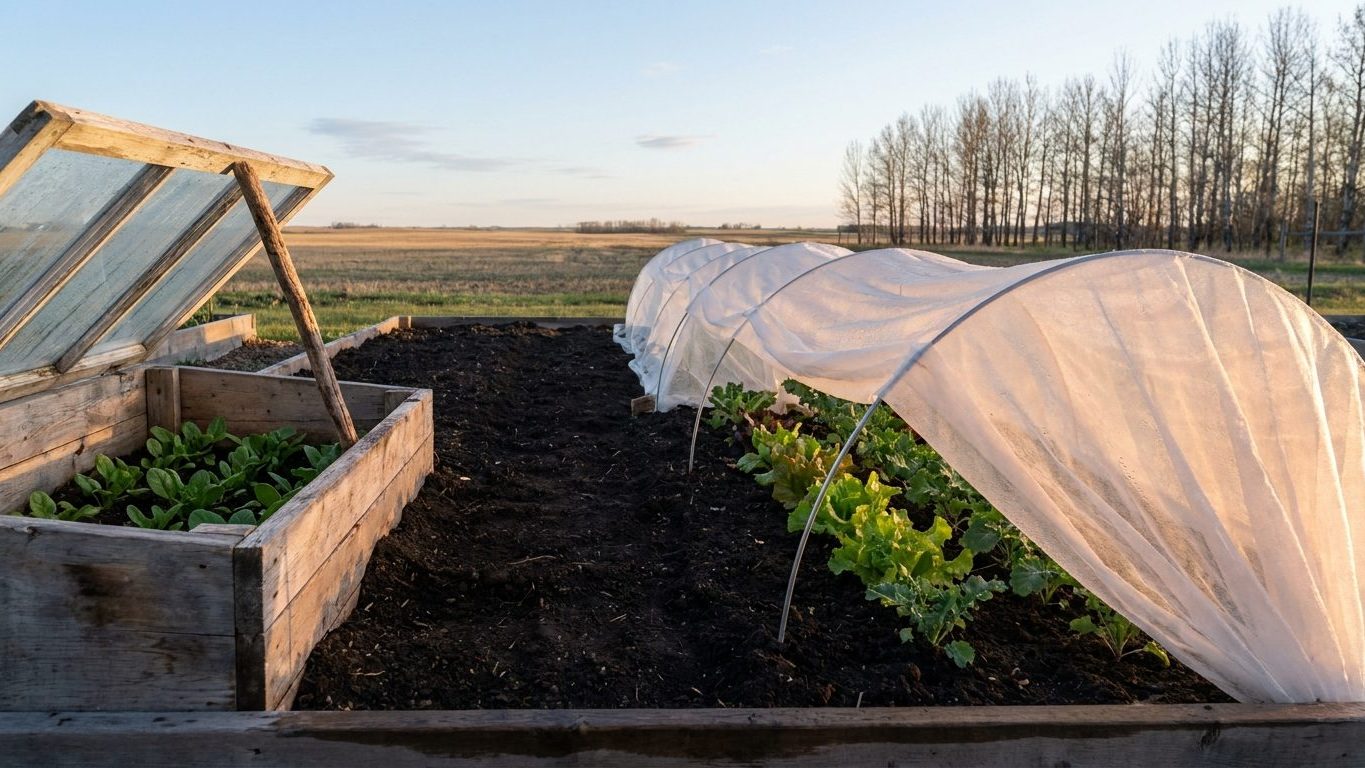

Floating row cover over low hoops, a cold frame, and individual cloches handle most season extension in British Columbia. A greenhouse or polytunnel earns its cost only for heat lovers such as tomatoes, peppers and melons. Winters near the coast are mild, so the main limits are cool soil in spring and short, dim days in winter. What to use depends on which of those two you are fighting.
The short answer for British Columbia
Start with a low tunnel: metal or plastic hoops about two feet high, covered with floating row cover. It protects spring seedlings and fall crops, goes up in an afternoon, and can be vented by lifting an edge. Add a cold frame for hardening off and for winter greens. Reserve a greenhouse or polytunnel for crops that need warm nights as well as frost protection.
The numbers explain why. At the Vancouver International Airport station, Environment and Climate Change Canada puts the average last spring frost at March 18 and the average first fall frost at November 10. That leaves about 237 frost-free days between the two dates. Both are midpoints. In one spring out of two, frost arrives after March 18, and in one fall out of two it arrives before November 10. A cover buys you a margin on either side of those dates, which is exactly its job.
The coldest month at that station has an average daily minimum of 0.8 °C (33.5 °F). Hardy crops like kale, leeks, spinach and mâche sit through that with little more than a light cover to keep rain and wind off. Canada’s Plant Hardiness Site lists the same city in zone 9a. That is the Canadian system, which is built on seven climate variables and does not translate into a USDA zone. Either way, the message is that the coast rarely needs a heater.
Which extender suits which job?
Matching the tool to the task saves money. A heavy structure that guards against a cold snap that rarely comes is poor value. A thin cover on a crop that wants heat is a waste of effort. The comparison below shows how the common options differ.
| Extender | Best job | Watch for |
|---|---|---|
| Floating row cover on hoops | Early spring sowings, fall salad crops, frost nights | Wind lifting the edges, pests getting in if the edges are not weighted |
| Clear plastic low tunnel | Warming spring soil before transplanting | Overheating on sunny days, so it needs venting |
| Cold frame | Hardening off, winter greens, starting seedlings | Cooking plants on a bright day if the lid stays shut |
| Cloche or cut jug | Single transplants, such as a squash or tomato seedling | Needs lifting daily once it warms |
| Greenhouse or polytunnel | Tomatoes, peppers, cucumbers, melons | Damp air, disease, and the cost of a sturdy frame |
For a broader look at stretching the calendar at both ends, see Extending the Growing Season in British Columbia.
What will not work here

Treating March 18 as a safe planting date is the first mistake. It is the middle of the frost window, so roughly half of years bring a frost after it. Tender transplants set out on that date with no cover are a gamble. The same goes for November 10 in fall: half the time the first frost comes sooner, so covers need to be on hand weeks before.
Sealed plastic with no ventilation is the second. Cool, wet weather is common across much of the province, and a closed tunnel holds humidity against the leaves. Gray mold and rot follow, especially on lettuce and young brassicas. Row cover breathes and clear plastic does not, so a plastic tunnel needs its ends or sides opened on any mild day. Then, on a sunny afternoon, an unvented tunnel can heat well past what seedlings tolerate.
A heated winter greenhouse for frost protection is a poor trade on the coast. When the coldest month averages a daily low of 0.8 °C (33.5 °F), most hardy vegetables survive outdoors with a light cover. The cost of heating buys very little extra growth, because of daylight. Vancouver sits at 49.20 degrees north, and in midwinter the days are short enough that most greens barely grow, warm or not. Seeds sown under cover in December mostly sit and wait. Autumn sowings timed so plants are nearly full size by late fall will give you winter harvests; sowings made in midwinter will not.
Thin row cover alone will not ripen heat lovers. Melons, peppers and eggplant want warm nights, and a light fabric adds only a few degrees. In a cool summer they stall even when no frost ever arrives. Cloches or a polytunnel give them what a fabric cannot, and so does a spot against a south-facing wall.
Lightweight hoops are the last thing to fail, where snow lingers. Inland and upland gardens can see wet snow sit on a low tunnel. Thin wire hoops buckle under that load, so brush snow off or use sturdier frames. The When to Cover Your Garden in British Columbia guide covers timing for putting covers on and taking them off.
What changes across British Columbia
The zone 9a rating and the March 18 and November 10 dates describe one reference city on the southwest coast. A province this size has no single answer. Valleys in the interior run hotter in summer and colder in winter. Northern districts and higher elevations run weeks behind the coast in both spring and fall, so the frost-free stretch is shorter at each end. Canada’s Plant Hardiness Site gives a zone for each municipality, and the spread across the province is wide.
If you garden in the north or at altitude, shift your plan in three ways. Start covers earlier in fall, because the first frost comes before the November 10 midpoint. Expect to wait longer in spring before soil is workable. And lean toward sturdier extenders: double layers of row cover, insulated cold frames, and a polytunnel for anything tender. The coast can get by with a light fabric on hoops; colder districts often cannot.
Latitude matters too. The 49.20 degrees north figure belongs to Vancouver. A garden several degrees farther north has noticeably longer summer days and shorter winter ones, and that changes when onions bulb and when winter greens stop growing. If you are near the northern edge of the province, check your own latitude rather than borrowing the coastal number.
Look up your own location on Canada’s Plant Hardiness Site instead of guessing a zone. Keep in mind that the frost dates here come from 1981-2010 normals, while the hardiness map uses 1991-2020 data, so the two will not line up exactly.
Where to check this for your own county
For local advice, go to the provincial agriculture ministry. British Columbia’s agriculture and seafood ministry is the provincial source. Browse it for what applies to your region, then compare that with what growers near you report.
Two things are worth finding there. The first is a planting calendar written for your district, with sowing and transplanting windows tied to local frost dates rather than the coastal ones. The second is a list of varieties trialled in your area. A tomato that ripens reliably on the coast may stall in a short-season valley, and a trial in your own district shows which ones finish.
A recommendation from your own district beats a provincial one every time, because it reflects your frost pockets, your rainfall and your elevation. Any province-wide guidance, including this article, is a starting point. If your local office or a nearby garden club has records of past last and first frost dates, use those over any average.
Checking this against your own garden
Every date above gives way to what your own soil and plants are doing. Three signs are worth watching, and none needs equipment.
- Soil warmth by feel. Push your hand a few inches into the bed in the morning. If it feels clammy and cold, seeds of warm-season crops will sit. A bed that warms sooner than your neighbor’s is a sheltered microclimate, and a bed that stays cold is a low spot or a shady one.
- The first male flowers on squash and cucumbers. Male flowers open before female ones. When they appear, the plant is telling you it is warm enough for the growth that matters, and you can judge from the date how long your covers should stay on.
- First true leaves on seedlings. The first pair are seed leaves. The next pair are true leaves, and when they show, a seedling is toughening up. If they come slowly under a cover, the site is cooler or dimmer than you assumed.
Keep notes for a season: when each sign showed up, and where. Next year you will have a calendar that fits your garden better than any average.
Common questions
Is row cover enough for winter on the coast?
For hardy crops, usually yes. The coldest month averages a daily low of 0.8 °C (33.5 °F) at the reference station, so a light cover keeps off rain and wind. Growth will still be slow because winter days are short.
Do I need a greenhouse in British Columbia?
Only for heat-loving crops like tomatoes, peppers and melons, or if you want a place to start seedlings. Hardy vegetables do well under low tunnels and in cold frames.
When should I put covers on in fall?
Before the first frost, which averages November 10 at the reference station and comes earlier in one year out of two. Colder districts should cover weeks sooner. Keep covers on hand by early fall.
Can I plant on March 18 if that is my average last frost?
Frost falls after that date in about half of years. Hardy crops can go out with a cover. Tender plants should wait until nights are reliably mild or stay under cloches.