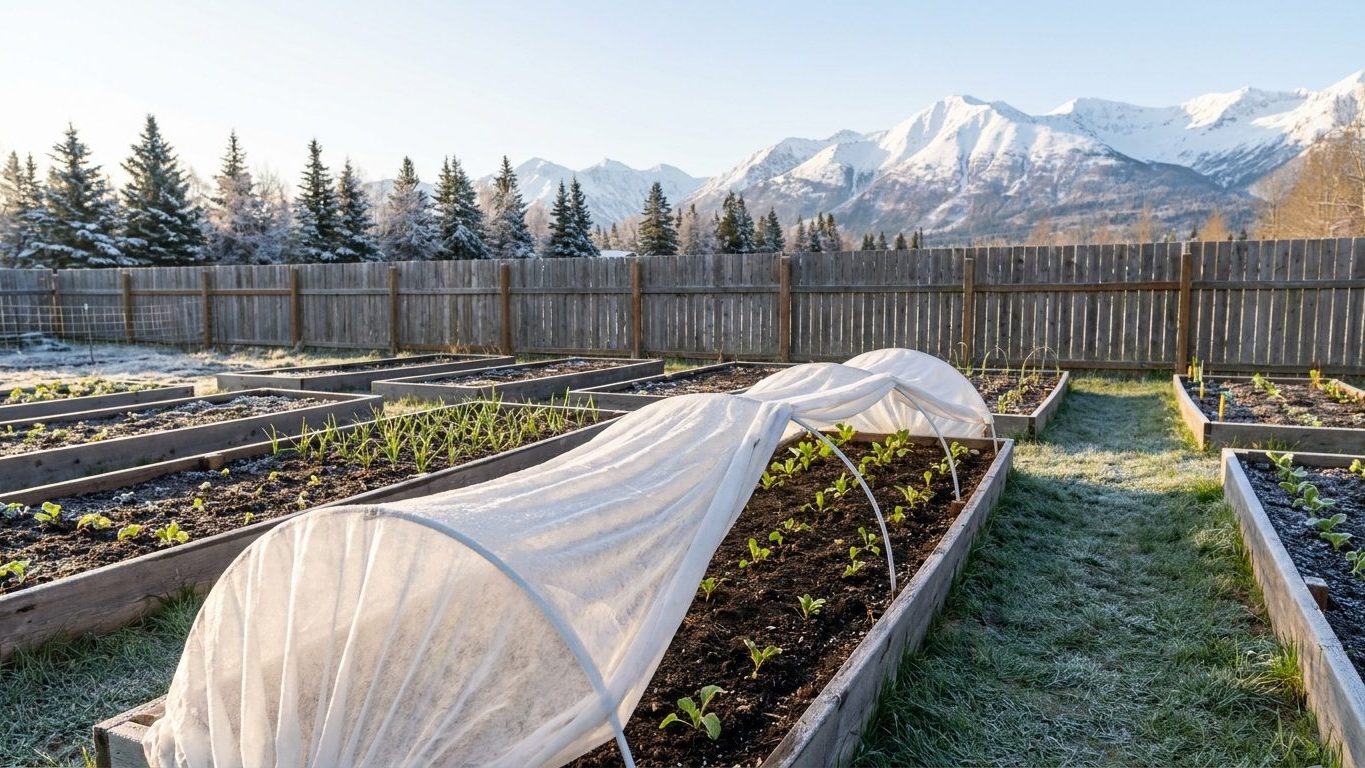

Cover tender crops before the first fall frost, and cover the bed two to three weeks before planting in spring so the soil warms ahead of the seedlings. On the southwest coast that puts the fall job in mid to late October and the spring job in late February or early March. Those timings belong to the Vancouver area. The rest of the province shifts, as the sections below explain, and the overview in Extending the Growing Season in British Columbia covers the wider picture.
The short answer for British Columbia
On the coast, cover from late February to mid-March in spring and from mid-October in fall. At Vancouver International Airport the last spring frost averages March 18 and the first fall frost averages November 10. Both are mean dates from Environment and Climate Change Canada’s 1981-2010 normals, so they are midpoints. In one year out of two the last frost falls later than March 18, and in one year out of two the first fall frost arrives before November 10.
A cover works on both ends of that stretch. In spring it warms cold soil before you plant. On a clear night it holds a few degrees of protection over the plants, which is often the gap between a nipped seedling and a healthy one.
Winters here are mild. The mean daily minimum of the coldest month is 0.8 °C (33.5 °F), so most nights hover just above freezing. Hardy greens and roots can sit under a cover through winter, and a hard freeze is an occasional event. Averages hide the cold snaps, though, and those nights are what the cover is for.
When do you cover the garden in spring and fall?
| Time of year | What triggers it | What to do |
|---|---|---|
| Late February to mid-March | Soil still cold, frost still likely | Lay fabric, plastic or a cold frame over the bed to warm the soil. Sow hardy crops underneath. |
| After March 18 | Frost still possible in about half of years | Keep covers on hand. Cover transplants at dusk when the forecast low nears 0 °C. |
| Mid-October | Nights cooling toward the first frost | Set hoops and fabric in place. Cover tender crops on any night forecast near freezing. |
| From November 10 onward | Frost now likely | Leave covers on hardy crops. Open the ends on mild days. |
Which material suits which date is a separate decision, covered in Which Season Extenders Work in British Columbia.
What will not work here

Why is March 18 not a safe planting date?
Because it is the middle of the range, and half the years run later. A tender transplant set out on March 19 with no cover is a coin flip. Even when frost does not arrive, spring nights on the coast are cool enough to stall warm-season crops, so cover earns its place well past the average date.
What goes wrong with covers on a wet coast?
Sealed covers do. Coastal winters are damp, and with the coldest month averaging only 0.8 °C, nothing freezes the slugs back. A plastic tunnel closed for weeks holds humid air around the leaves, and gray mold follows. Vent it on every mild day, and lift the ends so air moves through.
Spring brings the opposite problem. A low tunnel buttoned up on a sunny March afternoon can overheat seedlings in a few hours, even when the night before dropped near freezing. Plastic needs opening in the morning and closing at dusk. Fabric is more forgiving, which is one reason it suits busy gardeners.
Will a heavier cover keep crops growing all winter?
No. Vancouver sits at 49.20 degrees north, and the shortest days of December and January give plants too little light to grow much, whatever the temperature underneath. A cover keeps winter greens alive. It does not push them to size. Crops that are still small going into November tend to sit idle until February, so winter harvests depend on sowing early enough in late summer that plants are nearly full-grown when the light fades. A thick frost blanket left on all winter also shades what little light there is. Save the heavy weights for cold snaps and use light fabric the rest of the time.
Fall and winter storms off the Pacific are the last trap. Loosely pinned fabric ends up in the neighbor’s yard. Weigh down or bury the edges, and set hoops deep enough to hold in wind.
What changes across British Columbia
Vancouver’s reference reading is zone 9a on Natural Resources Canada’s plant hardiness map, based on 1991-2020 normals. That is the Canadian system, built on seven climate variables, and it does not convert to a USDA zone. NRCan itself says there are no simple conversions between the two. Treat 9a as one mild corner of a very large province.
British Columbia runs from the wet coast and the islands through dry interior valleys and mountain country to the far north. No single answer fits all of it, and the spread in hardiness zones from one end to the other is wide. The frost dates above come from one airport station and cover 1981-2010, while the zone uses a later period, so the two do not line up exactly. To see which zone applies to your own address, use Natural Resources Canada’s plant hardiness map rather than borrowing Vancouver’s.
What should northern and high-elevation gardeners shift?
Northern and upland districts run weeks behind the coast. Start spring covering later, since the soil thaws later, and keep covers on longer past the last frost. In fall, put them out earlier, because the first frost arrives ahead of Vancouver’s November 10. Where winter lows sit well below freezing, a cover protects the fall harvest but will not carry crops through the coldest weeks the way it can on the coast. Heavier fabric or a double layer helps there, and tunnels need a frame that can shed snow.
Elevation inside a single yard matters too. Cold air drains downhill and pools in low spots, so a bed at the bottom of a slope can frost while one a short way up the hill stays clear. Latitude shifts the picture as well: the 49.20 degrees belongs to Vancouver, so a reader far to the north should check their own.
Where to check this for your own county
The B.C. Ministry of Agriculture and Food is the provincial source for farm and garden guidance. Look there for the planting calendar written for your region, and for the vegetable varieties tested in conditions like yours. A variety that performs on the Fraser Valley floor may not suit a cold Interior valley, and regional trial results show that gap in a way no provincial average can.
Also look up the climate normals for the Environment Canada station nearest your garden. Frost dates from a station ten minutes away beat dates from one across a mountain range. Neighbors with long-running gardens, local garden clubs and community plots often hold the best records of all, because they know which spring was the one that burned the beans.
A recommendation for your county or regional district beats a provincial one every time. The Vancouver dates here are a starting point, and the local calendar should replace them once you have it.
Checking this against your own garden
Your own beds outrank every date above. Three observations cost nothing and tell you more than a calendar.
- Soil warmth by feel. Push your hand a few inches into the bed in the morning. If it feels cold against your skin, tender transplants will sit and wait. A bed under cover that feels warmer than an open one next to it shows how much the cover is gaining you.
- Where the frost shows first. On a clear, still morning, look at where white frost sits on the lawn, car roofs and fences. The spots that whiten first are your cold pockets, and the spots that stay green are your warm corners and the best home for early crops.
- First true leaves and male flowers. Seedlings that have put out their first true leaves, not just the seed leaves, are ready to handle cool nights. On squash and cucumbers, the first flush of male flowers means warmth has arrived. If covered plants flower days ahead of uncovered ones, the cover is working.
Keep notes for a season or two, with the date of the last frost you saw and the date you first covered in fall. Two years of your own dates will tell you more than a 30-year average from an airport.
Common questions
Should I cover seedlings on the average last frost date?
Cover them for several weeks past it. March 18 at Vancouver’s airport is a midpoint, and frost comes later in half of years. Watch the forecast, and put the cover on at dusk when the low nears 0 °C.
How early in spring can I put a cover on a bed?
About two to three weeks before you plan to plant. That gives the soil time to warm. On the coast, late February to early March works for hardy crops.
Do I need to cover the garden in winter on the coast?
Hardy greens and roots often survive uncovered, because the coldest month averages a minimum of 0.8 °C (33.5 °F). A cover still protects them through cold snaps and from heavy rain. Vent it on mild days to avoid mold.
When do I take covers off for good in spring?
When nights hold above freezing and your transplants have settled in. Remove covers on warm days first, and keep them nearby until well after the average last frost.