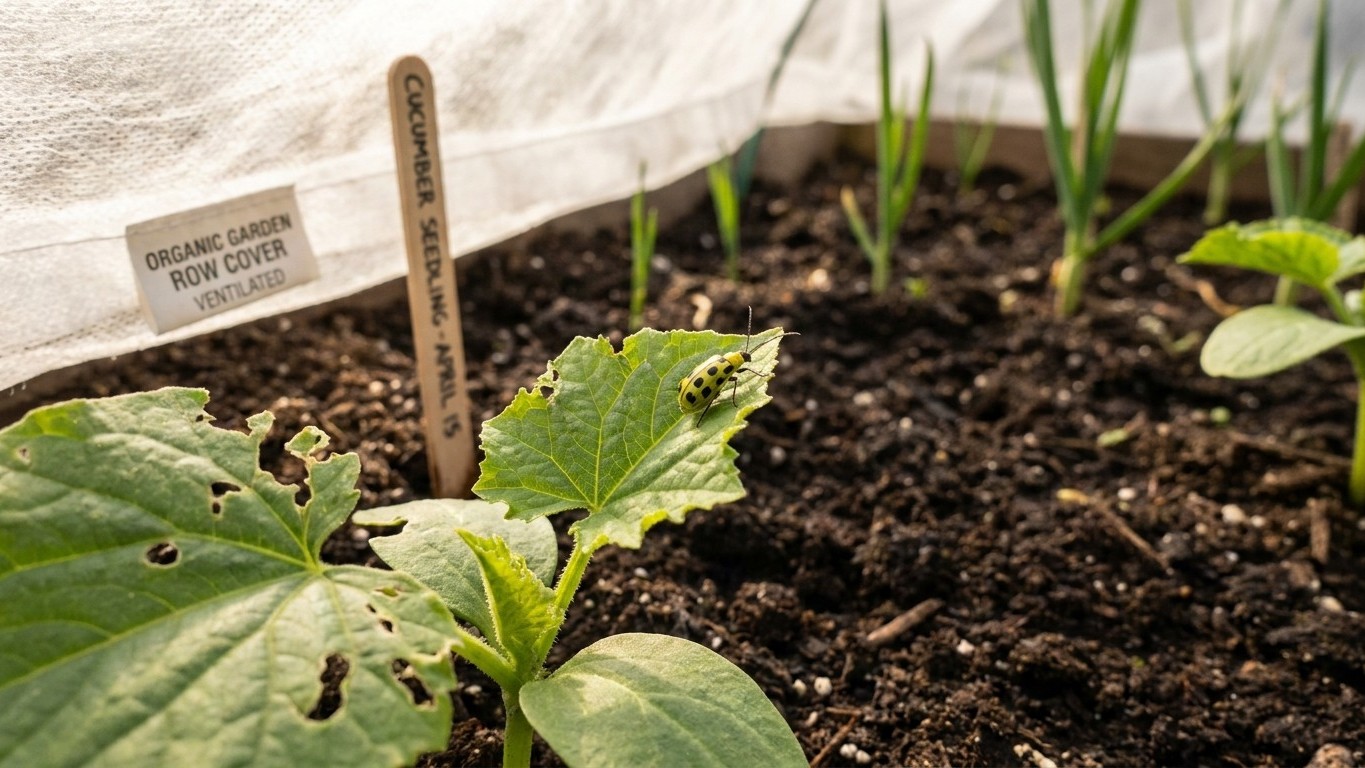

The Western spotted cucumber beetle turns up in British Columbia gardens once the soil warms past the point where its overwintering generation can move and feed, not on a fixed calendar day. It targets young cucurbit and bean seedlings first, and the treatments that work are cheap, timing-based, and useless once larvae are already inside a stem or root.
Reading the calendar from your last frost

Gardeners in the Lower Mainland and Vancouver Island plan their season around one date: the average last spring frost of March 18, recorded at the VANCOUVER INT’L A station by Environment and Climate Change Canada (1981-2010 normals). That number is a midpoint, not a promise. In one year out of two, frost actually arrives later than March 18, so treating it as a safe planting cutoff is a mistake many gardeners make once and don’t repeat.
The beetle itself doesn’t read a calendar at all. It responds to soil temperature. A cold, wet April pushes activity back by weeks; a warm, dry one brings adults out early, sometimes before transplants have even hardened off. That’s why the frost date matters less as a beetle-arrival predictor and more as a rough anchor for when to start watching.
Once cucurbit or bean seedlings go into the ground, the first feeding marks on young leaves typically appear within the first two to three weeks, while plants are still small and most vulnerable to setback. That narrow window is exactly when a floating row cover earns its keep: put it on at transplanting, before adults find the row, and take it off once plants start flowering and need pollinators to reach the blossoms. Miss that removal timing and you trade one problem for another.
Counting backward from “average last frost plus two weeks” gives a range, not a date you can circle on the fridge calendar. Local microclimate, whether you’re in a coastal valley or an upland district running weeks behind Vancouver’s own normals, shifts that window further. Treat it as a starting point for scouting, not a deadline.
What it attacks, and what the damage looks like
Most gardeners notice the damage before they ever spot the insect responsible. A cucumber or squash vine that wilts suddenly, even with adequate water, is often the first sign that something is feeding below ground. Pull back the soil near the base and you may find tunneling at the root crown or lower stem, the kind of injury that doesn’t show up until the plant is already stressed.
Above ground, the signature is different: small, ragged, lace-like holes scattered across leaves, chewed blossoms, and shallow scarring on the skin of young fruit. Adults feed on foliage, flowers, and pollen across a wide range of hosts, including cucumbers, squash, melons, pumpkins, snap beans, and corn seedlings, along with many garden flowers that aren’t the main target but get grazed anyway.
Which life stage does which damage
This distinction decides what a gardener can still do about it. Adult beetles cause the visible leaf and blossom damage, and they’re the stage you can hand-pick, trap, or block with a cover. Larvae cause the more serious injury, feeding on roots and boring into stems near the soil line, and by the time that damage shows up as wilting, the larvae are already protected inside plant tissue where surface treatments and covers can’t reach them.
That’s the practical takeaway: leaf damage means you still have options. Sudden wilting of an otherwise healthy-looking vine means the fight has already moved underground, and the tools that matter shift toward prevention for next season rather than rescue for this one.
How British Columbia sits in this pest’s range

On this site, the western spotted cucumber beetle is currently documented in two territories: British Columbia and Washington State. That’s a narrow footprint compared to some garden pests tracked across a dozen regions, and it puts BC near the edge of the mapped range rather than in the middle of it.
Because coverage is limited to these two territories, there’s no local British Columbia extension dataset built specifically around this insect’s behavior in coastal or interior BC conditions. The nearest published guidance comes from Washington State University Extension, across the border, where growing conditions in western Washington closely mirror those in the Lower Mainland: mild, wet springs, similar cucurbit planting windows, and comparable soil warming patterns.
That doesn’t mean BC gardeners are dealing with a different pest or a different risk level than what WSU documents. It means the practical advice, timing windows, and life-cycle notes available to BC growers are largely borrowed from a neighboring jurisdiction’s research rather than from a BC-specific study. Nothing in the current data supports ranking BC’s pressure as higher or lower than Washington’s, and no source here claims a trend over time for this territory. The honest picture is simpler: two territories documented, similar climate, one set of borrowed guidance.
What actually works against it
The cheapest and most effective move is timing. Delaying transplant of cucurbits and beans by even a week or two, until soil has warmed and the earliest wave of overwintered adults has already dispersed, reduces the number of beetles that find your seedlings at their most vulnerable stage. This costs nothing but patience.
Floating row covers come next. The mechanism is simple: a physical barrier keeps adult beetles from reaching leaves and laying eggs at the base of the plant. It works only while the cover stays sealed at the edges and only before flowering starts, since blossoms need pollinator access once fruit set begins. Once you remove the cover for pollination, protection ends, and that’s the tradeoff every grower using this method has to accept.
Hand-picking adults, done in early morning while beetles are sluggish and less likely to fly off, thins the population directly. It’s slow, but it works on the one life stage still exposed and reachable.
Where these methods stop working
None of the above touches larvae once they’re feeding inside a stem or tunneling through root tissue. At that point, the plant’s fate for the season is largely decided, and effort shifts to preventing next year’s problem rather than saving this year’s crop.
That’s where crop rotation and debris clearing earn their place. Rotating cucurbits and beans away from where they grew the previous year breaks the local buildup, since larvae overwinter in soil near host plant roots and a new location starves that generation of its preferred food source. Clearing old vines, fallen fruit, and plant debris at season’s end removes the sheltered spots where adult beetles overwinter, reducing the population that emerges to start the cycle again next spring.
Common questions
Does the western spotted cucumber beetle survive British Columbia winters?
Adults overwinter in plant debris and soil litter in mild coastal climates, which is why clearing garden debris in fall matters as much as any spring measure.
Are row covers enough on their own?
They protect seedlings well from transplant through the start of flowering, but they have to come off once blossoms need pollinators, which reopens the window for adult beetles.
Why does Washington State guidance apply to British Columbia gardens?
Because no BC-specific study on this pest exists on this site yet, and western Washington shares a similar climate and cucurbit planting calendar with the BC Lower Mainland, WSU Extension research is the closest available reference point.