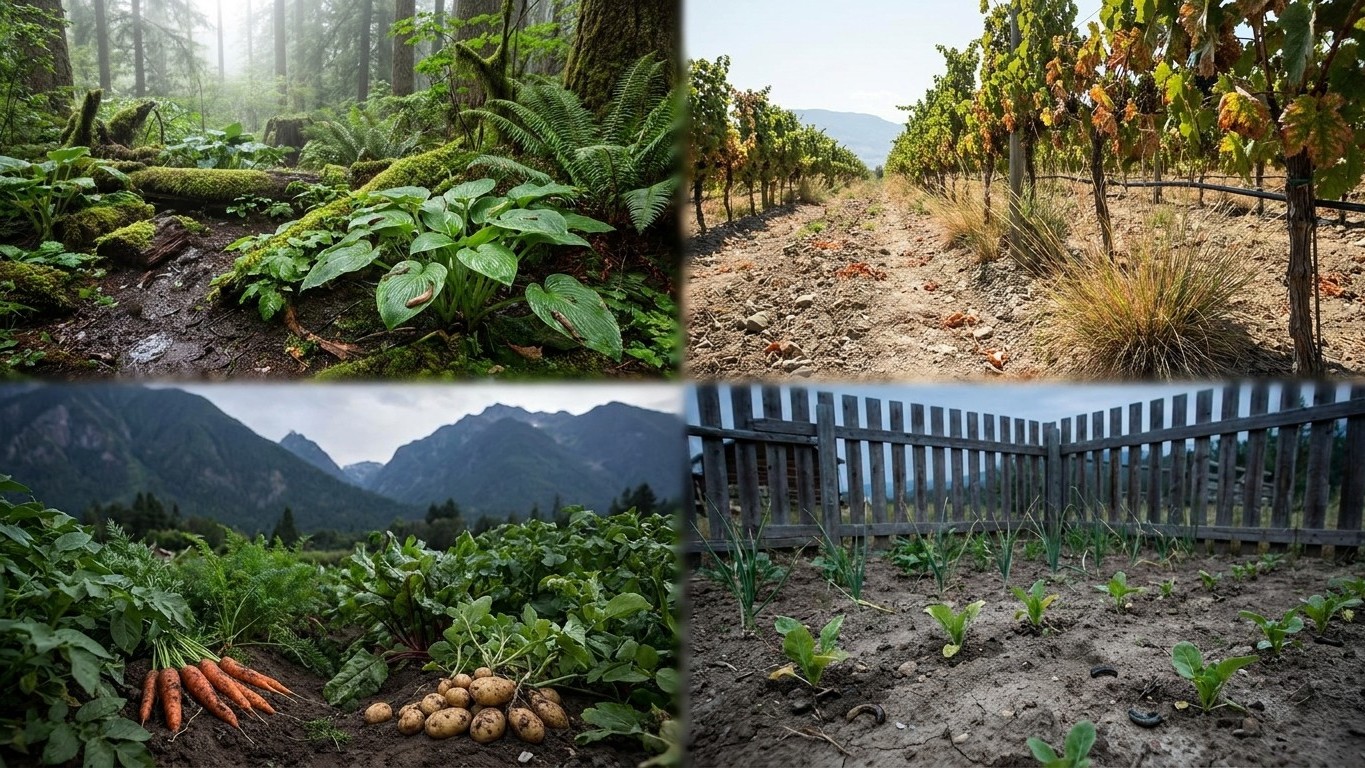

British Columbia doesn’t have one pest problem. It has at least four, depending on whether you’re gardening in a rainy Vancouver backyard, a dry Okanagan vineyard, a Cariboo homestead, or a Kootenay mountain valley. The province stretches from temperate rainforest to near-desert to subarctic plateau, and that geographic split means a gardener in Kelowna and a gardener in Nanaimo are fighting almost entirely different battles, often at different times of year.
Why Location Matters More in BC Than Almost Anywhere Else

Most states and provinces have some climate variation. BC has an extreme version of it. Coastal areas around Vancouver, Victoria, and the Sunshine Coast sit in a mild, wet zone where winter temperatures rarely drop below freezing for long stretches. Slugs, aphids, and soil-dwelling larvae simply don’t die off the way they would in a harsher climate. Move three hours east into the Okanagan Valley, and you’re in a semi-arid pocket with hot, dry summers, more like parts of eastern Washington than anything on the coast. Spider mites in British Columbia and Wireworms in British Columbia both thrive there instead. Push further north into the Cariboo or Peace River regions, and short growing seasons compress pest activity into a tight window, but Cutworms in British Columbia still show up right on schedule, along with root maggots and the Colorado potato beetle in British Columbia.
This isn’t a minor detail. A pest calendar built for Vancouver will be wrong for Kelowna by weeks, and a slug-control plan that works on Vancouver Island does almost nothing for a gardener dealing with Grasshoppers in British Columbia near Kamloops, just as a coastal approach to root maggots does little to help against Cabbage maggot in British Columbia when it turns up in a Cariboo brassica bed, against Onion maggot in British Columbia in a nearby allium row, against Carrot rust fly in British Columbia, or against the Pea leaf weevil British Columbia gardeners run into once pea crops go in, or against the Western spotted cucumber beetle British Columbia when it shows up in an Okanagan cucurbit patch, or against the Squash bug British Columbia gardeners find working through an Okanagan cucurbit patch when it shows up in a carrot patch just down the road.
Coastal and Lower Mainland Pests
Rain is the defining feature here, and it shapes everything. Slugs in British Columbia, both the native banana slug and the introduced European brown slug, are the top complaint from gardeners in Vancouver, Burnaby, and Victoria. Wet soil that never fully dries out lets them stay active nearly year-round, feeding on seedlings, hostas, and lettuce overnight. Coastal gardeners also deal heavily with leatherjackets, the larvae of European crane flies, which chew through grass and vegetable roots in lawns and raised beds through the wet fall and winter months. A patch of lawn that turns brown and pulls up like carpet in late winter is a classic leatherjacket sign.
Aphids in British Columbia are a constant on the coast too, favored by mild winters that let populations overwinter as eggs on rose canes and fruit tree bark instead of dying back completely. In recent years, Brown marmorated stink bug populations have also become a growing concern for Lower Mainland gardeners, showing up on fruit trees and vegetable crops through late summer. Early in the season, coastal vegetable growers also battle Flea beetles in British Columbia, which riddle young brassica and tomato seedlings with tiny shot-holes before the soil has fully warmed, and later in the season, Imported cabbageworm in British Columbia shows up on cabbage, broccoli, and other brassicas, while tomato plants later in summer often fall prey to Tomato hornworm in British Columbia. Soft fruit growers around the Fraser Valley also contend with spotted wing drosophila, a fruit fly that arrived in BC around 2009 and now targets ripening raspberries, blueberries, and cherries before harvest, laying eggs in fruit that’s still on the plant rather than waiting for it to rot.
Okanagan and Southern Interior Pests
Drive east and the pest lineup changes almost entirely. Summer heat in the Okanagan, often pushing past 90°F for stretches in July and August, favors spider mites, which multiply fast in hot, dry conditions and show up as fine speckling and webbing on tomatoes, beans, and ornamental shrubs. Wireworms, the larvae of click beetles, are a persistent problem in interior soils, particularly on land that was once pasture or grassland before being converted to garden beds. They tunnel into potatoes, carrots, and root vegetables and can persist in soil for several years before maturing.
Codling moth is the signature orchard pest of the valley, targeting apple and pear crops with larvae that bore straight into the fruit core. Commercial Okanagan orchards manage it with pheromone-based mating disruption, but backyard fruit trees without any control program often lose a large share of their crop to wormy apples. Grasshoppers also become a seasonal nuisance in drier grassland-adjacent gardens around Kamloops, Vernon, and the Similkameen, especially in years following a mild winter that let more egg pods survive.
Interior Plateau and Northern BC Pests
Further north and at higher elevation, in places like Prince George, Quesnel, and the Peace River block, the growing season is short and pest pressure concentrates into a compressed window. Cutworms are a common early-season problem, clipping young seedlings off at soil level overnight just as gardeners are getting transplants in the ground in late May and June. Root maggots target brassicas (cabbage, broccoli, radishes) throughout the region, laying eggs at the base of stems where larvae then tunnel into roots.
Deer pressure is heavier here and in many rural parts of the province generally than in dense urban cores, simply because gardens back directly onto forest and rangeland. Browsing damage on vegetable starts, young fruit trees, and ornamentals is one of the most frequently reported issues from rural BC gardeners, and it tends to intensify in late summer and fall as natural forage in the bush thins out.
The Newcomer Threat: Japanese Beetle
Not every BC pest problem is a long-standing one. Japanese beetle, a shiny copper-and-green beetle that skeletonizes leaves on hundreds of plant species, was first detected in East Vancouver in 2017. Since then, the Canadian Food Inspection Agency and the BC Ministry of Agriculture and Food have maintained regulated areas around confirmed detection zones, restricting the movement of soil, plants, and compost out of those neighborhoods to slow the beetle’s spread to the rest of the province and beyond.
For gardeners inside or near a regulated zone, this means checking current CFIA maps before moving potted plants, garden soil, or yard waste, even to a friend’s place across town. For everyone else in BC, it’s a reminder that the pest list isn’t fixed. New arrivals show up through nursery stock, shipping containers, and even backyard compost trades, and a beetle that didn’t exist here a decade ago can become a province-wide concern within a few growing seasons.
Seasonal Pest Calendar for BC Gardens
Timing shifts by region, but a rough province-wide pattern holds. Late winter into early spring, roughly February through April, is when overwintering aphid eggs hatch and coastal slug activity ramps back up as soil temperatures climb above roughly 42°F. Spring, from April through June, brings cutworm damage to fresh transplants nearly everywhere, plus the first cabbage white butterflies laying eggs on brassicas.
Summer, June through August, is peak season for the region-specific problems: spider mites in the hot interior, spotted wing drosophila on ripening soft fruit across the Fraser Valley and Okanagan, Japanese beetle adults flying and feeding in their regulated Vancouver zones, and grasshoppers building numbers in drier grassland gardens. Fall, September through November, shifts the focus to root maggots on brassica crops, crane flies laying the eggs that become next winter’s leatherjackets, and deer browsing pressure climbing as wild forage declines. Winter itself rarely gives coastal gardeners a full break, since mild temperatures let slugs, aphid eggs, and some soil larvae stay active or dormant just below the surface, ready to resume the moment conditions warm slightly.
Control Strategies That Actually Work in BC’s Climate
Blanket advice fails in a province this varied, but a few approaches hold up across regions. Matching control timing to your specific zone rather than a generic calendar makes the biggest difference. A coastal gardener treating for slugs needs a different rhythm than an Okanagan gardener watching for spider mites in July heat.
Encouraging natural predators pays off almost everywhere in BC. Ground beetles and birds reduce slug and caterpillar populations on the coast, while lacewings and ladybugs help keep aphid numbers down in both wetter and drier zones. Beneficial nematodes applied to soil in spring or fall can reduce leatherjacket and wireworm populations without broad-spectrum chemicals, and they work particularly well in the moist coastal soils where those pests concentrate.
For newer arrivals like Japanese beetle, prevention matters more than treatment. Buying nursery stock from reputable growers, avoiding the movement of soil or plant material out of any posted regulated area, and checking plants for adult beetles during their July and August flight period all help slow the spread before it becomes a bigger provincial problem. Physical barriers still have a place too: copper tape around raised beds discourages slugs on the coast, floating row covers keep cabbage moths off brassicas in the interior, and simple fencing remains the most reliable deterrent against deer browsing in rural gardens throughout the province.
Gardeners weighing pest pressure against a neighboring region, say garden pests in Washington just across the border, will notice real overlap in coastal species like slugs and spotted wing drosophila, but far less similarity once you compare BC’s dry interior to anywhere in the Pacific Northwest lowlands. For a broader look at how pest patterns shift province to province and state to state, the garden pests by state overview breaks down the pattern across the whole region.
Three More Pests Worth Watching For
Timing is everything with these problems, and a few other BC garden pests follow their own separate clocks worth knowing about. If your pea and fava bean seedlings come up looking lace-edged within weeks of breaking ground, that damage tracks soil warming in spring rather than a set date, and the page on pea leaf weevil lays out when to expect it and what actually stops it. Once cucurbit vines have sprawled out through mid-summer, a different insect tends to move in: the squash bug page covers the mid-June through early September window when adults and their damage peak, heaviest in July and August. And if young cucurbit or bean plants start showing feeding damage as soon as the soil warms enough for overwintering adults to get moving, that’s not a calendar event either — the western spotted cucumber beetle page explains how soil temperature, not the date on the wall, drives when this one shows up in BC gardens. Between all three, you’ve got a fuller picture of what’s coming for peas, squash, and cucumbers before it arrives.