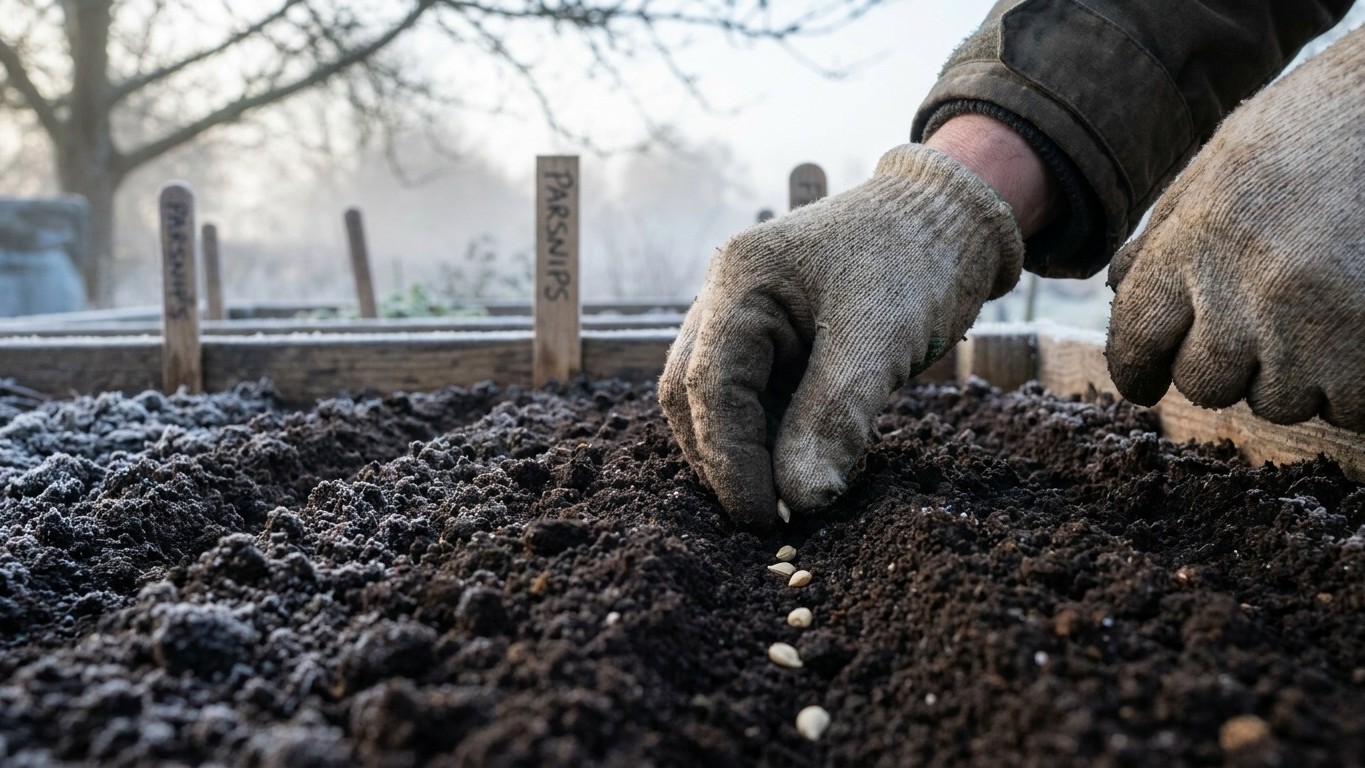

In coastal and Southern California, including Los Angeles, freezing weather essentially never happens, so parsnips can go into the ground almost any time you like outside the hottest stretch of summer. But that same frost-free calendar means the crop will grow fine without ever developing the deep sweetness parsnips are known for. In Northern California, the Central Valley, and the Sierra foothills, real winter cold shows up, and sowing timed for a fall harvest is what lets that cold do its work.
The short answer
Start with the one question that actually decides how to grow parsnips in a given part of California: does this location deliver several weeks of frosty weather each winter? For the Los Angeles reference station, the answer is no. NOAA’s 1991-2020 Climate Normals put the mean minimum temperature of the coldest month at 49.1°F. That’s not a record low or a cold snap. It’s the average low across the coldest stretch of the year, and it sits nearly 20 degrees above freezing.
That number matters more than any hardiness zone label. A hardiness zone tells you what a plant can survive over winter. It says nothing about whether a parsnip root will actually turn sweet. Sweetening is a specific chemical event: exposure to frost converts the starch stored in the root into sugar, and it takes several weeks of that cold exposure to do it fully, according to Utah State University Extension. A mild zone can still grow a perfectly healthy parsnip. It just won’t produce the sweet, nutty flavor gardeners are usually chasing.
In coastal and Southern California, where the coldest month averages a minimum of 49.1°F and NOAA’s data show effectively zero days at or below 32°F across three decades of records, that frost exposure simply doesn’t happen in an average year. The parsnip will size up, the root will fill out, and the flavor will stay closer to a mild, starchy carrot than the sweet, wine-like taste parsnips are prized for. That’s not a growing failure. It’s a mismatch between the crop’s flavor mechanism and the local climate.
Move away from that immediate coastal and Southern California zone and the picture changes fast. Northern California, the interior valleys, and Sierra elevations see genuine winter freezes, sometimes hard ones, and that’s where the frost-driven sweetening that parsnips depend on can actually occur. The state is too large and too climatically split to answer with a single date or a single number. The reference station data here describes the Los Angeles area specifically, not the state as a whole, and treating it as universal would be a mistake in either direction: assuming everyone gets the coastal mildness, or assuming everyone gets the interior’s real winter.
So the short answer, for anyone gardening in the frost-free coastal and Southern California belt, is that timing shifts from “when will frost let me sow” to “when will I get a decent root before the sugar conversion becomes impossible.” The constraint is heat and water, not cold.
Does the season fit?
Parsnips are slow. Utah State University Extension puts the full run at 100 to 120 days from seeding to harvest, and that’s after a germination period of 14 to 21 days just to get seedlings up out of the soil. Parsnips are also sown directly in place, not transplanted, so that entire clock starts the day seed goes into the ground, not the day green shows above it. Here’s how that math plays out against a frost-free coastal or Southern California calendar:
- Start with the frost window, or the lack of one. NOAA’s data for the Los Angeles reference station show no computable freeze normal at all, zero days at or below 32°F across 30 years of daily records, and a frost-free season listed as 365 days. There’s no last-frost date to count backward from and no first-frost date to count toward, because frost doesn’t reliably arrive.
- Add the germination lag. Fourteen to 21 days pass before seedlings even emerge. In a frost-free calendar, this doesn’t collide with a frost deadline, but it still eats a meaningful chunk of the growing window and needs to be planned for, especially since the soil has to stay consistently moist that whole time for germination to succeed.
- Count the full 100 to 120 days from seeding. Since sowing isn’t locked to a frost date here, gardeners have flexibility, but the trade-off is that the crop still needs three to four full months in the ground regardless of when it starts.
- Weigh the heat instead of the cold. Without a frost constraint, the real limiting factor becomes summer heat and water availability, since parsnips are a cool-season root that doesn’t perform well pushed through the hottest months.
- Accept the sweetening trade-off. Even with the season fitting comfortably time-wise, the absence of sustained frost exposure means the flavor payoff that normally arrives at the end of that 100-to-120-day window won’t fully materialize here the way it would somewhere with a real winter.
The season fits in terms of raw days available. What doesn’t fit is the frost exposure the crop uses to finish itself off. That’s a flavor limitation, not a scheduling one, and it’s worth planning around rather than fighting.
What goes wrong here
- Forked, split roots from heavy or stony ground. Parsnips push a single taproot straight down, and anything that deflects it, compacted clay, rocks, old root chunks, causes the root to split into two or three forks. Utah State University Extension recommends deep, sandy soil, and where the native ground is heavy, double digging to loosen and de-rock the bed a foot or more down before sowing.
- Forked roots from overwatering. This is a separate cause from soil texture, and it’s easy to confuse with the first. Excess water, especially inconsistent heavy watering after dry spells, can cause the same kind of root splitting even in reasonably loose soil. The fix is steady, moderate moisture rather than a flood-and-dry-out cycle, particularly once the root starts sizing up.
- A season that runs out before the root finishes. Because the full cycle takes 100 to 120 days plus 14 to 21 days just to germinate, sowing too late relative to the coming heat leaves the root undersized at harvest. In a frost-free area, the practical deadline is beating the hot, dry stretch of the year, not beating a freeze.
- A winter too mild to sweeten the crop. This is the flavor problem specific to coastal and Southern California. With the coldest month averaging a minimum of 49.1°F and essentially no days at or below 32°F, the frost exposure that converts starch to sugar doesn’t occur reliably. The root can still be harvested and eaten. It just won’t reach the deep sweetness the crop is known for elsewhere, and there’s no remedy for that within a frost-free garden other than adjusting expectations for flavor.
Common questions
Can parsnips be grown at all in coastal or Southern California?
Yes. The plant grows well in the region’s mild conditions. The limitation isn’t survival, it’s flavor: without sustained frost exposure, the root won’t develop the sweetness parsnips are typically grown for.
Does the mild winter mean parsnips can be sown any time of year?
Frost isn’t the scheduling constraint here, heat is. Since the crop needs 100 to 120 days from seeding plus 14 to 21 days to germinate, sowing needs to avoid pushing that long window through the hottest, driest part of the year.
Is Northern California or the Sierra different from the Los Angeles data given here?
Yes, substantially. The 49.1°F coldest-month minimum and the zero-freeze-day record are specific to the Los Angeles reference station. Northern California, the Central Valley, and Sierra elevations experience real winter freezes, which changes both the sowing calendar and the crop’s ability to sweeten.
What causes forked parsnip roots, and is there one fix for it?
There are two distinct causes, not one. Heavy, compacted, or rocky soil deflects the taproot, which double digging and loosening can address. Overwatering, especially uneven watering, is a separate cause that requires steady, moderate moisture instead of a soil fix.