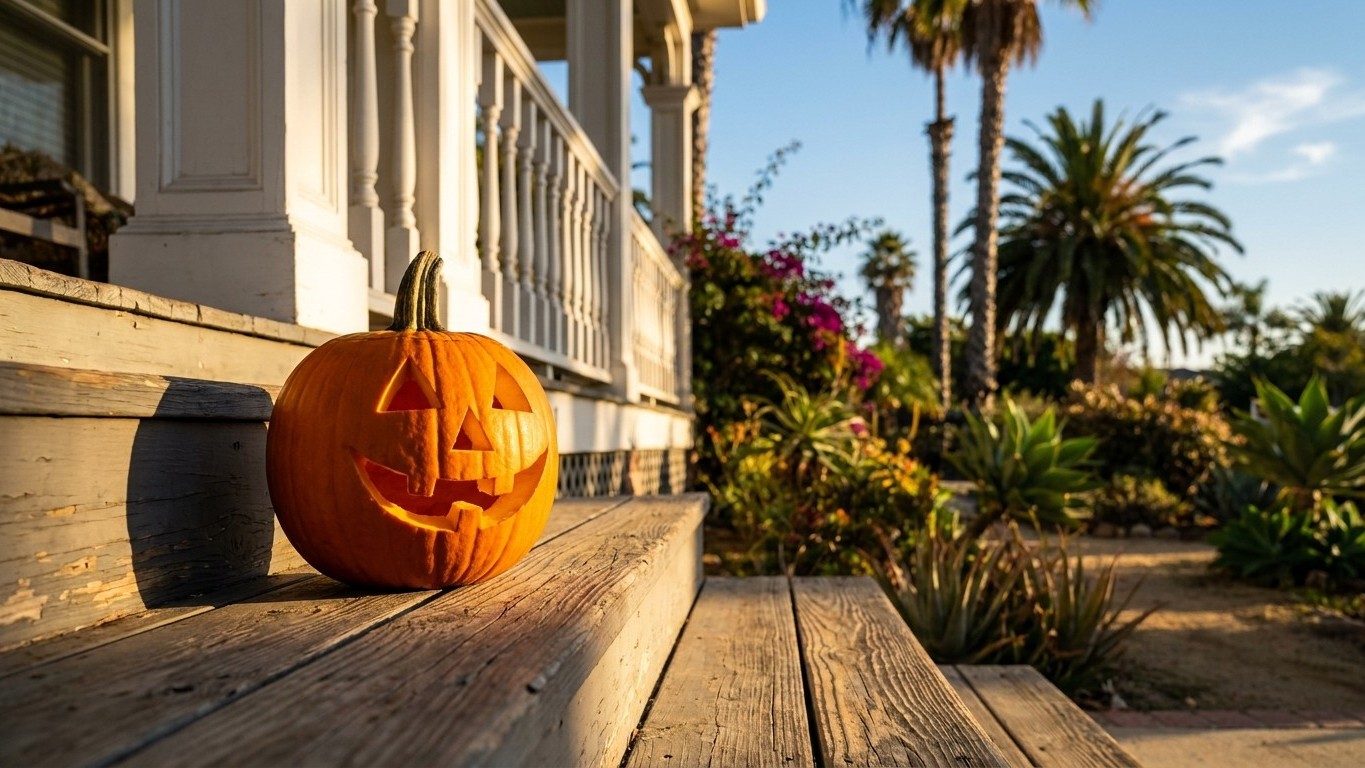

Most of California never needs to think about frost at all: in and around Los Angeles, and across the coastal and southern part of the state, an average year passes with zero days at or below 32°F. That single fact changes everything about pumpkin timing here, but it does not apply everywhere in this state, and knowing the difference is what actually decides when you carve.
The short answer

For coastal and Southern California, the numbers are almost startling if you’re used to a real autumn: no freeze occurs in an average year, and the frost-free season is listed at the full 365 days. There’s no “mean first fall frost” to count backward from, because there’s effectively no frost event to count from at all. A pumpkin sitting on a porch in Long Beach, Santa Barbara, or San Diego through October 31 isn’t racing a freeze. It’s racing something else entirely: heat.
That’s the part worth saying plainly, because it flips the usual advice on its head. In most of the country, the question is “how many days before Halloween does frost show up, and do I need to carve before then to protect the display?” Here, the question is closer to “how many days can a whole pumpkin sit in weather that’s often too warm before it starts to soften?” A whole, uncarved pumpkin keeps for three to six months in a cool, dark spot between 45 and 50°F. Southern California’s late October days routinely push well past that upper number, especially in the afternoon sun, even when the mornings feel mild.
So the practical window isn’t measured in “days before frost.” It’s measured in how long you can keep the pumpkin in the coolest, darkest spot available and still have a firm, unblemished shell on October 31. For most coastal and southern households, that means treating the last week before Halloween as the real carving zone, not because cold is coming, but because heat has already been working against the pumpkin since the day it left the patch.
Here’s the catch that matters for the rest of the state: this frost-free picture describes Los Angeles and similar coastal, southern climates. It does not describe Northern California, the Central Valley, or the Sierra foothills, where real fall freezes do happen, sometimes with real bite well before Halloween. If you’re gardening or displaying in Redding, Fresno, Sacramento, or up in the foothills, don’t borrow the “no frost” assumption from the coast. Your own county extension office (more on that below) will have the actual local pattern, and it’s worth checking rather than guessing.
Frost or heat: which one gets it here
The cold end
Los Angeles’ coldest month has a mean daily minimum of 49.1°F. That’s not a record low, and it’s not a monthly average, it’s the typical overnight low during the chilliest stretch of the year. Notice how close that number sits to the 45-50°F range recommended for storing a whole pumpkin. In practical terms, even the coldest nights in a coastal Southern California winter barely dip below the temperature you’d want anyway for keeping a pumpkin fresh. Freezing simply isn’t part of the equation here. There’s no need to worry about a pumpkin splitting or turning to mush from a hard freeze on the porch, because that kind of cold doesn’t show up.
The warm end
The real pressure runs the other direction. Late October in coastal and Southern California often produces daytime highs that sail past 50°F by a wide margin, sometimes into the 70s or 80s depending on the year and whether a late-season heat spell rolls through. That’s well outside the ideal storage band, and it’s the actual threat to a pumpkin sitting out for weeks. Heat accelerates softening, invites mold, and shortens the window between “picked at the patch” and “starting to sag.” So for this climate, the operating rule is heat, not frost. Anyone applying general “watch for the first freeze” advice to a Los Angeles-area pumpkin is worrying about the wrong thing entirely; the risk here comes from too much warmth, not too little.
Where to keep it until you carve
- Find the coolest shaded spot you have, whether that’s a north-facing porch, a covered patio out of direct afternoon sun, or a shaded side yard. Direct sun on a whole pumpkin in a Southern California fall can push its surface temperature well above that 45-50°F target within a few hours.
- Skip the garage if it bakes in the afternoon, which is common in inland and Central Valley homes where an attached garage can trap heat far above outdoor temperatures. A shaded exterior spot often beats an unshaded interior one here.
- Use an interior closet, laundry room, or hallway if your home lacks a basement, which is typical in much of California. These interior spots, away from windows, tend to stay closer to the cool, stable range a whole pumpkin needs.
- Keep it away from ripening fruit and vegetables, including apples, potatoes, and tomatoes. Ripening produce gives off a gas that speeds up the pumpkin’s aging, which is exactly why the fruit bowl on the kitchen counter is one of the worst places to park it.
- Check on it as Halloween nears, and if a warm spell is forecast, move it to whatever spot in the house stays coolest overnight rather than leaving it exposed on the porch all day.
Checking this against your own county
California’s climate isn’t one thing. A pumpkin sitting out in coastal San Diego is living a completely different fall than one on a porch in Redding or up in the Sierra foothills, where actual freezes do happen and can arrive well ahead of Halloween. Rather than guessing which pattern applies to your address, check with your local University of California Cooperative Extension office through UC ANR. County-level extension staff can tell you what’s typical for your specific area, whether that’s confirmation that frost simply doesn’t factor in where you live, or a heads-up that your region does see meaningful cold by late October.
Common questions
Does frost ever actually reach Los Angeles or San Diego? In an average year, no. The recorded data shows zero days at or below 32°F, with the frost-free season effectively covering the entire year. It’s not impossible in an unusual year, but it’s not something to plan around.
How long does a carved pumpkin last once you’ve cut into it? This isn’t published by university extension research, and no legitimate source offers a specific number of days or a preservation protocol for a carved pumpkin. What is established: choose a firm, unblemished pumpkin with 1 to 2 inches of stem intact, keep it whole for as long as possible, and carve it close to the day you plan to display it.
Why does the stem matter so much? The stem isn’t a handle, and a pumpkin should never be carried or lifted by it. It acts as a seal. Once it breaks off, that section of the pumpkin is exposed, which raises the chance of premature spoiling.
Is the timing different in the Central Valley or Sierra foothills than in Los Angeles? Yes, potentially quite different. Those areas can see real fall freezes, unlike the frost-free coastal and southern climate described here. Anyone in those regions should confirm local frost patterns with their county extension office rather than assuming the coastal timeline applies.