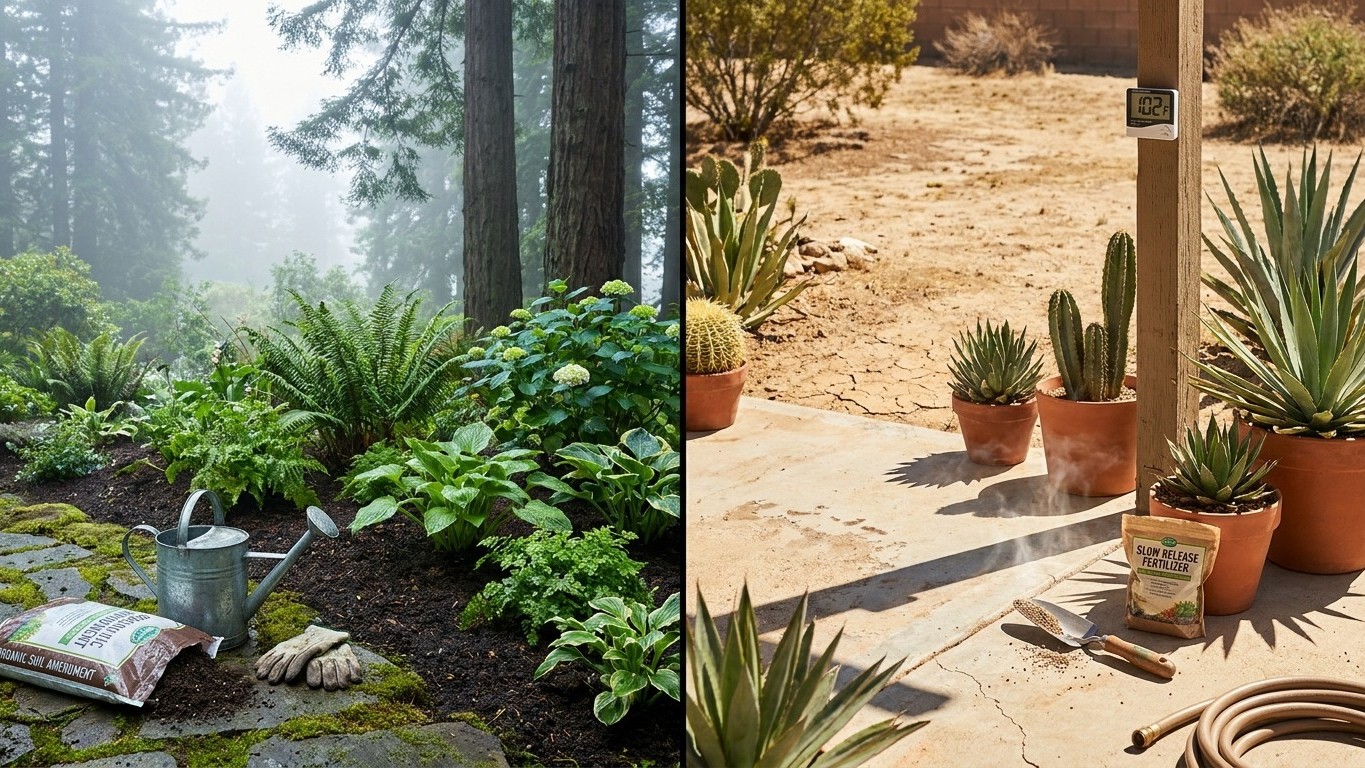

Late August in California means something different depending on whether you’re standing in a Eureka backyard fog bank or a Palm Springs patio hitting 110°F by 10 a.m. The short answer: this is not planting season for most of the state’s warm regions, it’s survival and prep season, and the real garden action starts once nighttime temperatures drop in September and October. What you do right now with water, soil, and timing sets up everything that grows through winter and spring.
California’s Climate Isn’t One Climate

The USDA Plant Hardiness Zone Map puts California anywhere from zone 4b in the high Sierra to zone 11a along parts of the Colorado Desert near the Salton Sea, according to the USDA Agricultural Research Service. That’s a wider range than most entire regions of the country pack into a single state. A gardener in Truckee is dealing with frost risk into June some years. A gardener in El Centro is dealing with soil temperatures that can cook plant roots by midsummer.
Local nurseries and extension offices in California often lean on the Sunset Western Garden Book zone system instead of, or alongside, the USDA map, because it accounts for coastal fog, marine influence, and elevation in a way the USDA system doesn’t capture as finely. A garden six miles from the Pacific can run fifteen degrees cooler in July than one just over the first ridge inland. That’s the practical reality: two addresses in the same county can need completely different watering schedules and plant lists.
Four broad zones capture most of what home gardeners deal with, though warmer inland valleys shift the picture entirely, with summer heat there making conditions like those in Growing Sweet Corn in California far more favorable than along the coast:
- Coastal strip (San Diego to Eureka): mild, fog-buffered, narrow temperature swings that make this region especially well-suited to cool-season root crops, with conditions outlined in Growing Carrots in California holding steady nearly year-round, similar conditions covered in Growing Parsnips in California that also favor this coastal band, the same mild swings that make Growing Beets in California a reliable option nearly year-round, conditions gentle enough that Growing Spinach in California can thrive across most of the calendar, and the steady coastal temperatures that make Growing Asparagus in California a dependable perennial crop for backyard beds
- Central Valley and inland basins (Sacramento, Fresno, Bakersfield): hot dry summers, cold foggy winters, with intense summer heat that makes conditions outlined in Growing Pumpkins in California especially relevant for gardeners planning their warm-season crops in this region, and knowing When to Carve a Pumpkin in California helps time the harvest right for fall decorating
- High desert and mountain (Sierra foothills, Tehachapi, Big Bear): real frost, shorter growing windows, conditions where cool-season staples covered in Growing Potatoes in California tend to do especially well when timed around the frost dates
- Low desert (Coachella Valley, Imperial Valley): brutal summer heat, mild winters that function like other regions’ summers, conditions that heat-loving crops like Growing Peppers in California can actually thrive in when timed right
Knowing which of these you’re in matters more than any generic planting calendar. A frost date that applies in Redding is meaningless in Indio.
What Late Summer Actually Allows
Right now, across most of the state, the honest answer is: not much new planting, and a lot of maintenance. Soil temperatures in the Central Valley regularly sit above 85°F at planting depth through late August, which stresses new transplants before they even get established. Coastal gardens have more room to maneuver because fog keeps daytime highs in check, but even there, August is more about keeping existing plants alive than starting new ones.
Water Rules Aren’t Optional Anymore
California’s drought years have left a lasting mark on how gardens get watered. Many water districts maintain permanent outdoor watering restrictions that don’t disappear when reservoirs fill back up. The California Department of Water Resources tracks conservation regulations that vary by district, and it’s common for cities to limit irrigation to two or three specific days per week, often before sunrise or after sunset, year-round. Checking your local water agency’s current schedule takes five minutes and can save you a fine.
Drip irrigation and soaker hoses do more work per gallon than sprinklers, especially in inland heat where overhead watering loses a meaningful percentage to evaporation before it hits the soil. Mulch, three to four inches of it around perennials and vegetable beds, is doing quiet but serious work right now by holding soil moisture and keeping root zones from overheating.
Fire Season Changes What Belongs Near the House
Defensible space isn’t a suggestion in most of California, it’s often required by state law and local fire codes. CAL FIRE’s guidance calls for a “lean, clean, and green” zone within five feet of structures, meaning no bark mulch, no dry vegetation, and no flammable landscaping touching the house itself. This is the season to walk the property and pull dead grass, trim back anything crispy, and rethink what’s planted directly against fences or siding. It’s not glamorous garden work, but in wildfire-prone counties it matters more than what you plant next.
Fall Is California’s Real Planting Season
Here’s the part that surprises transplants from colder states: in most of California, fall isn’t the wind-down, it’s the start line. Cooling soil temperatures combined with the arrival of winter rain (the state’s Mediterranean climate delivers most of its precipitation between November and March) make September through November the best window for establishing trees, shrubs, and cool-season vegetables.
Roots grow fastest when air temperatures are dropping but soil is still warm, which is exactly the window that opens once late September arrives inland and early October arrives on the coast. A tree planted in October has a full winter of rain to settle in before it faces its first California summer, which is a far better setup than a spring-planted tree facing 100°F heat within months of going into the ground.
For vegetable gardens, this means broccoli, kale, lettuce, spinach, and peas go in the ground once nights start cooling, typically late September in the Valley and into October along the coast where the shift is more gradual. Garlic and onion sets, which need a cold snap to bulb properly, go in from October through December depending on region. None of this happens in August, but August is when the beds get cleared, amended with compost, and prepped so there’s no scramble once temperatures break.
Regional Notes Worth Knowing
Coastal Fog Belt
Gardens from Santa Barbara up through Mendocino deal with a different problem than heat: not enough sun for certain crops. Tomatoes and peppers can struggle in deep fog zones even in July and August because they need consistent warmth to set fruit. Cool-season crops, on the other hand, often grow nearly year-round here. Slugs and snails thrive in the moisture, so this is also prime time to check under mulch and containers for damage before it spreads.
Central Valley and Inland Empire
This is the toughest zone for late-summer gardening. Afternoon highs regularly clear 100°F, and clay-heavy soils common in areas like Sacramento and Fresno hold heat and compact hard when dry. Morning watering, heavy mulch, and shade cloth over vegetable beds are standard practice here through September. Waiting for the first real cool snap before adding anything new isn’t caution, it’s just how the calendar works in this part of the state.
High Desert and Sierra Foothills
Places like the Antelope Valley, Tehachapi, or the foothill towns above Sacramento face a different clock: shorter growing seasons and real frost risk starting as early as October in higher elevations. Gardeners here are already thinking about season extension, cold frames, row covers, and getting root vegetables like carrots and beets in early enough to mature before the first hard freeze.
Low Desert (Coachella Valley, Imperial Valley)
Summer here functions like winter does elsewhere, meaning almost nothing grows in August except heat-adapted natives and a handful of desert-tolerant ornamentals. The real growing season runs October through April, and local gardeners essentially operate on an inverted calendar compared to the rest of the state. Planting in August in this region usually just means a dead plant by September.
Native Plants Do More With Less
California’s water constraints have pushed a lot of home gardeners toward native and California-friendly plants, and late summer is a good time to see why. Species like California poppy, manzanita, ceanothus, and various sages are built for exactly this dry stretch, often going semi-dormant rather than struggling. They need far less supplemental water than lawns or non-native ornamentals, which matters both for water bills and for districts with active conservation rules. Fall, once temperatures cool, is also the best time to install natives, since it gives root systems the same head start as vegetables and trees benefit from ahead of winter rain.
None of this means the garden goes quiet right now. It means the work shifts from planting to protecting, from expansion to maintenance, and from guesswork to paying attention to the specific microclimate sitting outside the back door. California doesn’t run on one gardening calendar. It runs on several, depending on fog, elevation, and how far inland the heat has room to build.
Where to check before you plant
Everything above assumes a particular valley or coastal strip, and California rarely cooperates with a single assumption. A garden in Eureka is working with fog and mild summers; a garden in Bakersfield is working with heat that arrives earlier and holds on longer. Elevation changes things again, and so does simple distance from the coast. Treat the guidance here as a starting point, not a fixed schedule.
Before committing seed or transplants to the ground, check with University of California Agriculture and Natural Resources ucanr.edu. It’s the state’s land-grant research and outreach network, and it maintains region-specific advice on soil, pest pressure, and planting windows that reflect actual local conditions rather than a statewide average.
Better still, find your county’s UC Cooperative Extension office. These are staffed by people who track frost patterns, water restrictions, and pest cycles specific to that county, sometimes down to particular valleys or microclimates. Their published calendars and bulletins will be closer to what’s happening outside your door than anything written for the state as a whole. A few minutes spent checking saves a season’s worth of guesswork.
Where to Go Next, Crop by Crop
All of this — the mild winters, the missing chill, the frost that never quite arrives — plays out differently depending on what you’re trying to grow. If you’ve ever wondered why a bulb from the store never splits into cloves the way it’s supposed to, planting garlic in California walks through the cold hours it actually needs and the dates that work around the state. If your yard looks thin no matter how much you water it, California lawn care lays out why a cool-season lawn struggles without real winter cold, and what to feed instead. And if tomatoes are the thing you’re chasing, growing tomatoes in California breaks down how the planting calendar shifts depending on whether you’re gardening somewhere with a true frost-free season or somewhere that still gets a cold snap. Same climate, three very different sets of rules — worth reading before you put anything in the ground.