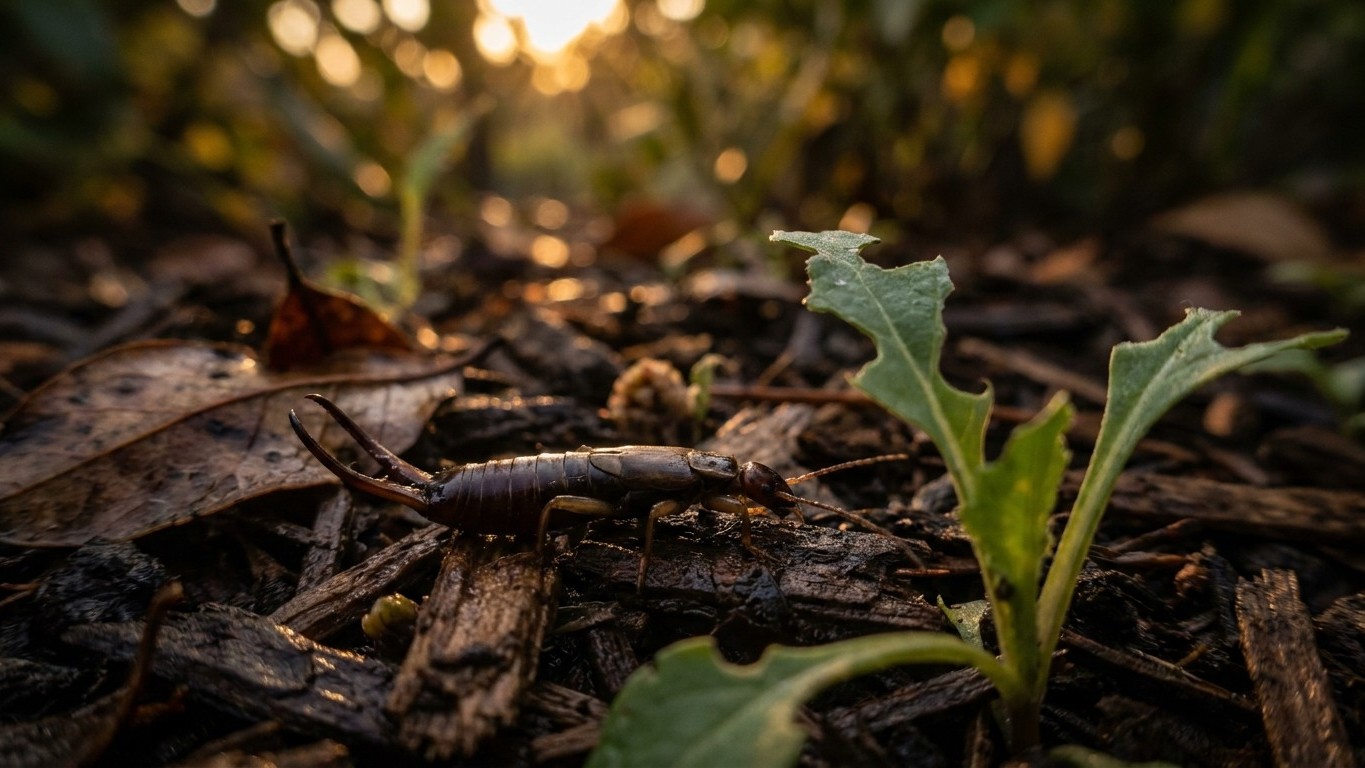

Earwigs turn up across California from early spring through fall, hiding in damp mulch and crevices by day and chewing on tender leaves, flowers and soft fruit at night. Coastal and southern gardens see them almost year-round; inland and mountain gardens see a sharper spring-to-fall curve tied to soil warmth and moisture rather than a fixed date.
When Earwigs turns up in California

UC Agriculture and Natural Resources, which runs the state’s Master Gardener and IPM programs, does not publish a specific seasonal window for earwigs the way it does for some other garden pests it tracks closely, like hornworms or melon aphid. So rather than invent a peak month that isn’t on record, it’s worth naming the general pattern that governs earwig activity in most California gardens, which follows moisture and temperature more than a printed calendar.
Earwigs are nocturnal and photophobic. During daylight they pack into cracks, mulch, rolled leaves, boards on the ground, and any spot that stays cool and damp. Once the sun goes down, they come out to feed. Populations build through spring as overwintering adults lay eggs and nymphs hatch, and activity is usually most noticeable in late spring into early summer, when nymph numbers peak and tender new growth is everywhere in the garden.
In hot inland areas, high summer often brings a lull, since dry, baked soil and mulch offer fewer of the damp daytime hiding spots earwigs need. Irrigation and cooler nights in early fall can bring a second wave of visible activity. Coastal and fog-belt gardens work differently: UC’s guidance on other night-active, moisture-loving pests in those same conditions, like snails and slugs, notes activity can continue year-round in mild southern coastal areas. Earwigs favor the same steady dampness, which is why gardeners along the coast often report seeing them well outside the “typical” spring-to-fall window that inland gardeners experience.
Reading the calendar from your last frost
Not every California garden has a last frost to count from. NOAA’s 30-year climate data for southern and coastal stations shows zero days at or below 32°F and a frost-free season listed at 365 days, meaning there’s no computable freeze normal at all for those locations. Northern California, the Central Valley, and the Sierra foothills are a different story entirely: they do freeze, and gardeners there still plan transplants around a last-frost date the way most of the country does.
| Region | Frost pattern (NOAA normals) | What it means for earwig timing |
|---|---|---|
| Coastal and Southern CA | No computable freeze normal; frost-free season listed as 365 days | No frost date to plan around; activity tracks moisture year-round rather than a spring start |
| Central Valley, Northern CA, Sierra | Measurable freeze normal; distinct last-frost date | Nymph emergence and transplant timing both follow the traditional last-frost window |
Earwigs don’t answer to a printed date any more than the frost does. What actually moves them is soil and mulch temperature: a warm, early spring pulls overwintering adults and hatching nymphs out sooner, while a cool, wet spring can push activity back by a couple of weeks in freeze-prone regions. Where a last-frost date exists, treat it as a normal, not a guarantee, since a single warm week can shift things either direction.
Damage from earwigs often becomes visible within one to two weeks of setting transplants out, as nymphs and adults find the softest new growth first. That’s the practical window for a row cover: put it on at transplant time, before the first ragged holes appear, and plan to take it off once plants are established enough to tolerate light feeding, or before flowers need pollinator access.
What it attacks, and what the damage looks like
Most gardeners spot the damage long before they spot the insect responsible. On seedlings and soft leafy greens like lettuce, look for ragged, irregular holes chewed between leaf veins, giving foliage a lace-like or shredded look. On soft fruit such as strawberries and stone fruit close to ripening, earwigs leave shallow, uneven gouges rather than clean bites. On flowers, especially dahlias, zinnias and marigolds, petals show chewed edges and ragged notches, and corn silks can be clipped short enough to interfere with pollination.
One useful distinction from other night-feeding pests: earwig damage doesn’t come with a slime trail. Snails and slugs leave a silvery track behind; earwigs don’t, so ragged leaf damage without slime is a decent field clue that earwigs, not mollusks, are the culprit.
Which life stage causes the damage
Earwigs go through incomplete metamorphosis, meaning nymphs look like small, wingless versions of the adult from the moment they hatch, and they start feeding immediately. There’s no separate larval stage tunneling somewhere out of sight the way there is with many moth or beetle pests. Practically, that means both nymphs and adults are chewing on the same plants at the same time throughout the season, so there’s no single life stage a gardener can target to “catch it early” the way you might with an egg mass or a soil-bound grub. Control has to work against an active, mixed-age population, not a narrow developmental window.
How California sits in this pest’s range

This site currently documents earwigs in two territories. That’s a narrow footprint, and it puts California near an edge of what’s published here rather than in the middle of a widely mapped range. A narrow count like this doesn’t say anything about how severe earwig pressure is in the state; it simply means there’s less side-by-side territorial data to compare against, and California’s own guidance has to carry more of the weight.
Within the state itself, though, the pattern is closer to what a wide range would show elsewhere: the insect shows up almost everywhere gardens exist, from coastal fog belts to Central Valley row crops to Sierra foothill vegetable beds, and what changes is timing and intensity, not presence. Frost-free coastal and southern gardens face earwigs as a near year-round nuisance shaped by irrigation and fog, while freeze-affected Northern California, Central Valley and Sierra gardens see a more compressed spring-through-fall pattern bounded by cold snaps on either end. Reading California’s own conditions, rather than borrowing a number from elsewhere, is the more reliable approach here.
What actually works against it
Several measures help against earwigs, roughly in order from cheapest to most involved.
- Timing transplants: avoid moving tender seedlings into beds with thick, damp mulch right when nymph populations are building in spring, since that’s exactly the daytime hiding habitat earwigs need close to a fresh food source, so waiting a week or two, or thinning mulch near new transplants, reduces how many earwigs are already camped next to the plants you’re trying to protect.
- Row covers: these work as a straightforward physical barrier, since earwigs can’t chew what they can’t reach at night, but the mechanism only holds while the cover stays sealed at the edges and while the plant is still small enough to need it, so once flowers need pollinator access or the cover comes off, the barrier stops doing anything.
- Hand-picking and simple traps: a rolled-up section of damp newspaper, a hollow cane, or a low board left on the soil overnight gives earwigs a daytime refuge they’ll pack into, which a gardener can then shake out into soapy water each morning, and this works because earwigs are photophobic, not because the trap kills anything on its own.
- Clearing debris, boards, and dense mulch: this reduces the daytime hiding spots that let local populations build up in the first place, and it’s most useful as ongoing garden hygiene rather than a one-time fix, since any leftover damp crevice gets reoccupied quickly, while crop rotation has limited value here compared with soil-bound pests, since earwigs are mobile at night and will travel to a new bed rather than stay put with a single host plant.
One point in a gardener’s favor: earwigs are surface feeders, not stem or root borers. Unlike pests that become untouchable once they’ve tunneled inside a stem, earwigs stay exposed at night, which means traps, hand-picking and covers keep working throughout the season rather than losing their usefulness once damage first appears.
Common questions
Are earwigs dangerous to people or pets? No. The pincers look alarming but earwigs aren’t venomous and rarely pinch hard enough to break skin. The real cost in a California garden is to plants, not to people.
Do earwigs do anything useful in the garden? Some. They’re omnivorous and will eat aphids, insect eggs, and other small pests along with plant tissue, so a small population isn’t purely bad news, especially away from prized seedlings and soft fruit.
Why do earwigs seem worse right after watering or rain? Moisture is what draws them out and keeps their daytime hiding spots livable. In dry-summer regions of California, irrigation often becomes the main moisture source driving that pattern, which is why beds on a regular watering schedule tend to show more earwig activity than drier, unwatered areas nearby.