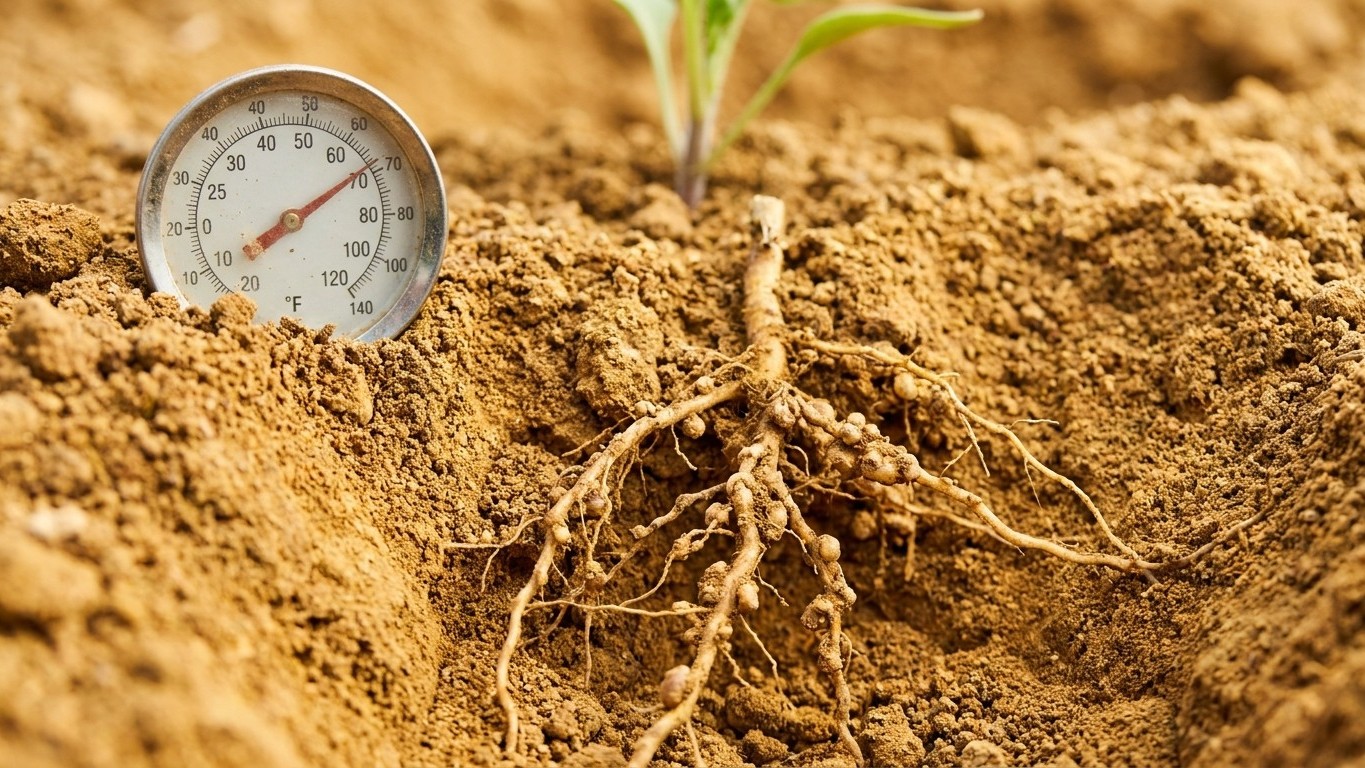

Root-knot nematodes turn up in California soil the moment temperatures climb past roughly 64°F, which in most of the state means late spring through early fall, with peak damage hitting during the hottest stretch of summer when soil temps sit between 80°F and 85°F. They slow down in winter but rarely disappear completely, especially in the Central Valley and other regions where soil never gets cold enough to kill off the population. Stopping them means combining resistant plant varieties, crop rotation, soil solarization, and strict sanitation, since no single tactic wipes out an established infestation on its own.
Why California’s Soil and Climate Are Ideal for Root-Knot Nematodes

Four species dominate California fields and gardens: Meloidogyne incognita, M. javanica, M. arenaria, and M. hapla. The first three thrive in the warm, sandy-to-loamy soils common across the San Joaquin and Sacramento Valleys. M. hapla prefers cooler ground, which is why it shows up more often in coastal counties and higher-elevation gardens where summer nights stay mild.
Sandy soil is the real accelerant here. Nematodes move through soil pores to find roots, and loose, well-drained sandy loam lets them travel far more easily than dense clay. That’s part of the reason nematode pressure tends to run higher in the western San Joaquin Valley and parts of the Sacramento Valley, where decades of tomato, carrot, and melon production have built up soil populations in fields with light texture. Clay-heavy soils in the Delta region generally see less severe infestations, though they’re far from immune.
Host range matters just as much as soil type. These nematodes feed on more than 2,000 plant species, including tomatoes, potatoes, carrots, peppers, melons, grapes, stone fruits, roses, and most turfgrasses. A backyard vegetable bed that’s hosted tomatoes for several summers running is prime territory, even if the gardener has never seen a symptom above ground.
When Root-Knot Nematodes Show Up: A Seasonal Pattern
Eggs overwinter in soil and in root tissue left behind after harvest. They sit mostly dormant once soil temperatures drop below the mid-60s, which in inland California usually happens sometime in November and lasts through February or March. As spring soil warms, juveniles hatch and start searching for new roots within days.
Once a juvenile penetrates a root, it triggers the plant to form the swollen galls that give the pest its name. That process takes roughly three to four weeks under warm conditions, meaning damage from an April infection often isn’t visible until May. From there, each female can produce 500 or more eggs in a single egg mass, and in the Central Valley’s long warm season, three to five generations can cycle through in a single year.
Desert growing regions, like the Imperial and Coachella Valleys, see an even faster cycle because soil warms earlier and stays hot longer. Coastal counties from Santa Cruz to San Diego run a slower, more compressed season, with nematode activity concentrated in the summer months when fog burns off and soil temperatures finally climb enough to support reproduction.
Signs to Watch For Above and Below Ground
Above-ground symptoms are frustratingly nonspecific: stunted growth, yellowing leaves, wilting during the heat of the day even with adequate water, and reduced yield. Growers often mistake this for a nutrient deficiency or irregular watering, which is why the pest goes undiagnosed for a full season in many home gardens.
The confirmation comes from pulling a plant and looking at the roots. Root-knot galls are round or irregular swellings that can range from the size of a pinhead to nearly an inch across on heavily infested tomato or carrot roots. Unlike beneficial nitrogen-fixing nodules on legume roots, which can be gently rubbed off, galls are part of the root tissue itself and won’t detach.
What Stops Root-Knot Nematodes: Practical Control Strategies
No fumigant or single product eliminates an established population from California soil. Effective control relies on stacking several tactics across a full growing cycle, and timing each one to the nematode’s seasonal weak points.
Resistant Varieties and Rootstocks
Plant breeders have built resistance into many popular crops, and this is often the cheapest, lowest-effort control available. Tomato varieties labeled with a capital “N” on the seed packet (as in “VFN” designations) carry resistance genes effective against the three most common warm-climate species, though that resistance can break down in soil that regularly exceeds 82°F, since the resistance gene itself is heat-sensitive. Grape growers rely on resistant rootstocks bred specifically for nematode-heavy vineyard soils in the San Joaquin Valley, and several stone fruit rootstocks offer similar protection for orchard replants.
Crop Rotation With True Non-Hosts
Rotating to a genuine non-host crop for one to two full seasons starves the nematode population down significantly, since eggs and juveniles die off without a root to feed on. Corn, wheat, and other small grains work well as rotation crops in California fields. Certain marigold varieties, particularly French marigold cultivars bred for nematode suppression, release compounds from their roots that are actively toxic to root-knot juveniles, making them a useful cover crop between susceptible plantings rather than just a decorative border.
The catch is that rotation only works if the replacement crop is a true non-host. Many common rotation choices, including beans, peas, and most cucurbits, are actually susceptible hosts themselves, so a poorly chosen rotation can maintain nematode populations instead of reducing them.
Soil Solarization
This is one of the more California-specific tools available, because it depends on strong, consistent summer sun. Clear plastic sheeting laid over moist, tilled soil for four to six weeks during the hottest part of summer can raise soil temperatures in the top several inches high enough to kill a large share of nematode eggs and juveniles. It works best in the Central Valley and inland valleys where daytime highs regularly clear 90°F, and it’s far less effective along the fog-prone coast where summer sun is inconsistent.
Organic Matter, Biofumigation, and Soil Health
Building up organic matter with compost supports populations of nematode-trapping fungi and predatory soil organisms that naturally suppress nematode numbers over time. Some growers plant mustard or other brassica cover crops and then till them into the soil while still green, a practice called biofumigation, because decomposing brassica tissue releases compounds toxic to nematodes. It’s a slower approach than chemical fumigation but leaves the soil in far better shape for long-term production.
Sanitation and Soil Testing
Nematodes travel in contaminated soil clinging to tools, boots, tires, and the root balls of nursery transplants. Cleaning equipment between plots and buying certified nematode-free transplants prevents introducing a new population into clean ground. For anyone unsure whether a plot is infested, a soil sample sent to a diagnostic lab before planting is far more reliable than waiting for above-ground symptoms, since populations can build for a full season before wilting becomes obvious.
Commercial growers dealing with severe infestations sometimes still use chemical fumigants, but their use in California is tightly regulated under state pesticide law, and several older nematicide products have been phased out over the past two decades due to groundwater and air quality restrictions. For home gardeners, that regulatory shift means the practical toolkit really comes down to resistant varieties, rotation, solarization, and organic soil management rather than a bottle from the garden center.
Regional Differences Worth Knowing
Nematode pressure isn’t uniform across the state, and the right strategy shifts with the region. In the Central Valley, where sandy soils and long hot summers create ideal conditions, growers lean hard on rotation and resistant rootstocks because the pest is essentially a permanent resident of the soil profile. In coastal counties, cooler soil and the presence of M. hapla mean solarization is less reliable, so resistant varieties and organic matter management carry more of the load. Desert agriculture in the Imperial Valley deals with the fastest reproduction cycles in the state, which makes early-season soil testing especially valuable before a crop goes in the ground.
Home gardeners in raised beds have one advantage growers in open fields don’t: they can replace the entire soil volume if an infestation gets bad enough, something that’s economically unrealistic across acres of farmland but entirely doable in a 4-by-8-foot bed. For more detailed identification and management guidance specific to California crops, the University of California’s Integrated Pest Management Program maintains detailed pest notes at ipm.ucanr.edu.
One detail that surprises a lot of gardeners: root-knot nematode damage often looks worse in years with adequate rainfall than in drought years, simply because moist soil lets juveniles move farther to find new roots. A dry summer can actually slow the spread within a bed, even though it stresses the plants in other ways.