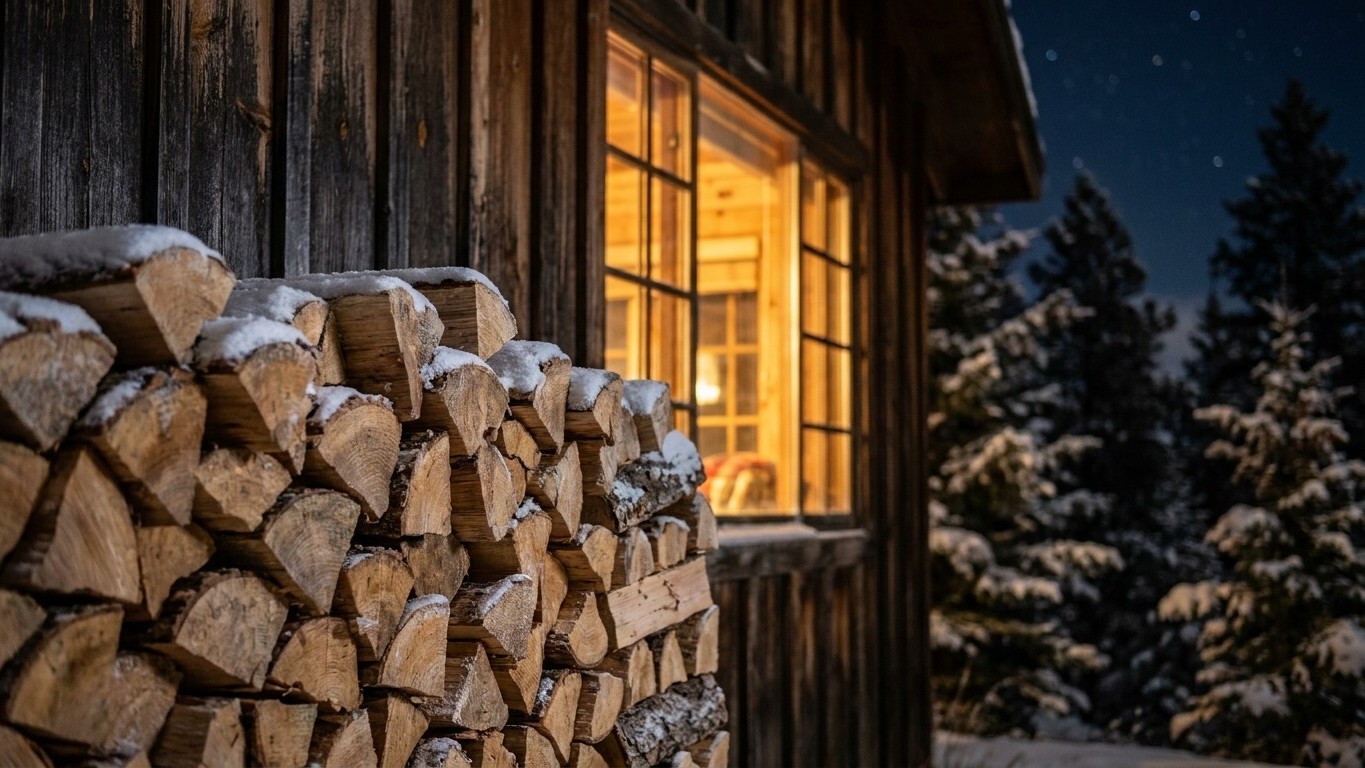

Colorado winters get cold enough that firewood stops being decor and becomes a heating plan. At the Denver reference station, the coldest month averages an overnight low of 18.4°F. That single number shapes almost every choice below: how dense your wood needs to be, how many cords you’ll burn, and how long you need to season a log before it’s actually ready to burn.
How cold it actually gets here

The 18.4°F figure comes from NOAA’s 1991-2020 Climate Normals for Denver, and it’s worth being precise about what it measures. It’s not the record low that makes the evening news once a decade. It’s not a monthly average that blends warm afternoons with cold nights into a mushy middle number. It’s the mean daily minimum for the coldest month, which means on a typical night during that stretch, the temperature is expected to sit right around 18°F before sunrise. Half the nights run colder than that.
For a homeowner burning wood, that’s the number that matters. A fire that can hold heat through a night bottoming out near 18°F is doing real work, not just adding ambiance to a living room. This is sustained cold, night after night, for weeks at a stretch during the heart of winter. Compare that to a climate where the coldest month barely dips into the 40s, and the difference in what firewood needs to accomplish is enormous. In that milder scenario, wood heat is a supplement and a mood. Here, for a lot of Colorado, it’s closer to a requirement, especially for anyone without central heat backing it up, or anyone trying to hold down a propane bill through a long stretch of single-digit nights.
It’s also worth remembering that Denver’s normal represents the Front Range at its elevation, not the whole state. Mountain communities sitting several thousand feet higher run colder overnight than the reference station, sometimes by a wide margin, and anyone heating a cabin or a mountain-town house should treat the Denver figure as a floor, not a ceiling, for how hard their winter will lean on a wood supply. The practical takeaway is simple: if you’re heating with wood anywhere in Colorado, plan for genuine cold, not just a chilly evening. That reality drives the next question, which is what kind of wood can actually carry a fire through a night like that.
Which woods are worth the effort here
A cord is a fixed volume: 4 feet by 4 feet by 8 feet, or 128 cubic feet, no matter what species fills it. That’s the detail that trips up a lot of firewood buyers, because two cords can look identical stacked in a driveway and still hold very different amounts of usable heat. The reason is density. A cord of well-seasoned hardwood carries roughly 20 million BTU, according to Michigan State University Extension research on firewood heat energy, which the university translates into something a homeowner can actually picture: about 145 gallons of #2 fuel oil, or 215 gallons of LP gas. But that 20 million BTU figure is an average across hardwood species. A denser species packs more wood fiber, and therefore more stored energy, into that same 128 cubic feet than a lighter one does.
That’s why density matters more here than it would in a mild climate. With overnight lows regularly near 18.4°F, the wood carrying you through the coldest stretch of the night needs to be the densest you can reasonably get and season properly. A dense hardwood burns slower, holds coals longer, and is far more likely to still have heat left in the firebox at 4 a.m. than a lighter wood is. Lighter, softer species have their place too, mainly for getting a fire started quickly or for shoulder-season burning in October and April, when you want heat but not an all-night furnace. They’re not built to hold a house warm through a January night at altitude on their own.
What actually shows up at a Colorado firewood dealer or on a Craigslist listing matters as much as any density chart. Beetle-killed pine has been widely available across mountain communities for years, a byproduct of the pine beetle epidemic that swept through Colorado’s forests, and it’s often the cheapest, most locally sourced wood a mountain homeowner can find. It burns hot and fast rather than long and slow, which is exactly the kind of wood better suited to starting a fire or supplementing a denser load than carrying a whole cold night by itself. The honest advice here is that a dense species you can’t actually get seasoned and delivered is worse, in practice, than a lighter species you can buy locally and season properly yourself. Availability and seasoning status beat a spec sheet every time.
How much wood a winter takes
There’s no honest single number for how many cords a Colorado winter requires, and anyone publishing one without context is guessing on your behalf. The estimate depends on three things working together: how cold your specific location actually runs, how well your house holds onto the heat you generate, and whether wood is your main heat source or something you’re layering on top of a furnace or a propane system.
Start with the cold figure. A location running near that 18.4°F overnight low for weeks demands a lot more sustained burning than a milder pocket of the state would, simply because the fire has more degrees to fight against, for longer stretches, night after night. Layer insulation on top of that. A poorly insulated house, drafty windows, thin attic insulation, no weatherstripping around doors, can lose heat fast enough to genuinely double the wood a tight, well-sealed house burns through the same winter in the same climate. That’s not a minor rounding error. It’s the difference between three cords and six.
Finally, factor in role. A household burning wood as a supplement to a working furnace, mostly for cost savings and evening ambiance, uses a fraction of what a household relying on wood as its only heat source burns through the same season. So instead of chasing a published average, work through your own three variables: how cold your location actually runs relative to that Denver benchmark, how tight your house is, and how much of your heating load wood is actually carrying. Track what you burn through one full winter, and you’ll have a number that’s actually yours, not a stranger’s guess.
Drying wood in this climate
Seasoning matters more than species, in almost every climate, and Colorado is no exception. The target is the same everywhere: 20 percent moisture or less before you burn it, because green wood can hold over 60 percent moisture, and every bit of that water has to boil off inside the firebox before the wood gives you any real heat. That boiling process eats energy you wanted for your living room, not your firewood. Split green wood typically reaches that 20 percent threshold after one full summer, but only if it’s split and stacked so air can actually move through the pile. Rounds left whole, or wood piled in a heap instead of a stack, dry far slower no matter how sunny the summer was.
Colorado’s dry climate is genuinely an advantage here. Low humidity and consistent airflow move moisture out of split wood faster than a muggy Southeastern summer would, and that’s the mechanism that actually dries wood, air and time working on exposed surface area, not direct sun beating down on the pile. A stack tucked under a simple cover to keep rain and snow off, but open on the sides for airflow, will season faster in Colorado’s air than the same stack would in a humid climate back east.
One species deserves a specific caution: red oak dries slowly because of its cell structure, according to MSU Extension, and needs meaningfully longer than a typical hardwood to reach that 20 percent target, even with good stacking. And here’s the mistake that trips up a lot of Colorado households every year: wood cut and split in spring for that same winter is usually not ready by the time the cold arrives. A summer’s worth of drying time sounds generous until you remember the coldest month is pushing lows near 18.4°F, and wood that’s still sitting at 30 or 40 percent moisture simply won’t perform when you need it most. Buy or cut a full year ahead whenever you can, and let the stack sit through an entire summer before it ever sees a firebox.