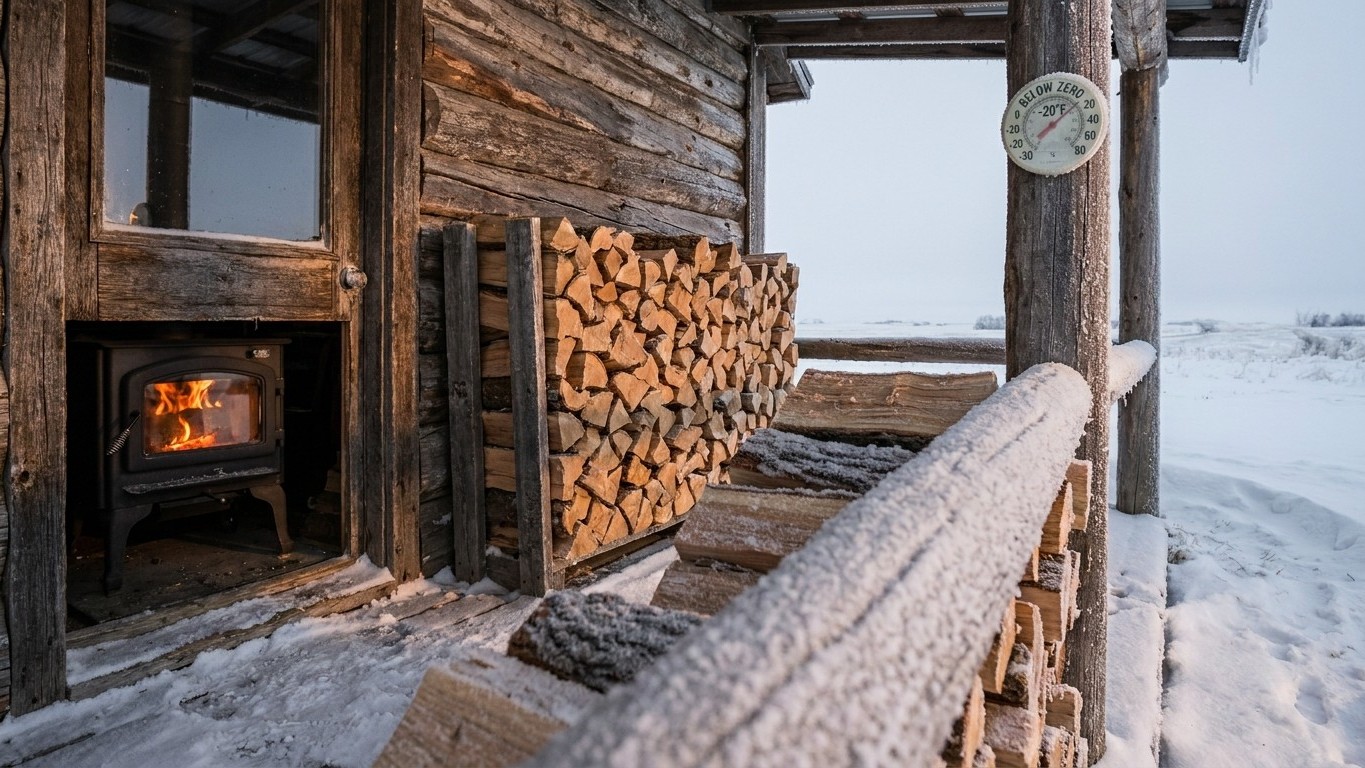

Winter in North Dakota isn’t a matter of ambiance. When the average daily low in the coldest month sits at 0.2°F, as it does in Fargo, firewood becomes a heating decision with real stakes. This guide walks through what that cold means for wood choice, quantity, and drying time.
How cold it actually gets here

The reference number for Fargo is 0.2°F. That’s the average daily minimum for the coldest month, per NOAA’s 1991-2020 Climate Normals, not a record low and not a monthly average temperature. It means that on a typical night in the depths of a North Dakota winter, the mercury sits barely above zero, not just once or twice, but as the expected baseline across the whole month.
That figure changes what firewood is for. In milder parts of the country, wood heat is a supplement, something for cool evenings or a backup during a power outage. Here, a fire that goes out at 2 a.m. in January isn’t a minor inconvenience. It’s a house losing heat fast, pipes at risk, and a homeowner who has to rebuild a fire from cold coals in a room that’s already dropped ten degrees.
What zero degrees does to a wood-heated house
Cold this deep pushes every decision toward density and dryness. A loosely packed, half-seasoned load of soft wood might keep a cabin comfortable in a place where winter lows hover in the 30s. In Fargo, that same load burns through fast, leaves the firebox needing reloading every couple of hours overnight, and forces whoever’s tending the stove to get up at 3 a.m. to keep the house from going cold.
This is also why the seasoning standard matters more here than almost anywhere else. Wet wood wastes energy boiling off moisture before it produces heat, and in a climate where every BTU is doing real work against a genuinely brutal outdoor temperature, that waste shows up as a colder house, not just a less efficient one. North Dakota firewood isn’t about mood lighting. It’s infrastructure.
None of this means the wood has to be exotic or expensive. It means the choices below, species, seasoning, and quantity, all get evaluated against a single question: does this hold up on the night it’s zero degrees outside and staying that way for a week?
Which woods are worth the effort here
A cord is a fixed volume, a stack 4 feet by 4 feet by 8 feet, or 128 cubic feet, whether it’s packed with a dense hardwood or a light, airy species. According to Michigan State University Extension, a cord of well-seasoned hardwood carries roughly 20 million BTU on average, which is comparable to about 145 gallons of #2 fuel oil or 215 gallons of LP gas. But that number is an average across species. Density is what pushes an individual cord above or below it, and in a climate as cold as Fargo’s, that swing matters.
North Dakota’s woodlots and shelterbelts run mostly to bur oak, green ash, American elm, boxelder, cottonwood, and aspen. The denser hardwoods, bur oak and green ash chief among them, pack more wood fiber into the same 128 cubic feet, which means more fuel and a longer, steadier burn. Those are the woods to save for the overnight load on the coldest nights, the ones meant to still have coals in the morning. Lighter species like cottonwood, aspen, and boxelder burn faster and hotter at first but drop off quickly. They’re good for getting a fire started or for shoulder-season evenings in October and April, not for carrying a house through a week of subzero nights.
Availability beats the chart
None of this matters if the wood you need isn’t seasoned and sitting in your stack. Green ash and bur oak are widely available across North Dakota from tree services, land clearing, and shelterbelt maintenance, which makes them practical choices, not just theoretical ones. A modest species you can actually get seasoned and dry beats a premium hardwood you have to special-order and burn half-green. Red oak, where it’s available, is a notable exception worth planning around: it dries slowly due to its cell structure and needs extra time on the stack before it’s ready.
| Species | Density / BTU per cord | Smoke | Sparks |
|---|---|---|---|
| Bur oak | Above average, dense | Low once seasoned | Low |
| Green ash | Above average, dense | Low | Low |
| American elm | Near average, harder to split | Moderate | Low |
| Boxelder | Below average, lighter | Moderate | Moderate |
| Cottonwood / aspen | Below average, light | Higher, especially if not fully dry | Higher |
How much wood a winter takes
Any published “cords per winter” number for North Dakota is close to useless on its own, because it skips the three things that actually determine the answer for a specific house. The starting point is the climate figure above, a 0.2°F average low means long stretches of hard heating demand, not just a handful of cold nights. From there, everything depends on the building and how it’s used.
- Local winter severity: how many days and weeks actually sit near or below that 0.2°F average, versus milder stretches in between.
- How well the house holds heat: insulation, air sealing, window quality, and even how exposed the house is to wind all change how much fuel is needed to hold a given indoor temperature.
- Whether wood is the main heat source or a supplement: a house relying on wood as its sole heat source burns through far more cordage than one using wood to take the edge off a furnace or supplement a heat pump on the coldest days.
The mechanism that makes these estimates swing so much comes down to heat loss. A poorly insulated, drafty older farmhouse in a hard North Dakota winter can burn through roughly double the wood that a tightly built, well-sealed home uses in that same climate, even though both are heating against the identical outdoor temperature. That’s not a small rounding error. It’s the difference between stacking three cords for the season and stacking six.
The practical move is to track actual usage for one season rather than trust a generic figure. Note how many cords go through the stove or furnace from first fire to last, then adjust based on whether that winter ran colder or milder than the Fargo norms, and whether any insulation or sealing work happened since. That homegrown number will always beat a published average, because it accounts for the specific house doing the specific heating.
Drying wood in this climate
Seasoning matters more than species selection almost everywhere firewood is burned, and North Dakota’s climate shapes how long that process takes. The target doesn’t change with geography: wood needs to reach roughly 20 percent moisture or less before it burns efficiently, down from over 60 percent in green wood fresh off the tree. What changes locally is the calendar it takes to get there.
What dries wood is airflow and time, not direct sun. Splitting logs and stacking them loosely, ideally off the ground and with the wind able to move through the pile, lets that moisture escape steadily over the growing season. North Dakota’s summers run warm and relatively dry compared to more humid regions, which helps the process along, but a single summer is still typically the minimum for most species split and stacked in spring. Red oak needs longer than that because of how its cell structure resists drying, so it should go on the stack a full year or more ahead if possible.
This is where the most common local mistake shows up: cutting and splitting wood in spring, then expecting it to be ready for that same winter’s heating. By the time the first hard cold hits in November, wood stacked only since April has had roughly six months, often not enough for a full drop to 20 percent moisture, especially for denser species like bur oak. The wood that goes into the stove on the coldest nights of a North Dakota January should generally have been split and stacked the previous year, giving it a full summer and then some to actually dry before it’s asked to perform against zero-degree air.