
Cover crops go into Colorado soil once the ground itself has warmed, not on a fixed calendar date, and they come out most easily by mowing, crimping, or simply letting a hard fall frost do the killing for you. The window is short on the high plains, shaped by wide temperature swings and by winters cold enough to decide which species live and which die.
When the soil is warm enough in Colorado
The reader asking “when do I plant” usually means “when is it safe,” and in Colorado that safety comes late. NOAA’s 1991-2020 Climate Normals, drawn from station USW00003017, put the last spring freeze at 32°F somewhere between May 1 and May 11, the window where freeze probability sits between 30% and 70%. That’s a range, not a guarantee: some years the risk clears earlier, some years a cold snap sneaks in after it.
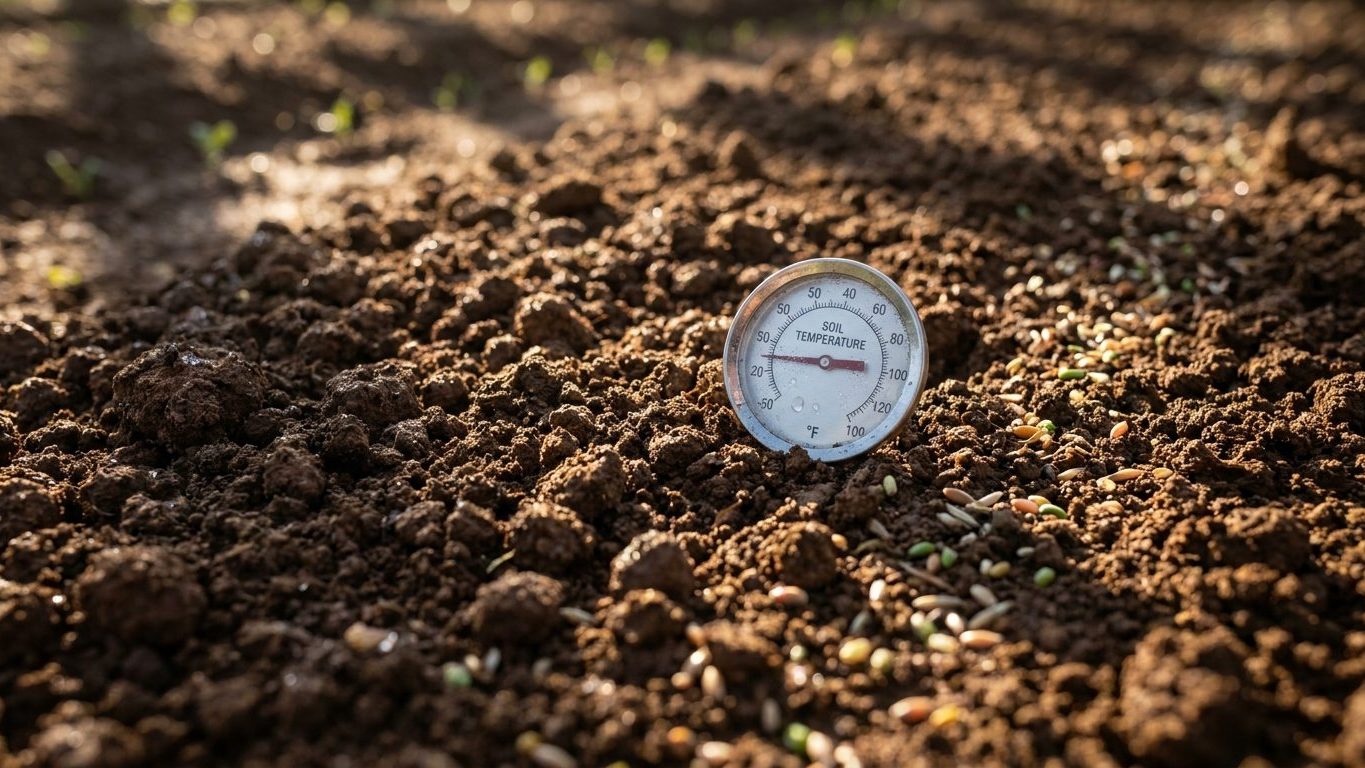
Here’s the part gardeners in Colorado tend to miss: that frost date is a proxy, not the actual trigger. Seeds don’t care what the calendar says about air temperature at 2 a.m. They care about soil temperature at seed depth, and soil warms on its own schedule, usually a week or two behind the last frost risk, because dirt holds cold longer than air does. A cover crop of oats or field peas sown into ground that’s still in the low 40s will sit and sulk, sometimes rot, before it ever sprouts. Waiting those extra days after the frost date passes is not overcaution. It’s the difference between a stand that establishes and one that doesn’t.
Elevation complicates this further. Denver sits at 5,280 feet on the plains, and the dates above reflect that station. Mountain towns run a shorter season by weeks, sometimes with frost risk lingering into July, and the western slope follows its own pattern entirely, shaped by valley cold-air drainage and different exposure. Anyone gardening outside the Front Range corridor should treat the May 1 to May 11 window as a starting reference, not a local fact.
How much seed to put down is a separate question, and it’s not one this page will answer with a number. Rates depend on the species chosen, whether you’re broadcasting or drilling, seed size, and germination percentage, and a rate borrowed from a bag mix or a different state can waste an entire season’s growth. The reliable source is Colorado State University Extension, which tests rates against actual conditions on the Front Range and the plains rather than a national average.
Termination here is mechanical, and that fits Colorado’s climate well. Mowing works once a crop like oats or peas has flowered. Crimping flattens a stand of rye or vetch to form a weed-suppressing mat. And in a lot of years, the first hard fall frost does the job on its own, killing tender species outright and leaving them as surface mulch through winter. No spraying required, and for a cover crop, none of that timing needs a herbicide label to get right.
How long the season lasts here
Subtracting the two frost dates from NOAA’s normals gives a growing window of roughly 141 to 164 days, running from the May 1-11 spring frost period to the September 30-October 12 fall frost period, both drawn from station USW00003017. That’s a moderate window as far as U.S. gardens go, longer than a mountain valley, shorter than a low-elevation southern state, and it shapes almost every decision that follows about what a cover crop can accomplish before winter shuts things down.
A five-month window is enough room to be intentional rather than reactive. It allows for a spring-sown cover crop, terminated by early-to-mid summer, followed by either a food crop or a second cover crop planted for fall and winter cover, if the gardener wants that second pass. It’s also just barely enough room to let a slower-growing legume like field peas put on real biomass before termination, something that gets squeezed out entirely in shorter mountain seasons where frost can arrive by August.
Where the window gets tight is at the edges. A cover crop sown right at the tail end of that spring frost period, say mid-May, and left to grow through a full cycle, may not leave enough calendar room afterward for a food crop that also needs 80 to 100 days to mature before the September frost risk begins. That’s the real planning question in Colorado: not whether there’s room for cover crops, but whether there’s room for both a cover crop cycle and a harvest cycle in the same year without crowding one out.
This is where succession planning earns its keep, because the alternative to squeezing everything into one long pass is staggering shorter plantings across the season instead. Colorado’s window supports a spring cover crop terminated in June, a summer vegetable crop, and then a fall-sown cover crop going in after that vegetable crop clears, timed to establish before the September 30-October 12 frost arrives and winterkill takes over. For the mechanics of staggering plantings like this without collisions, the succession sowing guide on this site walks through the sequencing in more detail.
The shorter side of that range, the towns running closer to 141 days, changes the math on transplanting too. Starting a cash crop indoors and setting it out as a transplant buys back two or three weeks that a direct-seeded planting would otherwise cost, and in a season this tight, that recovered time can be what makes a second cover crop pass fit at all rather than getting cut for lack of calendar room.
Heat and water in Colorado
For most warm-season vegetables, the conversation here would center on how many days climb past 90°F and how much rain falls in summer. For cover crops, that’s largely the wrong question. Cover crops aren’t grown for a harvest that needs to dodge heat stress at flowering; they’re grown for biomass and root structure, and the factor that actually decides their fate in Colorado is winter, not summer.
The number that matters is the mean daily minimum of the coldest month: 18.4°F, per NOAA’s 1991-2020 Climate Normals for the Denver reference station. That’s cold enough to reliably winterkill species that aren’t built for it. Oats are the clearest example. In a mild coastal climate, oats can overwinter and turn into a volunteer weed problem the following spring, something growers there have to actively manage. In Colorado, with winter lows averaging in the high teens, oats reliably die back on their own, turning into a protective mulch layer over the soil through the cold months. The same cold that makes gardening feel unforgiving here is doing free termination work for anyone who sowed oats in late summer.
The USDA Plant Hardiness Zone Map places Colorado across a wide range, 3b to 7b, built on average annual extreme minimum temperatures. That spread matters because it’s a territory-wide range, not one number: a garden in a mountain valley and a garden on the eastern plains can sit in genuinely different zones, and a species that winterkills reliably in one spot might survive and need mechanical termination in the other. The 18.4°F coldest-month figure cited above is specific to the Denver reference station, and gardeners elsewhere in the state should treat it as a benchmark to compare against, not a number that applies uniformly.
Summer heat and rainfall totals for this territory aren’t the deciding variable the way they are for say, a tomato crop, and no reliable region-specific figures for days above 90°F or summer precipitation are cited here, because the climate story for cover crops in Colorado is a winter story. What that low humidity and dry high-plains air do contribute is fast drying after any rain, which cuts down on the fungal and mildew pressure that plagues cover crop stands in wetter, denser-air climates. A legume like field peas or a grass like winter wheat used as cover tends to stay cleaner here than in a humid southeastern state, simply because the air doesn’t hold moisture on the leaf surface for long.
Which cover crops suit Colorado
Reasoning from the season length and the winter cold above points toward a short list of types, not varieties. A season running 141 to 164 days favors species that establish fast and put on biomass quickly rather than slow starters that need a long runway. Cool-season grasses and legumes that germinate in cooler soil and tolerate the swing between warm days and cold nights fit that window better than crops built for a longer, milder season.
Given the coldest-month minimum of 18.4°F, species that reliably winterkill are genuinely useful here rather than a liability. Oats fall into that category, as do field peas in most winters, both of them dying back into a surface mulch that protects soil over winter without needing a spring mowing pass. Species that overwinter and need active spring termination, like cereal rye, are a different tool entirely, useful where a gardener wants living cover straight through to spring, but they require planning for mechanical termination, mowing or crimping, once growth resumes.
Legumes matter here for a mechanism, not a number. A legume like field peas or hairy vetch fixes nitrogen through root nodules formed with soil bacteria, and how much of that nitrogen becomes available to the next crop depends on the species grown, how much biomass it built before termination, and how it’s terminated, whether tilled in, left as surface mulch, or crimped. That’s a real contribution, but it’s not a figure that transfers cleanly from a national chart to a Front Range garden bed, which is exactly why this page won’t put a pounds-per-acre number on it.
The honest limit of this page is the same for seeding rates and for variety choice: Colorado spans hardiness zones 3b to 7b, and the varieties that perform well in a Denver-area garden aren’t necessarily the ones trialled and recommended for a mountain valley or the western slope. Colorado State University Extension runs the local variety trials that account for that range, and naming a cultivar here, without knowing where in the state a reader gardens, would be a guess dressed up as advice. Choosing by type, then confirming the specific variety through Extension, is the actual recommendation for this territory.