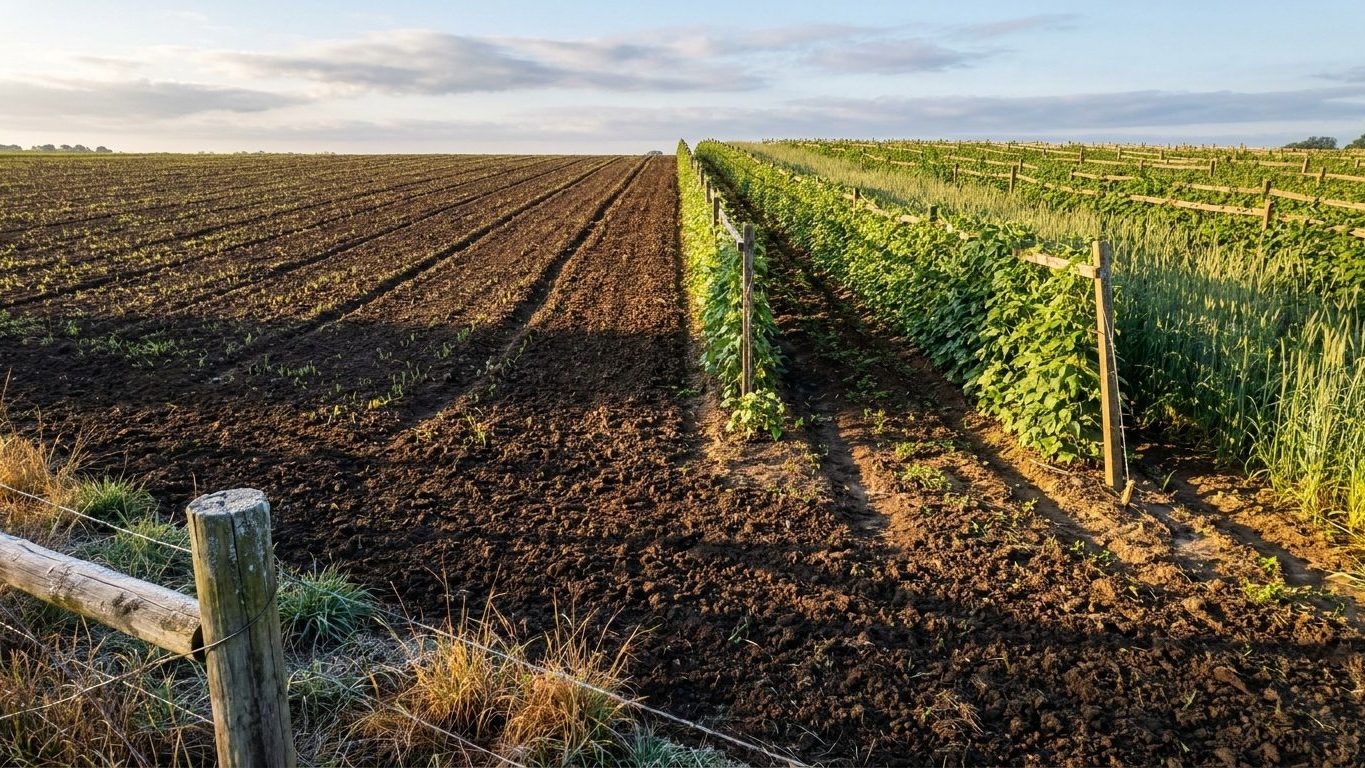

Cool-season cover crops like winter rye, hairy vetch, and field peas go in the ground here in two windows: right after the last spring frost, which lands between May 1 and May 11 in the Denver area, or six to eight weeks before the first fall frost, which falls between September 30 and October 12. Everything else in this article explains why those dates shift so much once you leave the Front Range.
The short answer for Colorado
Those frost dates come from NOAA’s 1991-2020 Climate Normals for station USW00003017, and they aren’t a single guaranteed date. They mark a 30-70% probability band for a 32°F freeze. That means at the early edge of the window, May 1 in spring or September 30 in fall, there’s still a meaningful chance of frost on either side. At the later edge, May 11 or October 12, the odds have shifted but haven’t disappeared. Treat the whole window as a range of risk, not a calendar you can circle in pen.
Spring window
For anything you’re direct-sowing as a spring cover, oats, field peas, spring-planted vetch, the safe play is to wait until after May 11 if you want the lower end of frost risk, or to accept some gamble by planting closer to May 1 if you need the extra growing days before summer heat arrives. Gardeners on the plains around Denver, sitting at 5,280 feet, are working from this baseline. Anyone higher up should push later, sometimes by weeks, not days.
Fall window
Fall-seeded covers need six to eight weeks of growth before a hard freeze locks them down, so counting back from September 30 puts the sowing date in mid-August for the cautious end, and counting back from October 12 stretches it to early September for the optimistic end. Winter rye and hairy vetch tolerate a late start better than crimson clover does, which wants more established growth heading into winter. The station this data comes from represents the Denver plains. Mountain towns run far shorter seasons and can see frost in July; the western slope runs on its own separate clock entirely.
What will not work here
The number that does the most damage to over-optimistic seed catalogs is 18.4°F, the mean daily minimum of Denver’s coldest month. That’s not a record low, it’s the average low night the coldest month produces, and it’s the figure that decides whether a cover crop survives winter here at all, not just whether it sounds hardy on a seed packet.
Winter-kill by the numbers
Cover crops rated for warmer zones than what a coldest-month minimum of 18.4°F demands will winter-kill on the plains, and worse at elevation. Crimson clover sits on the marginal edge in a lot of Colorado locations; it can survive a mild winter and disappear in a harsh one. Hairy vetch and winter rye tend to hold up better because they’re bred for colder tolerance, but even they need to be established, not just germinated, before that cold arrives. A cover crop seeded in late September with barely two true leaves showing has almost no reserve built up to survive a January cold snap.
Too little season, too much heat
Run the math on the frost dates and the growing season on the plains stretches to roughly 142 to 164 days depending on where in the probability band you land. That’s workable for a fast cover crop, but it punishes anything slow. A summer-annual cover that needs 90-plus days to reach full biomass and gets sown after the first week of June is racing a clock it might lose, especially at higher elevation where the season compresses further. Layer on Colorado’s dry, high-sun summers, and a cover crop that wants weekly watering to germinate in July heat is fighting the climate on two fronts at once: not enough moisture, and a shorter window to recover from any stress.
What changes across Colorado
Colorado’s USDA hardiness zone spans 3b to 7b, which is not a small spread. That range covers everything from high mountain valleys and the San Luis Valley, where zone 3b and 4 conditions mean a brutally short frost-free season, down to lower-elevation stretches that behave more like zone 6b or 7b. There is no single sowing date for a range like that, and any recommendation has to be read as a starting point tied to one reference city, not a rule for the whole state.
From the plains to the peaks
The frost dates and coldest-month figure used in this article come from the Denver reference station, sitting at 5,280 feet on the plains. A reader gardening at 8,000 feet or higher needs to compress the entire calendar: push spring sowing later because frost lingers longer, and pull fall sowing earlier because frost arrives sooner, sometimes as early as July in the highest valleys. Someone on the western slope is working a different climate again, with its own frost pattern shaped by valley geography rather than flat plains exposure. None of this article’s dates should be read as fixed for a mountain town or a western-slope valley. The only way to know which zone actually applies to a specific piece of ground is to check the USDA Plant Hardiness Zone Map directly rather than guess from a statewide range.
Where to check this for your own county
This page gives a state-level answer built from one reference station near Denver. A county recommendation will always beat that, because it accounts for local elevation, local soil, and the varieties that have actually been trialled nearby rather than a statewide average. Colorado State University Extension runs that local layer, and it’s worth going there before finalizing a sowing date based on anything written here.
What to look for once you’re there
Start at Colorado State University Extension and look specifically for two things: a local planting calendar tied to your county’s elevation and frost pattern, and any published trial results on cover crop varieties tested in your region. Extension offices often maintain county-specific guidance that adjusts for exactly the kind of elevation swing this article can only describe in general terms. If a county office lists a different sowing window than the one described above, follow the county office. That number reflects local station data and local trial results, while this page reflects one statewide reference point.
Checking this against your own garden
Every date in this article is a probability, not a promise, and your own garden will tell you more than any calendar once the season actually starts. Three things to watch outrank the calendar every time.
Three signs, three answers
Soil warmth by feel is the first check: dig down two or three inches and feel for a soil that’s warmed through, not just warm on the surface. If it still feels cool and damp deep down, germination will lag no matter what the calendar says. The first flush of flowers on an early-planted test patch, whether it’s the male flowers on a legume cover or the first blooms on a fast annual, tells you the plant has moved past establishment and into active growth, which is the signal that your microclimate has caught up to the season. And the first true leaves appearing on direct-seeded covers, as opposed to the rounder seed leaves that show up first, mark the point where a plant has enough root and leaf structure to handle a light frost without total setback. Watch those three signs on your own ground for a season, and they’ll tell you more about your actual sowing window than any regional average can.