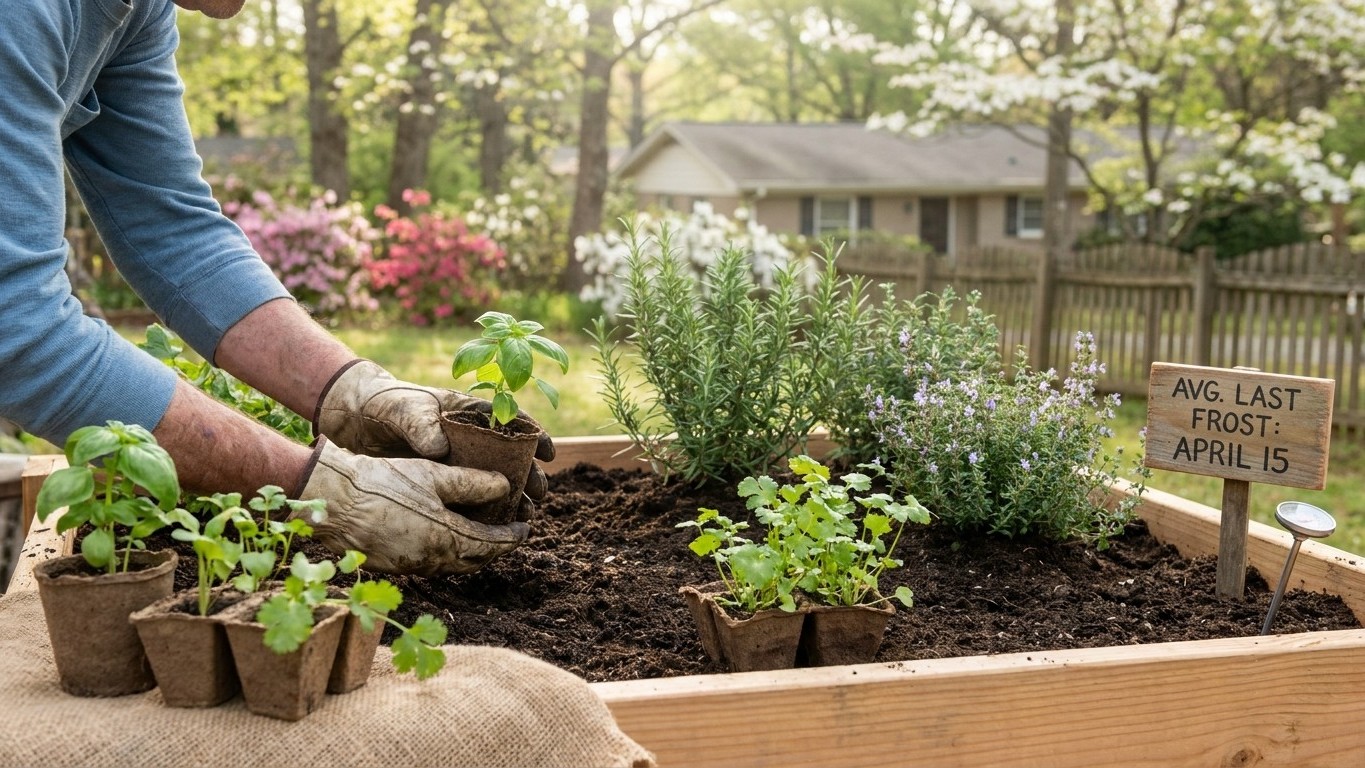

Most culinary herbs go in the ground here between mid-May and early June, once the frost risk from the May 1 to May 11 window has passed. Cold-hardy perennials like chives, thyme, and oregano can go earlier; tender annuals like basil wait until the soil warms and the risk drops further.
The short answer for Colorado
NOAA’s station data for the Denver area puts the last spring frost somewhere between May 1 and May 11, and the first fall frost between September 30 and October 12. That’s not a guarantee, it’s a probability band: those dates mark the window where a 32F freeze has a 30 to 70 percent chance of happening on any given day. In practical terms, planting tender herbs on May 1 means real odds of losing them to a late cold snap. Planting on May 11 or after cuts that risk substantially, though it never hits zero.
For frost-tender herbs, basil, cilantro, dill in its early stage, and most tropical-leaning herbs like lemongrass, the safer play is to wait until after that band closes, so late May into the first week of June for most of the Denver metro and similar elevations. Direct-seed or transplant then, and you’re working with roughly four months of growing season before the fall frost window opens again in late September.
Hardy perennial herbs don’t need to wait that long. Chives, thyme, sage, oregano, and winter savory tolerate a light frost once established, so many Colorado gardeners set these out three to four weeks before the last-frost window closes, hardening them off gradually. Parsley falls in between: it germinates in cool soil but the seedlings are tender enough to want frost protection if a late snap comes through.
Rosemary is its own case. It’s not reliably winter-hardy in most of Colorado outside the mildest pockets, given a coldest-month average minimum of 18.4F at the reference station. That figure, the mean daily low for the coldest month, is what decides whether a woody perennial survives a Colorado winter outdoors, and for rosemary the answer is usually no. Most gardeners here grow it as an annual or bring a potted plant indoors before the first fall frost arrives.
So the calendar splits into two tracks: hardy herbs on an earlier schedule anchored to the tail end of the frost-risk window, and tender herbs on a later schedule anchored to when that risk has mostly cleared. Neither track is a fixed date. Both are windows built on probability, and the actual right day for your yard depends on what the soil and the sky are doing that particular spring, not on a number printed on a seed packet.
What will not work here
A four-month frost-free stretch, at best, rules out a few things outright. Herbs that need a long, steady warm season to bulk up before they bolt struggle in a state where the growing window can close as early as late September. Cilantro is the clearest example: it wants cool soil to germinate but bolts fast once temperatures climb, and Colorado’s swing from a cool spring straight into hot, dry summer days gives cilantro a narrow strip of good conditions rather than a long one. Succession sowing every two to three weeks, rather than one big spring planting, is how most local gardeners keep a supply going instead of losing the whole crop to bolt in a single hot week.
The coldest-month minimum of 18.4F also rules out treating certain herbs as reliable perennials. Rosemary, bay laurel, and some Mediterranean lavenders are marginal at best left outdoors year-round at that temperature floor. Gardeners who plant them expecting them to behave like they do in milder states, and skip the step of potting them up or mulching heavily, tend to lose them over winter and then wonder why. That’s not a failure of technique so much as a mismatch between the plant’s native tolerance and the actual winter floor here.
Watering habits that work in humid states don’t translate either. Along Colorado’s Front Range and eastern plains, summer days run hot and dry, and herbs watered on a once-a-week schedule, the kind that might suffice in a wetter climate, dry out fast in sandy or clay soils under direct sun. Basil and other soft-leaved herbs wilt visibly within a day or two of a missed watering in July. The fix isn’t more water all at once, it’s shorter, more frequent watering and mulch to hold moisture, since a deep soak once a week doesn’t compensate for how fast the surrounding air pulls moisture out of the soil at altitude.
On the flip side, tight spacing meant for humid gardens can backfire here in the other direction: airflow is rarely the limiting factor in Colorado’s dry summer air, so crowding isn’t the risk it is in the Southeast. The bigger error is assuming any single set of rules, whether for watering, spacing, or winter protection, travels unchanged from a wetter or milder state into a high, dry one.
What changes across Colorado
Colorado’s USDA hardiness zone range runs from 3b to 7b, a spread of nine half-zones within one state’s borders. That’s not a rounding error, it’s the difference between a mountain valley where extreme winter lows can approach negative 30F and a lower, milder pocket where they might stay above 5F. A herb that overwinters reliably in one part of the state can die outright in another, even though both gardeners are reading the same statewide planting guide.
Elevation drives most of that spread. Denver sits at 5,280 feet on the plains, and the frost dates and coldest-month figures cited here come from a station at that elevation. Mountain towns a few thousand feet higher run noticeably shorter growing seasons, and it’s not unusual for a high-altitude garden to see a frost in July, something that would be almost unthinkable on the plains. Gardeners at altitude generally need to shift both ends of the calendar inward: start hardy herbs a bit later relative to local conditions, and plan for the fall frost window to open earlier than the plains dates suggest.
The western slope is its own case again, with different weather patterns driven by the Rockies blocking or redirecting storm systems compared to the Front Range. A planting calendar built around a plains reference station won’t describe a garden in a mountain valley or on the western slope with the same accuracy it describes Denver or a similar-elevation town nearby.
None of this means the numbers above are useless outside Denver, but it does mean they’re a starting reference, not a statewide constant. If you garden at meaningfully higher elevation, or west of the Continental Divide, treat the frost dates and hardiness figures here as a baseline to adjust, not a fixed answer. The state doesn’t have one climate, and no single planting date fits all of it. For where your own county actually falls, the hardiness zone map is the tool built for that job, not a guess based on which part of the state sounds similar to yours.
Where to check this for your own county
Colorado State University’s extension service publishes county-level guidance at extension.colostate.edu, and that’s the source to check before locking in a planting date based on statewide figures. A state-level planting calendar, including this one, is built on data from one or two reference stations. Your county’s extension office works from local trial data and local frost records, which beats a statewide average every time your county differs from Denver’s elevation, soil, or microclimate, and in a state with a hardiness range this wide, many counties do differ.
Two things are worth looking for specifically once you’re on the site. First, a local or regional planting calendar, if your county office publishes one, will typically list actual recommended sow and transplant dates for common herbs and vegetables, adjusted for that county’s frost pattern rather than the statewide 30 to 70 percent band cited here. Second, look for any variety trial results or recommended cultivar lists specific to your area. Colorado’s growing conditions vary enough that a basil or cilantro variety that performs well on the eastern plains isn’t automatically the best choice for a mountain valley garden, and county extension offices sometimes track which varieties actually held up locally.
If your county doesn’t publish its own detailed calendar, the state extension service can typically point you toward the nearest office or regional resource that covers your growing conditions more specifically than a statewide page can. Master Gardener programs, run through the same extension network, are another local resource worth asking about, since volunteers in that program often have direct experience with the quirks of a specific county’s soil and weather.
The frost dates and hardiness figures in this article describe the state in broad strokes, anchored to a single reference station. They’re a reasonable starting point for planning, not a substitute for what your county extension office knows about the ground you’re actually planting in.
Some gardeners also time this by the Moon: when to plant herbs by the moon, as almanac tradition rather than fact.
Checking this against your own garden
No calendar, state or county, replaces what your own soil and plants are telling you in a given year. Three things are worth checking before you trust a printed date over what’s in front of you.
Soil warmth by feel is the first. Push a finger a couple inches into the bed on a morning in late spring. If it still feels cold and damp rather than just cool, tender herb seeds and transplants are likely to sit and sulk rather than grow, even if the calendar says the frost window has closed. Warm, slightly dry-to-the-touch soil is a better green light than a date on paper.
The first flush of new growth on anything you already have overwintering, chives, established thyme, perennial oregano, is the second signal. When those plants push visible new green growth rather than just sitting dormant, it’s a sign the ground and air have genuinely turned the corner for the season in your specific yard, not just on average across the region.
The appearance of true leaves on any seedlings you’ve started is the third. The first set of leaves after the initial seed leaves tells you the plant has moved past its most fragile stage and is building real root and leaf tissue, which is the point where a light late frost becomes far more dangerous than it would be a week or two earlier or later. Watching for that stage, rather than counting days from a calendar, tells you when your particular seedlings are at their most vulnerable, and that’s worth more than any printed date on a page like this one.