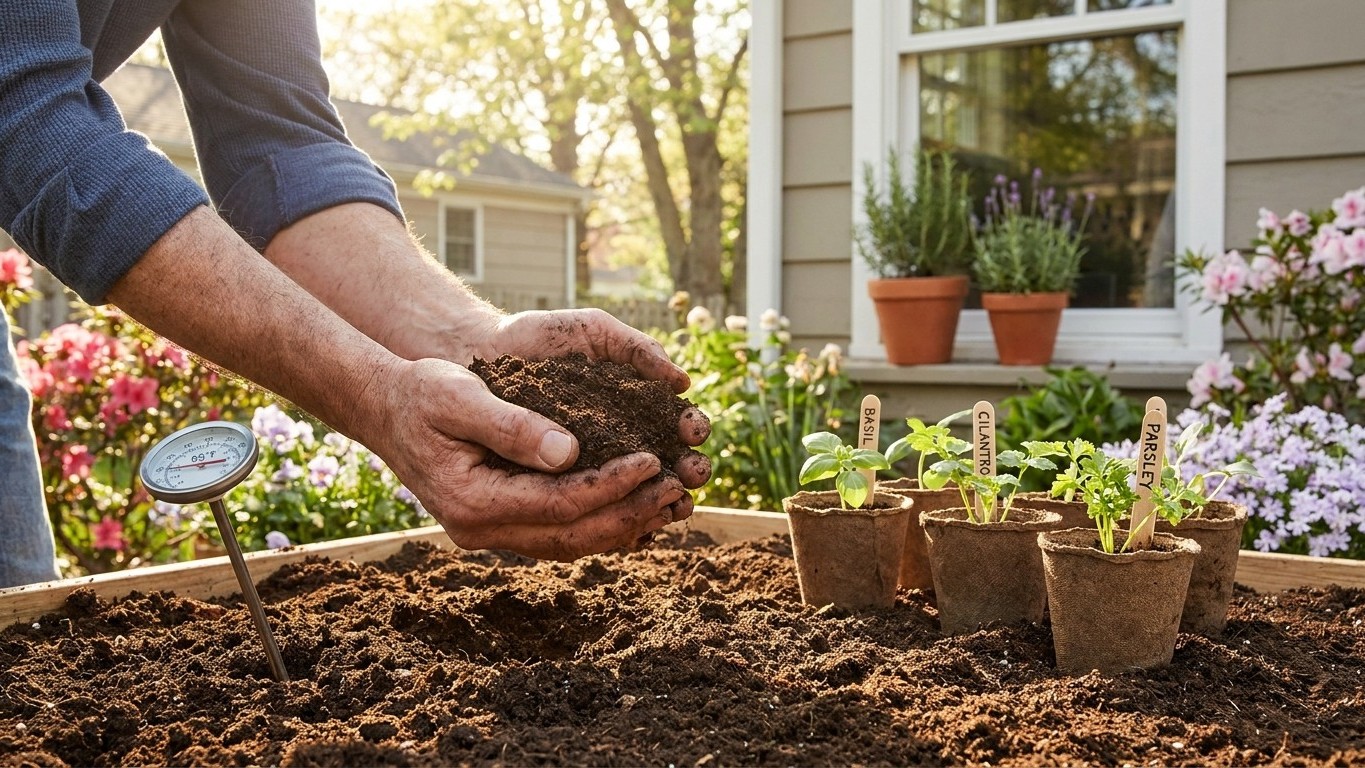

Colorado herb gardeners get a short but workable window: soil warms enough for planting from early to mid-May on the Front Range, and the growing season runs about five months before frost returns in fall. Winter cold, not summer heat, decides which herbs stay in the ground year-round and which need a container and a spot indoors.
When the soil is warm enough in Colorado
The last spring frost along Colorado’s Front Range falls between May 1 and May 11, based on NOAA’s 1991-2020 Climate Normals for station USW00003017. That’s a 30 to 70 percent freeze probability band, meaning it’s a statistical window, not a guarantee. Some years the risk clears earlier, some years a cold snap pushes past mid-May, and the number itself is a probability, not a promise.
Frost date is a proxy for something else gardeners actually need: warm soil. Herb seeds and transplants don’t respond to the calendar or to air temperature alone. Basil, for instance, stalls and sulks in cold ground even if the air feels mild during the day. Soil at 4 inches deep needs to hold steady warmth, and that typically happens a week or two after the last frost risk has passed, once the ground itself has caught up to the season. A gardener who plants tender herbs the same week as the last frost date is often planting into soil that’s still too cold for fast root growth.
Why this shifts by elevation
Denver sits at 5,280 feet on the plains, and the May 1 to May 11 window applies to that kind of elevation. Mountain towns run dramatically shorter seasons and can see frost well into July some years. The Western Slope operates on its own pattern entirely, shaped by different air drainage and different soil types. Anyone gardening outside the Front Range plains should treat the frost dates here as a reference point, not a local forecast, and check conditions specific to their own valley or bench.
Some herbs tolerate a cold start better than others. Hardy perennial types in the mint, allium, and mustard families shrug off a light frost and can go in the ground before the last frost date arrives. Tender annual herbs from warmer native ranges, on the other hand, want that soil warmth locked in before they go in the ground, or they simply sit without growing until conditions improve. This page won’t identify specific wild look-alikes or make any medicinal claims about particular herbs. Several herbs carry long-standing folk reputations for health uses; this page doesn’t evaluate those claims and isn’t the place to test them. The safe move is planting confirmed nursery stock or seed from a known source, not foraged material.
How long the season lasts here
Subtracting the frost dates gives a real number: the frost-free window on Colorado’s Front Range runs roughly 142 to 164 days, depending on which edge of each probability band you use, from the May 1-11 last frost through the September 30-October 12 first fall frost recorded at station USW00003017. That’s under five and a half months at the long end, and under four and a half months at the short end.
That length changes what’s realistic to grow, not just when to start. A 160-day season leaves room for a second sowing of fast annual herbs after an early harvest, since there’s enough calendar left for a follow-up crop to mature before the fall frost shuts things down. A season closer to the 140-day end doesn’t leave that cushion. In a short-season year, the first sowing is effectively the only sowing, and timing it well matters more than trying to squeeze in a second round.
This distinction also affects whether transplanting versus direct seeding is worth the trouble. In a longer window, transplants bought or started early give a head start that pays off across two plantings. In a compressed window, the difference between transplanting and direct seeding narrows, because there isn’t enough season left to exploit the extra few weeks a transplant provides. Gardeners weighing a second round of quick-growing herbs, or deciding whether transplants make sense given how tight the calendar runs, should check the site’s succession sowing guide for how to time a follow-up planting against a given frost window.
The frost dates themselves are a range, not a fixed pair of days, which means the season length is also a range rather than one hard number. Treating either end as certain is a mistake; planning around the shorter estimate is the more conservative approach for anyone who wants a second harvest without racing the first fall frost.
Heat and water in Colorado
Summer heat isn’t the defining challenge for herb growers here, and it isn’t what separates a good herb bed from a struggling one in this territory. The number that actually organizes the whole herb garden is winter cold: the coldest month on the Front Range averages a daily minimum of 18.4°F, and the hardiness zone across Colorado spans USDA Zone 3b to 7b, a wide range built entirely on average annual extreme minimum temperatures.
That range matters because it isn’t one zone, it’s a spread covering very different conditions from the eastern plains to the mountain valleys. A recommendation dated to Denver’s zone won’t hold for a mountain town two zones colder, or for a warmer pocket on the lower Western Slope. Anyone making a planting decision based on hardiness zone should check where their own location falls within that 3b-7b spread rather than assuming the territory-wide range applies evenly.
The 18.4°F coldest-month minimum is the number that decides which herbs survive outdoors through winter and which don’t, more than any summer statistic could. This is a mean daily minimum for the coldest month, not a record low and not a monthly average, which makes it a more honest measure of what a plant actually experiences on a typical cold night. A herb that tolerates occasional dips into the teens as an established perennial is a very different plant from one that collapses the first hard freeze. That single distinction reorganizes the whole herb bed: it’s the line between herbs planted once as permanent perennials and herbs treated as annuals or grown in containers that come indoors before winter sets in.
Where summer conditions run cool and damp, as they do in Colorado’s higher elevations and shoulder seasons, the risk shifts away from heat stress and toward mildew, slower ripening, and fungal disease pressure on crowded foliage. Airflow between plants and avoiding overhead watering late in the day matter more in those conditions than shade cloth or heat protection would. Along the drier lower-elevation stretches, the concern flips toward consistent watering rather than disease, since low ambient humidity dries out shallow-rooted herbs faster than a humid climate would.
Which herbs suit Colorado
The short season and the wide hardiness range point toward a few practical categories rather than any single named variety. Fast-maturing annual herbs, the types that reach a usable size within a compressed window, make sense given a season that can run as short as 142 days. Herbs in the cilantro, dill, and basil families fall into this group, though basil specifically wants that warm soil discussed earlier and won’t tolerate a frost at either end of the season.
Hardy perennial herbs suited to a cold winter, including types in the chive, thyme, oregano, and sage families, are the ones worth planting as permanent fixtures rather than replacing every year, provided the local hardiness zone within that 3b-7b range supports them. In the colder end of that range, or at higher elevation where the coldest-month minimum runs well below Denver’s 18.4°F, some of these same herbs perform better as container plants brought indoors or into an unheated garage for winter rather than left in open ground.
Rosemary is a useful example of the general pattern without picking a specific cultivar: across much of Colorado’s hardiness range, rosemary doesn’t reliably survive winter outdoors and is better managed as a potted plant that moves indoors before the first fall frost arrives. Mint-family herbs tend toward the opposite issue, spreading aggressively enough in decent soil that a container often serves better than open ground regardless of hardiness concerns.
This page isn’t going to recommend a specific variety within any of these herb types, and that’s deliberate rather than an oversight. Variety trials run locally by a state’s extension service are the only source that reflects how a particular strain actually performs against that region’s frost timing, disease pressure, and winter minimums. Colorado State University Extension, at extension.colostate.edu, maintains that kind of regionally tested guidance and is the right next stop for anyone choosing between specific varieties within these herb categories.