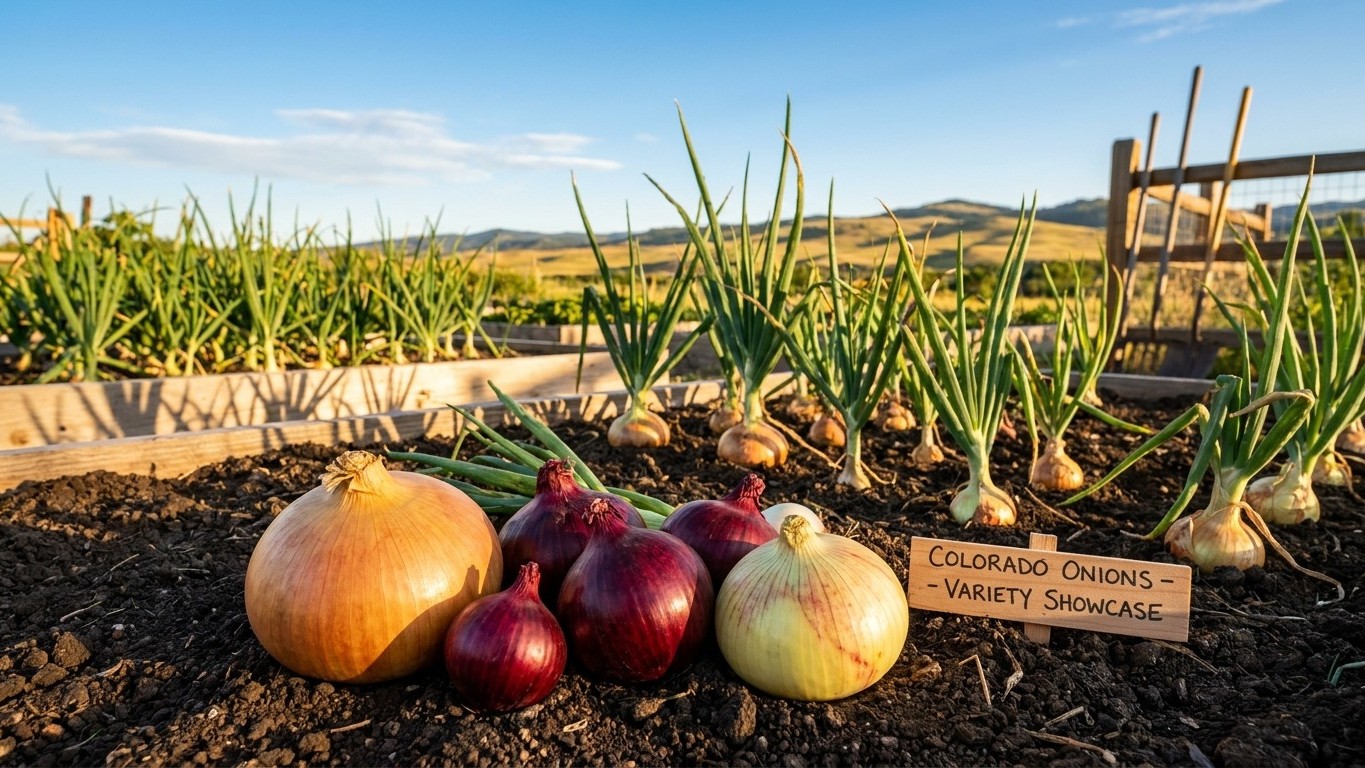

At Colorado’s reference latitude of 39.83 degrees north, the longest day of the year delivers 14 hours and 50 minutes of daylight. That single figure rules out an entire category of onion and opens the door to two others. For a state built around this latitude, the answer is intermediate-day and long-day varieties, not short-day ones, and eighteen documented varieties fit the bill.
The short answer for Colorado

Onions do not bulb because the weather warms up. They bulb because daylight crosses a threshold their variety is bred to detect. Short-day types trigger at around 12 hours, intermediate-day types wait for something between 12 and 14 hours, and long-day types hold out for 14 to 16 hours before they’ll stop making leaves and start making a bulb. At 14 hours 50 minutes on the summer solstice, Denver comfortably clears both the intermediate-day and long-day thresholds. That’s why both groups have a home in Colorado gardens, while short-day onions do not.
Among the long-day varieties whose published range covers 39.83N, eight are documented for this territory: Ailsa Craig, Barolo, Blush, Bridger, New York Early, Patterson, Rossa di Milano, and Walla Walla Sweet. These are the varieties bred for the long summer days of the northern half of the country, and Denver’s day length falls squarely inside what they need.
Ten more come from the intermediate-day group, which asks for slightly less daylight and tends to bulb a little earlier in the season: Cabernet, Calibra, Candy, Elsye, Expression, Monastrell, Red Long of Florence, Red Long of Tropea, Scout, and Sierra Blanca. Because Colorado’s reference latitude sits near the boundary where intermediate-day catalogs stop and long-day catalogs begin, both groups perform reliably here, which gives a gardener more room to choose based on flavor, color, or how long the onion needs to store rather than worrying about whether it will bulb at all.
What will not work here
This is the part of the decision that actually saves a season. Short-day onions are bred for latitudes far south of Colorado, where the day never gets much past 12 hours even at the solstice. Plant one in Denver and the plant reads 14 hours 50 minutes of daylight as its cue to bulb long before it has grown enough leaf mass to feed a decent bulb. The result isn’t a smaller harvest spread over more time. It’s a marble-sized onion, because whatever size the plant reached before the day-length trigger fired is the size it stays.
On the opposite end, a handful of long-day varieties are bred for latitudes north of Colorado, where summer days stretch even longer than 14 hours 50 minutes. Plant one here and the trigger they’re waiting for never arrives. There’s no small onion at the end of the season. There’s no onion at all. The plant spends the whole summer making leaves, then rots in the ground with nothing underneath.
- Gabriella (short-day, bred for 20-35N): bulbs while still small; expect tiny onions, not a delayed harvest.
- Madalyn (short-day, bred for 20-35N): same early trigger, same undersized result.
- Red Rock (short-day, bred for 30-36N): bulbs too soon for Colorado’s longer days.
- White Castle (short-day, bred for 30-38N): still too far south-adapted for 39.83N.
- Powell (long-day, bred for 43-47N): the day here never gets long enough; leaves all season, then rot.
- Redwing (long-day, bred for 43-65N): needs daylight Colorado’s solstice doesn’t reach.
- Safrane (long-day, bred for 42-50N): waits for a trigger that never comes at this latitude.
- Talon (long-day, bred for 42-50N): same failure mode, no bulb forms.
Two varieties sit close enough to a published boundary that the answer isn’t a flat yes or no. Frontier (long-day, 40-50N) and Red Carpet (long-day, 40-45N) both have ranges that start just above 39.83N. They may bulb in Denver, but a gardener growing them here is working at the edge of what the catalog data supports, not comfortably inside it.
What changes across Colorado
Colorado is not one latitude any more than it’s one elevation. The state’s borders run from roughly 37 degrees north at the New Mexico line to roughly 41 degrees north at the Wyoming line, a span of about four degrees. Denver, at 39.83N, sits closer to the northern edge of that range than the southern one, and the 14-hour-50-minute figure belongs specifically to Denver, not to Trinidad or Cortez in the south or to Fort Collins in the north.
| Location | Approximate latitude | What changes |
|---|---|---|
| Southern Colorado (near the New Mexico border) | ~37N | Slightly shorter longest day than Denver’s 14h50; intermediate-day varieties still bulb well, short-day varieties still fail |
| Denver (reference city) | 39.83N | 14h50 on the longest day; baseline for every figure on this page |
| Northern Colorado (near the Wyoming border) | ~41N | Slightly longer longest day than Denver’s; edge varieties like Frontier and Red Carpet are more likely to bulb fully |
The practical effect isn’t dramatic, but it’s real. A gardener in Alamosa or Durango is working with marginally less summer daylight than the Denver figure suggests, which makes the intermediate-day group the safer default rather than a toss-up with long-day types. A gardener near Fort Collins or Greeley is working with marginally more, which nudges the odds in favor of the two edge varieties, Frontier and Red Carpet, that Denver’s own figure leaves uncertain.
Sweet now, or onions that last
Colorado’s position between the intermediate-day and long-day zones hands the gardener a genuine trade-off, and it’s chemistry, not luck. The bite in a pungent onion comes from volatile sulfur compounds. Those same compounds are what protect the bulb from rot in storage. A sweet variety has fewer of them, which is exactly why it tastes better raw on a sandwich and exactly why it won’t survive a Colorado winter in the pantry. As University of Missouri Extension puts it, sweet onions do not store as well as the more pungent types.
Among the varieties documented for Colorado, Walla Walla Sweet and Candy sit on the sweet, short-keeping end. They’re excellent eaten within weeks of harvest and a poor bet for a February casserole. On the pungent, long-keeping end sit varieties like Patterson and Ailsa Craig, storage onions bred to hold their structure and flavor for months in a cool, dark space.
What this means for a Colorado kitchen is straightforward. A garden planted entirely in sweet varieties gives a wonderful August and September and an empty onion basket by Thanksgiving. A garden that includes the sharper, longer-day storage types still gives up some of that immediate sweetness, but it’s what puts an onion on the cutting board in March, months after the last one was pulled from the ground. Most Colorado gardeners split the difference deliberately, growing a sweet variety for the table now and a pungent one for the shelf later.
Checking this against your own garden
The figures describe Denver, at 39.83N, more closely than the rest of Colorado. They describe Denver, at 39.83N, and a gardener an hour’s drive from that reference point is still close enough that the guidance holds. A gardener near the state’s northern or southern edge is not, and the difference is worth five minutes of checking before ordering seed or sets.
- Look up your own latitude if you garden well north or south of the Denver metro area, since a few degrees can shift which day-length group is the safer choice.
- Confirm your local frost dates rather than relying on a statewide average. Colorado’s elevation swings hard from the plains to the foothills, and frost timing follows elevation more than it follows latitude.
- Call your county extension office. Colorado State University Extension maintains local offices that track frost dates and variety performance specific to your county, not just the state as a whole.
- Note your garden’s elevation. A higher-elevation plot can see a shorter effective growing season even where latitude and day length are identical to a lower spot nearby.