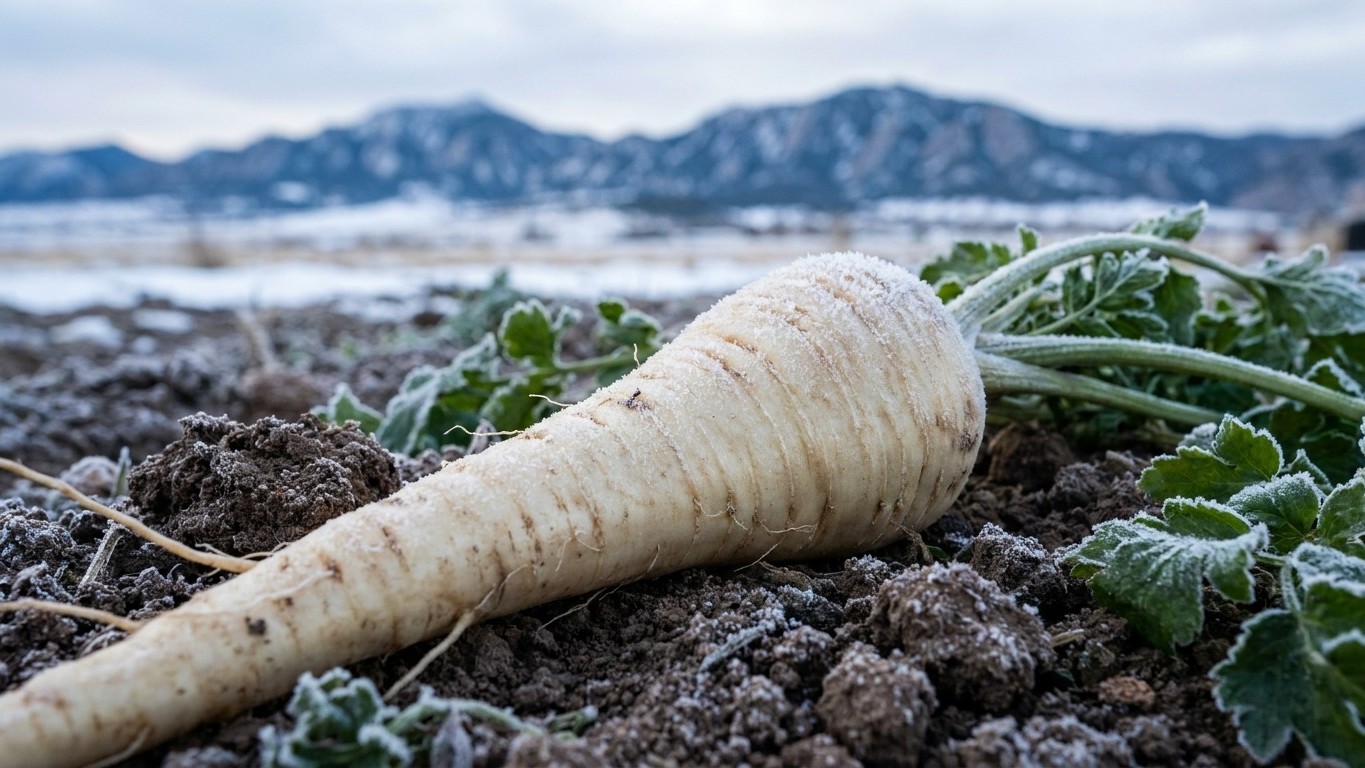

On the Colorado plains, parsnips sown in April are full-sized by late summer. They are not worth eating until frost has worked on them for several weeks, so plan to dig from late October into November. They can then keep four to six months, but only in cold, humid storage and well away from the fruit bowl. The figures below use Denver as the reference station, and each claim is tied to its source.
The short answer
Does this territory deliver several frosty weeks? On the Front Range, yes, without much argument. The mean daily minimum of the coldest month at the Denver reference station is 18.4°F (NOAA NCEI Climate Normals). That is 13.6 degrees below freezing on an ordinary night, with no cold snap needed. A parsnip grown here will sweeten, not merely grow.
The reasoning rests on frost exposure, not on a hardiness zone. A zone number says whether a plant survives winter, and a parsnip survives nearly anything the plains throw at it. Sweetening is a different job. According to Utah State University Extension, parsnips taste best after several weeks of cool, frosty weather, which converts stored starch to sugar. The first fall frost typically arrives between September 30 and October 12 (the 30 to 70 percent probability band for 32°F freezes), and the nights only get colder from there. For the mechanism in more depth, see Will Parsnips Sweeten in Colorado?
When to lift
Count several weeks forward from the first frost and you land in late October at the earliest, more often into November. Roots sown in April are usually size-ready long before that, and the temptation is to pull a few in September. Resist it. A September parsnip is edible, but it is the starchy version. A thick layer of straw or leaves over the row keeps the soil workable, so you can dig through the cold months as you need them. Lift the rest before new top growth starts in spring.
How long they keep
USDA Agricultural Handbook 66 puts parsnip storage at 4 to 6 months, which is a long keeper by any standard. The figure assumes 32 to 34°F at 98 percent relative humidity, held steady. Almost no house does that, so expect less from a garage shelf or a refrigerator drawer.
The handbook is also explicit that parsnips are not chilling sensitive, so cold itself is not the risk. The risk is ethylene. Parsnips produce very little of it (under 0.1 µL per kilogram per hour at 68°F), but even low levels of exposure in cold storage cause bitterness, likely through a compound called xanthotoxin. Store them next to apples or any ripening fruit and they turn bitter, even at the right temperature. Keep them in their own container or their own end of the cold room.
One handling rule from the same source: top the roots after harvest, but do not trim into the crown. The full text is in the USDA handbook (PDF).
Does the season fit?
It fits comfortably on the plains. The arithmetic below uses the Denver reference station, with the last spring frost falling May 1 to May 11 and the first fall frost September 30 to October 12 (NOAA NCEI 1991-2020 Climate Normals). Parsnips are sown in place, so the clock runs from seeding.
- Start with the last spring frost, May 1 to May 11. Parsnips go in 2 to 3 weeks before it, which puts the sowing between about April 10 and April 27.
- Allow for germination. Seed takes 14 to 21 days to come up, so the row looks like bare soil until roughly April 24 at the earliest and as late as May 18. Do not dig it up and re-sow.
- Add the growing time. Utah State University Extension gives 100 to 120 days from seeding. The earliest sowing plus 100 days is about July 19. The latest sowing plus 120 days is about August 25. Roots reach full size somewhere in that span.
- Compare that with the first fall frost, September 30 to October 12. In the tightest case, a late sowing with a slow crop, the root finishes about five weeks before frost. In the loosest case, an early sowing with a quick crop, the margin is nearly twelve weeks.
- Test a late sowing. Seed put in on May 11, the far edge of the last-frost window, plus 120 days reaches September 8, still ahead of the earliest first frost. Sow around June 2 and the same 120 days runs into September 30, which leaves no cushion at all.
The practical reading: April is the target, mid-May is acceptable, and June is a gamble. Those dates describe Denver at 5,280 feet. Mountain towns run far shorter seasons and can see frost in July, and the western slope differs again. Dates for those places are not published here, so a gardener there should check a nearby station before counting days.
What goes wrong here
Most Colorado parsnip trouble comes from the ground and the calendar, not from the cold. Colorado soils vary enormously, from sandy loam to dense clay to cobble, and any general soil description is a starting point, not a diagnosis. Dig a test hole a foot or more deep before sowing.
- Forked roots in heavy or stony ground: the root splits when it meets clay or a stone. Utah State University Extension recommends deep sandy soil and says heavy soil must be double dug. Loosen the bed to full depth and pull out stones before sowing.
- Forked roots from overwatering: this is a separate cause, and a loose bed does not cure it. Keep the seedbed moist until the seedlings are up, then water deeply and evenly instead of keeping the row soggy.
- A season that runs out: a sowing in June leaves no margin before frost, as the arithmetic above shows. Sow in April, count 100 to 120 days from seeding, and do not mistake the 14 to 21 days of germination for failure.
- Lifting too early: the plains winter is cold enough to sweeten the crop, so the realistic Colorado version of the “too mild” failure is a warm fall followed by an early dig. If frost has been on the tops for only a week or two, wait. The roots hold in the ground.
- Bitterness in storage: a parsnip in the same crisper drawer as apples picks up ethylene. Give the roots their own container, topped but with the crown left uncut. Rodent and insect damage to roots is a different problem, covered in What Eats Parsnip in Colorado, and When.
Common questions
Can parsnips stay in the ground all winter in Colorado?
Yes, with mulch. Parsnips tolerate cold, and the plains climate delivers plenty of it. A deep layer of straw or leaves keeps the soil from locking solid, so you can dig as needed. Lift whatever remains before top growth restarts in spring.
How soon after sowing will seedlings show?
Germination takes 14 to 21 days. Parsnip seed is slow, and the row can look empty for three weeks. Mark it, keep the seedbed moist, and give it the full time before concluding anything.
Can I store parsnips near apples?
No. USDA Handbook 66 reports that low-level ethylene exposure in cold storage causes bitterness in parsnips, and apples and other ripening fruit give it off. Temperature can be perfect and the roots will still turn bitter. Store them separately.
Do these dates apply outside the Front Range?
Not reliably. They come from the Denver reference station. Mountain towns have much shorter seasons and can frost in July, and the western slope differs again. Frost dates for those areas are not published here. For the wider picture of sowing and harvest, start with Growing Parsnips in Colorado.