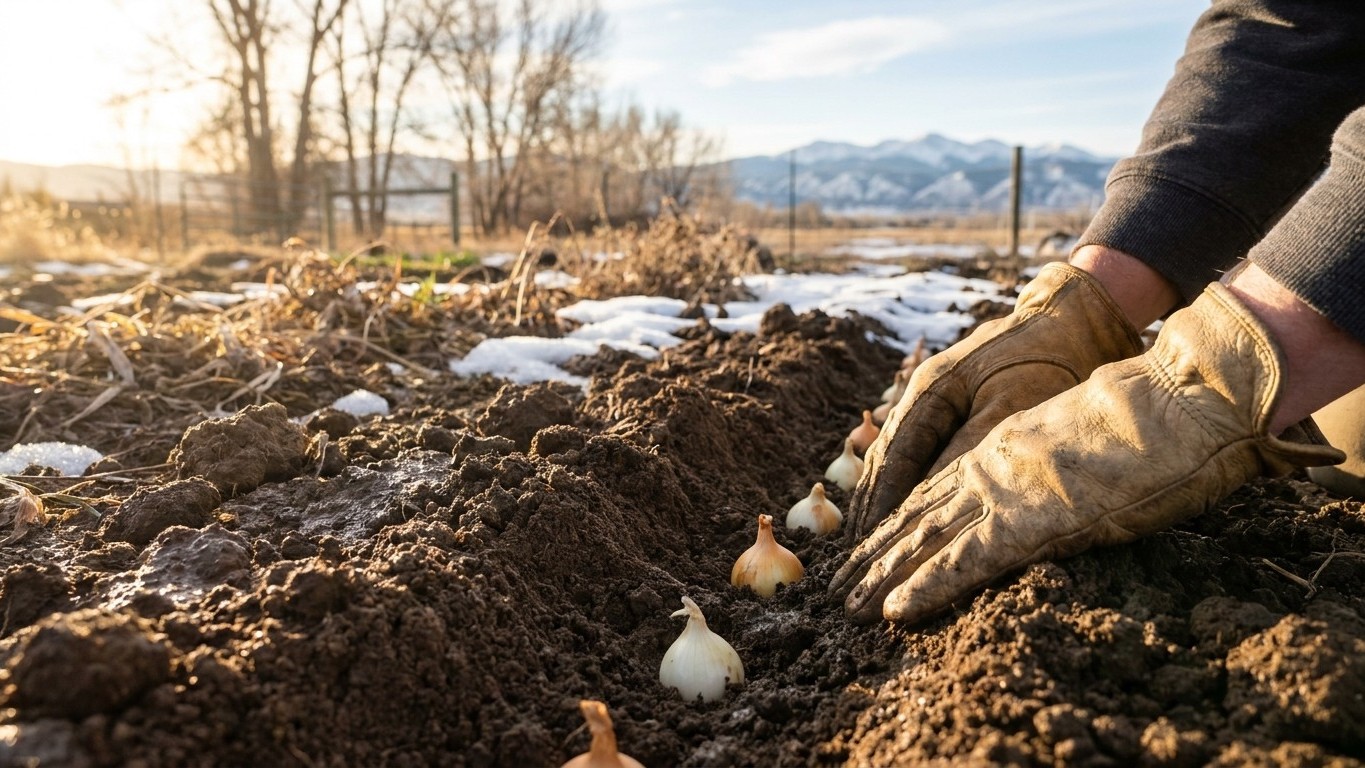

Colorado onion growers plant in late winter to early spring, not fall. At Denver’s latitude of 39.83°N, the longest day of the year delivers 14 hours and 50 minutes of daylight, enough to trigger bulbing in long-day and intermediate-day types by early-to-mid summer. Get sets or transplants into the ground as soon as the soil can be worked, because every week lost before that daylight trigger arrives is a week the bulb never gets back.
The short answer for Colorado

Colorado’s growing calendar runs opposite to what a gardener in Georgia or coastal Texas would recognize. In those mild-winter states, onions go into the ground in fall and overwinter as small plants. Colorado’s winters are too cold for that gamble at almost any elevation, so the planting window shifts to late winter through early spring, roughly February into April depending on how quickly the ground thaws in your specific spot.
The reason has nothing to do with frost tolerance and everything to do with daylight. Onions don’t bulb because the calendar says summer. They bulb when day length crosses a threshold their variety is bred to respond to. At 39.83°N, the sun delivers 14 hours and 50 minutes of daylight on the June solstice. That’s comfortably inside the range that triggers both intermediate-day varieties (roughly 12 to 14 hours) and long-day varieties (roughly 14 to 16 hours), which is why Colorado gardens draw from both groups rather than being locked into one.
Eighteen documented varieties fall inside this latitude’s published range: long-day types such as Ailsa Craig, Barolo, Blush, Bridger, New York Early, Patterson, Rossa di Milano, and Walla Walla Sweet, alongside intermediate-day types like Cabernet, Calibra, Candy, Elsye, Expression, Monastrell, Red Long of Florence, Red Long of Tropea, Scout, and Sierra Blanca. Two more, Frontier and Red Carpet, sit close enough to the edge of their published range that they may perform here but shouldn’t be counted on without a trial row.
What all of these share is enough growing time before the solstice arrives. Plant in late winter or early spring, give the seedlings a couple of months of leaf growth, and the plant has real size on it by the time daylight hits the trigger. That’s the whole strategy in one sentence: grow leaves first, let daylight decide when bulbing starts, and make sure the plant is large enough when that happens.
What will not work here
Planting an onion too late doesn’t push the harvest back a few weeks. It shrinks the harvest, permanently. An onion bulbs based on day length, not on how many days it’s had in the ground. Whatever size the plant has reached when the daylight trigger fires is the size the bulb will be, full stop. A gardener who plants in May instead of March isn’t buying a later harvest window; they’re guaranteeing a smaller one, because the plant simply hasn’t had time to build the leaf mass a bulb is made from.
Variety choice fails the same way, in two opposite directions. Some varieties are bred for latitudes well south of Colorado, where the day never gets long enough for a long-day type to matter. Planted here, they bulb almost immediately, before the plant has grown much of anything:
- Gabriella (short-day, 20-35N), bulbs while the plant is still tiny, giving undersized onions
- Madalyn (short-day, 20-35N), same failure, triggered far too early for Colorado’s daylight
- Red Rock (short-day, 30-36N), bulbs at roughly 12 hours of daylight, reached here well before the plant is grown
- White Castle (short-day, 30-38N), bulbs too early for the plant to have any size on it
Other varieties fail for the opposite reason. They’re bred for latitudes north of Colorado and need more daylight than 39.83°N ever provides. These plants never receive their trigger. They keep making leaves all season, then rot in the ground with no bulb at all:
- Powell (long-day, 43-47N), needs daylight hours Colorado’s summer doesn’t reach
- Redwing (long-day, 43-65N), bred for far-northern day length, never triggers here
- Safrane (long-day, 42-50N), same story, no bulb forms
- Talon (long-day, 42-50N), leaves all summer, then rot, not a small onion but no onion
What changes across Colorado
Denver sits at 39.83°N, but Colorado itself is a rectangle running from 37°N at the New Mexico border to 41°N at the Wyoming and Nebraska lines, roughly four degrees of latitude from edge to edge. A gardener near Fort Collins or Sterling gets a bit more daylight on the solstice than Denver does; a gardener near Trinidad or Cortez gets a bit less. Neither difference is large enough to knock a variety out of its published range, but it does shift the exact week a bulbing trigger fires.
| Location | Approx. latitude | Summer day length | What it changes |
|---|---|---|---|
| Northern Colorado (near Fort Collins) | ~41°N | Slightly longer than Denver’s 14h50 | Long-day varieties get marginally more time to bulk up before bulbing; plant a little earlier where frost allows |
| Denver (reference city) | 39.83°N | 14h50 | Baseline for this page’s figures |
| Southern Colorado (near Trinidad) | ~37°N | Slightly shorter than Denver’s 14h50 | Intermediate-day varieties edge closer to their bulbing threshold; spring soil work can often start a bit sooner |
Latitude isn’t the only variable working against a single statewide date, either. Elevation matters as much or more in Colorado, and it doesn’t always track with latitude. The San Luis Valley in the south sits above 7,500 feet and stays colder into spring than plenty of northern-plains ground at lower elevation. A gardener there may share Trinidad’s latitude but not its frost-free window at all. Latitude sets the daylight trigger; elevation sets how much growing time you get before that trigger arrives.
Sweet now, or onions that last
The onions a Colorado garden produces come with a trade-off built into the chemistry, not a matter of luck or variety marketing. The compounds responsible for an onion’s sharp bite are volatile sulfur compounds, and those same compounds are what protect the bulb during storage. A variety bred to be mild has fewer of them, which makes it better eaten fresh and worse at surviving a winter in the pantry. University of Missouri Extension puts it plainly: sweet onions do not store as well as pungent types.
This lines up with the day-length pattern already at work in this state. Southern gardens, closer to shorter-day varieties, tend to produce milder, faster-eating onions. Northern and higher-elevation gardens, leaning on long-day types, tend to produce the sharper onions that hold up in storage. Colorado sits close enough to the middle of both groups that a grower can choose either outcome deliberately rather than by accident. Walla Walla Sweet, documented in this latitude’s range, earns its name honestly and won’t last past a few weeks in a cool pantry. Sharper long-day types from the same list, grown and cured properly, can carry a household into late winter.
The practical question isn’t which variety is “better.” It’s what your kitchen actually needs. A household that eats onions raw all summer, on burgers and in salads, gets more value from a mild variety even if it means buying onions again by December. A household that cooks through winter wants the sharper, longer-keeping types even if that means skipping the sweetest options on the list.
Checking this against your own garden
Everything above uses Denver’s latitude and daylight figures as the reference point for Colorado. A garden near either state line, or up in the mountains, deserves a closer look before committing to a variety or a planting date. Check these this week:
- Your own latitude, especially if you garden near the Wyoming, Nebraska, New Mexico, or Kansas borders rather than near Denver
- Your local last frost date, which can vary by weeks even between towns at similar latitude, once elevation is factored in
- The elevation of your specific garden site, not just your town’s average, since valley floors and hillsides a mile apart can differ by hundreds of feet
- Whether your chosen variety’s published range actually includes your latitude, rather than assuming Denver’s figures apply everywhere in the state
- Your county extension office, which keeps localized frost-date records and can confirm planting windows for your exact area
If you follow the almanac, here is when to plant onions by the moon. It is a tradition, not a proven method.