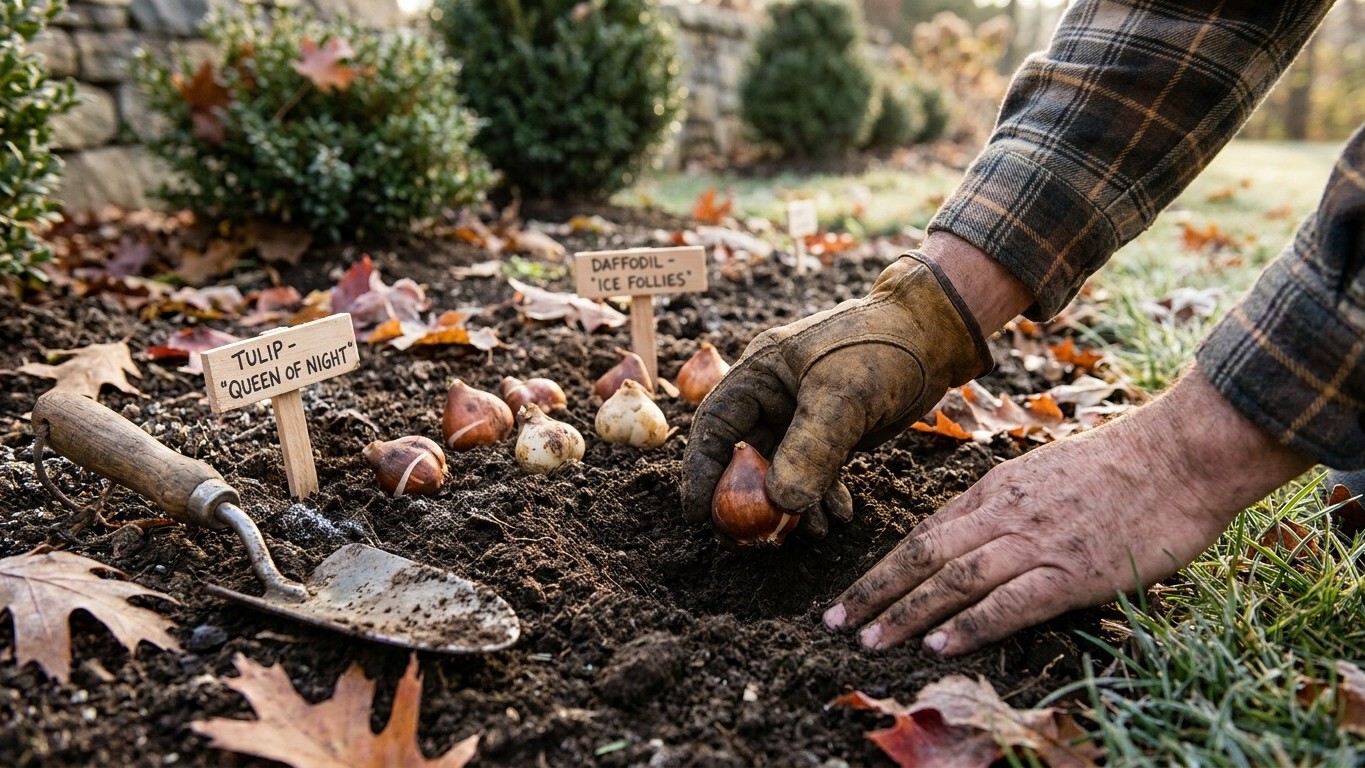

Connecticut’s winters give spring bulbs everything they need to bloom well, but the planting window matters more than most garden center tags let on. Get bulbs into the ground once the soil has cooled but before it locks solid, in the roughly six weeks before the ground freezes hard, and nearly every classic spring bulb winters over without any special help. Timing it against a frost date that shifts every year is the real trick.
When to plant bulbs in Connecticut

Connecticut’s average first fall frost lands somewhere between October 28 and November 10, based on the 1991-2020 climate normals recorded at the coastal Bridgeport station. That date anchors everything else, because the ground doesn’t freeze hard the moment frost first touches the grass. It takes weeks of steadily colder soil after that first bite before the top several inches lock up, and that stretch, roughly six weeks, is the real planting window.
For most of the state, that puts bulb planting squarely in the second half of October through late November. Coastal towns along Long Island Sound, where Bridgeport sits, often stay workable into early December, since the Sound moderates soil temperatures longer than inland ground does. Farther north and west, in Litchfield County and the hill towns near the Massachusetts line, the math runs earlier: the ground there freezes solid well before December, so bulbs need to be in by mid-November at the latest.
Plant too early and the trouble isn’t cold, it’s warmth. Bulbs set into soil still holding summer heat push top growth before winter arrives, and that growth gets killed by the first hard freeze, weakening the bulb before it has had a season to establish. Plant too late and the opposite problem shows up: bulbs dropped into half-frozen ground never root before everything locks up, and they come up stunted in spring, or not at all.
The frost date itself deserves a plain caveat. It’s an average, which means roughly half of all years in the record fall earlier than it and half fall later. A gardener who waits for “the frost date” as though it were a fixed appointment is planning around a coin flip. Watching the soil rather than the calendar works better: once soil temperature holds steady in the 40s and daytime highs stop climbing back into the 60s, the window is open, and it stays open until a hard freeze locks the ground for good.
Within that window, order matters a little. Daffodils root best with extra time in still-mild soil, so plant them early in the window. Tulips tolerate a later planting than most bulbs, rooting fine even close to the point the ground stiffens, which is why many Connecticut gard[eners save them for last. Gardeners short on in-ground space, or working with poor soil, can sidestep timing worries almost entirely by Growing Spring Bulbs in Containers in Connecticut, where drainage and depth are easier to control.]eners save tulips for last and get daffodils, crocus, and hyacinth in the ground first. For gardeners who miss the outdoor window entirely, or simply want blooms sooner than nature allows, Forcing Spring Bulbs Indoors in Connecticut offers a reliable way to enjoy spring color well ahead of schedule.
Whether your winter is cold enough
Every spring bulb worth planting needs a long, unbroken stretch of cold before it will flower. The standard figure, worth keeping in mind for any bulb offered at a garden center, is twelve to fourteen weeks with soil temperatures holding below about 45°F. Skip that requirement and a bulb doesn’t just flower late, it often skips flowering entirely, producing leaves and nothing else, or a bloom stalk too short to ever clear the foliage.
Connecticut clears that bar without much trouble. On the USDA Plant Hardiness Zone Map (2023 edition, built on 1991-2020 normals), the state spans zones 6a to 7b, and the coldest-month mean minimum at the Bridgeport reference station runs 24.4°F. Soil temperatures across the state sit below 45°F for roughly four to five months, from late November through March, which means Connecticut delivers something like eighteen to twenty weeks against the twelve-to-fourteen-week minimum hardy spring bulbs need. That margin is wide enough that pre-chilling, refrigerating bulbs for twelve weeks before planting to simulate winter cold they’d otherwise miss, isn’t necessary anywhere in the state for standard hardy bulbs. Gardeners in warmer regions have to isolate bulbs in a fridge away from ripening fruit, since the ethylene gas apples and pears give off breaks down the flower bud inside the bulb before it’s ever planted. Connecticut gardeners can skip that step and go straight into the ground.
The one spot the state’s cold margin doesn’t help is with bulbs that were never built to need much chilling in the first place, and mixing those into a fall bed is a common way to waste money. Paperwhite narcissus is the clearest case: it needs no cold period to flower, which is exactly why it’s sold for indoor forcing, and it isn’t winter-hardy anywhere near Connecticut’s cold minimum. Planted outside here, it doesn’t fail from lack of chill. It fails because the ground gets far colder than the bulb can survive.
| Bulb | Weeks of cold required (below 45°F) | What Connecticut delivers | Verdict |
|---|---|---|---|
| Tulip (Tulipa) | 12-14 weeks | ~18-20 weeks | Plant directly, no pre-chill needed |
| Daffodil (Narcissus) | 12-15 weeks | ~18-20 weeks | Plant directly, no pre-chill needed |
| Crocus | 8-15 weeks | ~18-20 weeks | Plant directly, no pre-chill needed |
| Hyacinth (Hyacinthus orientalis) | 8-14 weeks | ~18-20 weeks | Plant directly, no pre-chill needed |
| Paperwhite narcissus (Narcissus tazetta) | 0 weeks (no chill requirement) | Far colder than the bulb tolerates | Indoor forcing only, do not plant outdoors |
Which bulbs suit Connecticut
Given a hardiness range of zones 6a to 7b and a cold season that runs long and deep, Connecticut suits nearly every bulb sold as a hardy spring-flowering type. The standbys below each carry a USDA hardiness range that covers the state with room to spare:
- Tulip (Tulipa), zones 3 to 8
- Daffodil (Narcissus), zones 3 to 9
- Crocus, zones 3 to 8
- Hyacinth (Hyacinthus orientalis), zones 4 to 8
- Grape hyacinth (Muscari), zones 4 to 8
- Allium, zones 3 to 9
- Snowdrop (Galanthus), zones 3 to 9
- Checkered lily (Fritillaria meleagris), zones 3 to 8
- Glory-of-the-snow (Chionodoxa), zones 3 to 8
Every bulb on that list is winter-hardy well past what Connecticut asks of it, which is why each shows up in nearly every planting guide for the state and why they’re the safest first purchase for a new bed.
The bulbs that disappoint here tend to come from warmer growing zones, and each fails in its own way. Ranunculus (Ranunculus asiaticus, hardy only in zones 8 to 11) rots in Connecticut’s wet winter soil rather than simply freezing to death; the corms sit in ground that freezes and thaws repeatedly and holds moisture, and they break down before spring. Freesia and ixia, both rated for zones 8 to 10, don’t survive a Connecticut winter outdoors at all, and gardeners who plant them get one season of bloom, essentially as an annual, with nothing returning the following year.
Anemone coronaria sits closer to the edge, rated for zones 7 to 10, which puts it right at the border of Connecticut’s mildest coastal towns. That’s a useful reminder that a hardiness range isn’t a wall. A sheltered spot against a south-facing foundation in Fairfield County, with mulch and good drainage, might carry an anemone through a mild winter that would kill the same corm in an exposed bed forty miles inland. The zone number starts the conversation, it doesn’t end it.
What digs them up here
Squirrels and voles dig through fall beds for an easy meal, and which bulbs survive that raid comes down to chemistry rather than luck. Daffodils and other bulbs in the amaryllis family contain lycorine, a compound that makes them bitter and mildly toxic, and most rodents leave them alone after one bite. Alliums, being onion relatives, carry the same built-in defense. Tulips and crocus have no such protection, and their starchy, sweet bulbs sit near the top of a squirrel’s fall shopping list.
Of the bulbs recommended above, the split looks like this:
- Bulbs squirrels and voles generally leave alone: daffodil (Narcissus), allium, snowdrop (Galanthus), checkered lily (Fritillaria meleagris)
- Bulbs squirrels and voles regularly dig up: tulip, crocus, hyacinth, grape hyacinth (Muscari)
For that second list, the one practical measure that actually holds up is physical: lay galvanized wire mesh flat over the planting bed, pinned at the edges, and leave it in place until the ground freezes hard. Squirrels can smell a freshly disturbed bed and will dig the very next day if nothing stops them, but they can’t get through mesh, and once the ground locks up for winter the disturbed-soil smell fades and the risk mostly passes. Repellent sprays and granules do work for a few days, but rain and irrigation wash them off fast enough that they need reapplying weekly through the entire fall, which makes wire mesh the far less fussy option.
Where to check for your own county
Every figure above is built on the Bridgeport station, the NOAA reference point for coastal Connecticut and, not coincidentally, the mildest corner of the state. That’s a fine baseline, but Connecticut runs from Long Island Sound up through the Litchfield Hills, crossing from USDA zone 7b down to 6a along the way, and a planting calendar built for the shoreline can be off by two to three weeks once you’re up in Canaan or Norfolk.
The first fall frost in those northwest hill towns typically arrives well before the October 28 date Bridgeport sees, and the ground there freezes harder and holds that cold longer into spring. A gardener working from a shoreline planting window in a colder inland county risks planting too late and missing the rooting window entirely.
The University of Connecticut Extension Service (extension.uconn.edu) publishes planting calendars and soil data broken out by county, and the county office is the better source than any statewide average once you’re outside the immediate shoreline. Extension agents can confirm local frost records against a property’s specific microclimate, since a valley bottom and an open hilltop within the same county can differ by a week or more on either end of the frost season.