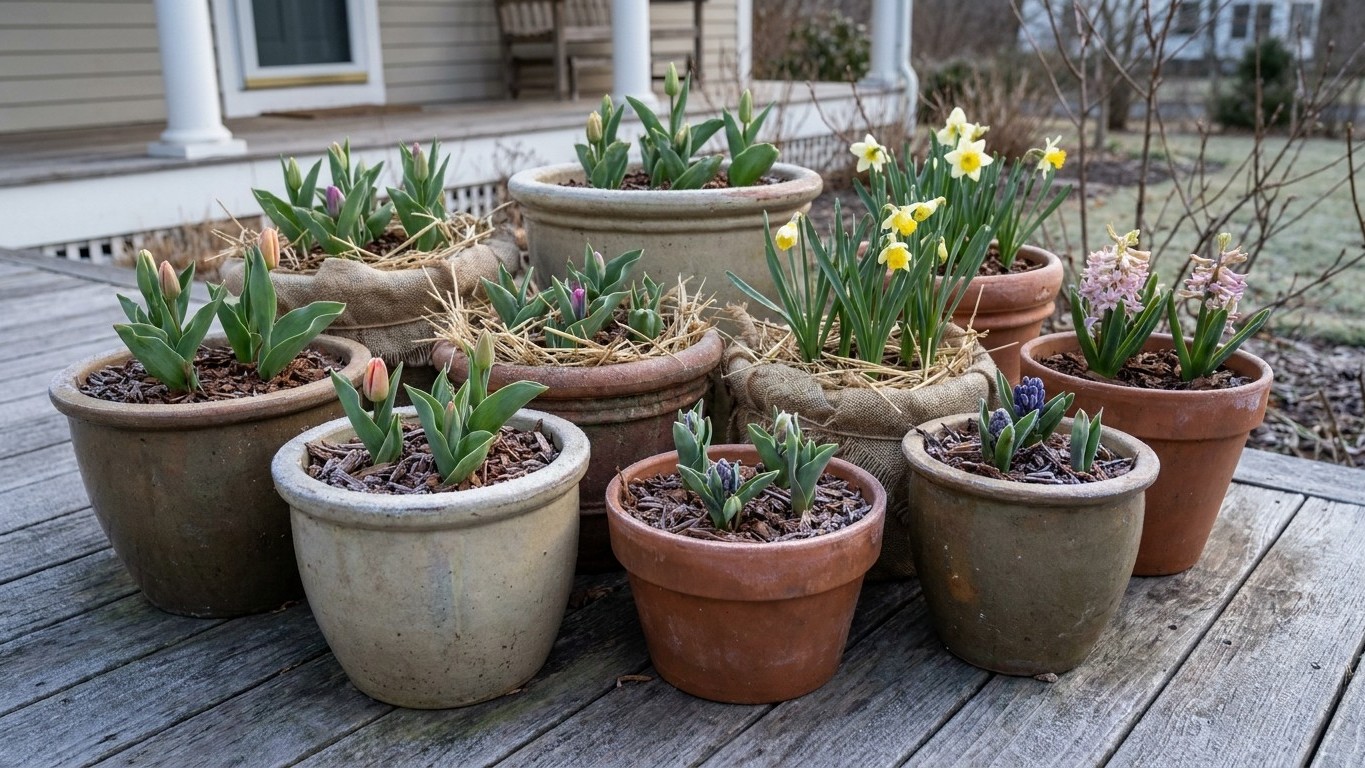

Spring Bulbs in Containers in Connecticut run into two separate risks: not getting the chilling that triggers bloom, and a pot that freezes solid faster than garden soil ever would. Bridgeport’s coldest-month average low sits at 24.4°F, squarely inside USDA zones 6a-7b for the state. That number settles the question fast: Connecticut isn’t short on cold. The challenge is protecting a container from too much of it, while using forcing indoors on your own schedule, not the calendar’s.
Why this matters in Connecticut

The mean daily minimum for the coldest month at the Bridgeport reference station is 24.4°F, according to NOAA NCEI Climate Normals for 1991-2020. That’s not a record low, and it’s not a single freak night. It’s the average low across the coldest weeks of the year, and it stays below 45°F for well past the 12 to 14 weeks a tulip, daffodil, or hyacinth needs to break dormancy and push a stem. Ground planted in a Connecticut yard gets that chilling automatically, no fridge or garage required.
So forcing, in the strict sense of substituting a refrigerator for a missing winter, isn’t a structural need here the way it is in places where January barely dips below 50°F. Connecticut’s problem sits somewhere else entirely: the container itself. A pot sitting on a deck or a set of porch steps has no soil mass buffering it. Cold moves through the sides and bottom of a pot far faster than it moves down through open ground, so the whole root ball can freeze solid, exactly at temperatures that only skim the top few inches of a garden bed.
That’s the gap that trips people up. The USDA Plant Hardiness Zone Map (2023 edition, built on the same 1991-2020 normals) puts Connecticut across zones 6a to 7b, a range built entirely on the average annual extreme minimum temperature of open ground. A bulb rated hardy to zone 6 in the ground is not automatically hardy to zone 6 in a pot standing on that same ground. Treat the two as different climates, because for a bulb’s roots, they are.
Forcing still has a real place in this state, just not the one people assume. Gardeners use it to pull bloom time forward, to have hyacinths or crocuses flowering on a windowsill in the dead of winter well before anything stirs outside, or to grow bulbs like paperwhites and amaryllis that need no chilling at all and were never going to survive a Connecticut winter outdoors regardless. The technique is about timing and control here, not about compensating for a winter that’s too mild to do the job on its own.
How to do it here
The sequence below covers both routes: chilling bulbs deliberately for indoor forcing, and keeping a planted container alive outdoors through a Connecticut winter. Follow it in order.
- Check the bulb’s chill requirement before buying. Most spring-flowering bulbs, tulips, daffodils, hyacinths, crocuses, need 12 to 14 weeks at temperatures between about 35°F and 45°F before they’ll flower. Paperwhite narcissus and amaryllis need none of this and can be skipped ahead to potting.
- Pot the bulbs in a well-draining mix, pointed end up, with the tips just below the soil surface, in a container with drainage holes. No holes means no chilling schedule matters, because the bulb rots before it gets there.
- Choose where the chilling happens. An unheated garage that stays reliably above freezing but below 45°F works well in most Connecticut winters. A refrigerator crisper drawer works too, but keep it away from any ripening fruit; the ethylene gas fruit gives off damages the flower bud forming inside the bulb, before it ever gets a chance to open.
- Track the weeks, not the calendar date. Count from the day the pot goes into cold storage. Twelve weeks is a minimum for most tulips and daffodils; hyacinths and crocuses often need less. Pulling a pot early is the single most common mistake in forcing.
- For containers left outdoors all winter, the pot needs to rate at least two hardiness zones colder than the bulb itself, or it needs to move. A bulb hardy to zone 5 can usually survive a Connecticut winter in an unprotected pot; a bulb only hardy to zone 7 generally can’t.
- If the pot can’t move, mulch it heavily, four to six inches of straw or shredded leaves piled against the sides, or group several pots together against a foundation wall where the building itself blocks some wind and holds a little heat.
- Bring forced bulbs into a cool, bright room once chilling is complete, not a warm one. Moving straight from a 40°F garage to a heated living room too fast is its own failure point, covered below.
Which bulbs are worth it
Not every bulb pays back the trouble of forcing or wintering in a pot. Short chill requirements force faster and more predictably; short stems hold up in a container without staking. Tall growers with long chill windows are harder to time and easier to lose to a toppled pot on a windy porch.
- Paperwhite narcissus, no chilling required at all, blooms in three to four weeks from potting
- Crocus, short chill window, short stem, rarely needs staking
- Muscari (grape hyacinth), compact and reliable, forgiving of a slightly short chill
- Hyacinth, especially bulbs sold pre-chilled or “prepared” for forcing
- Amaryllis (Hippeastrum), no chill needed, large dramatic bloom for a single container
- Tulips, tall stems that lean or topple in a pot once the flower’s weight sets in, and less forgiving of an incomplete chill
- Trumpet-type daffodils like King Alfred varieties, height works against them in a container the way it doesn’t in a border
- Fritillaria, uneven forcing results even under good conditions
- Allium, tall and top-heavy, plus a cost per bulb that makes an unreliable pot outcome sting more
Paperwhites and amaryllis are worth singling out for a different reason. A forced paperwhite bulb rarely rebuilds enough strength to bloom well a second time, and it was never going to survive outdoors in a Connecticut winter regardless. Treating it as a one-season purchase costs nothing extra; that was always the deal.
What goes wrong, and when you can still fix it
Leaves but no flower
This means the chilling period ran short, whether the pot came out of the garage or fridge before hitting 12 to 14 weeks, or an unusually mild stretch in the garage pushed temperatures above 45°F for too many days in a row. There’s no rescue this season; a bulb that skipped its cold quota simply won’t flower now no matter how it’s treated. Let the foliage grow and yellow naturally, then plant the bulb in the ground and give it a full, uninterrupted winter outdoors for a shot at blooming next year.
Flower on a stem too short to see
This is the opposite problem: the bulb was warmed up before it had time to elongate its stem properly, usually by moving it from cold storage straight into a hot, sunny window. The flower still opens, low and stunted, but it won’t stretch after the fact. Nothing corrects it this season. Let it finish blooming and set foliage, then treat it as a candidate for next year’s cooler, slower warm-up.
Rot in a pot
Soft, mushy, foul-smelling bulb tissue almost always traces back to drainage that never existed in the first place: no holes in the container, a saucer that held standing water, or a potting mix packed too dense to let excess water through. This bulb is gone for the season, and usually for good. The only fix is prevention next time: drainage holes, a mix that includes perlite or coarse sand, and a pot that’s never left sitting in its own runoff.