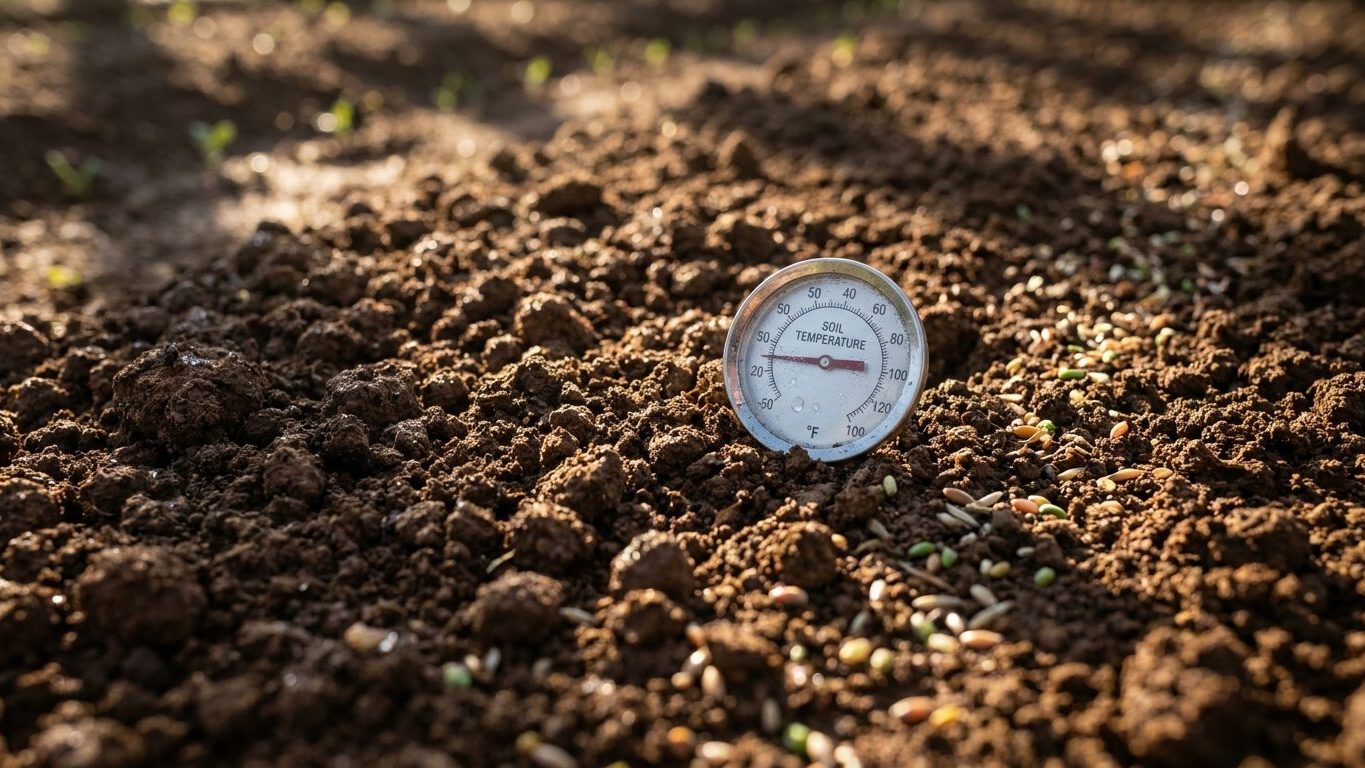

Cover crops in Connecticut go into the ground once soil temperature, not the calendar, says the risk of frost has passed, and they come out mechanically before spring planting begins. The right species depends on how long your local season runs and how cold your winter actually gets, both of which vary sharply between the shoreline and the northwest hills.
When the soil is warm enough in Connecticut
The instinct is to circle a date on the calendar and sow that day. Cover crops do not work that way. NOAA’s 30-year climate normals for the Bridgeport station (USW00094702) put the last spring frost between April 2 and April 12, based on the 30 to 70 percent freeze probability band for 32°F. That is a range built from three decades of weather, not a promise about this particular spring. It tells you when the air stops reliably freezing, not when the soil is ready to grow anything.
Why the frost date is only a starting point
Soil warms slower than air. A morning in early April can feel mild while six inches down the ground is still cold and slow to release nitrogen or support root growth. This matters more for cover crops than for hardy vegetables, because most cover crop species (clovers, vetches, oats, buckwheat) germinate poorly in cold, wet soil no matter how confident the forecast looks. Waiting a week or two past the frost date, until the soil itself has warmed and drained, usually beats planting on the theoretical “right” day. And remember: Bridgeport sits on Long Island Sound, the mildest pocket in the state. Gardens in Litchfield County or the northwest hills should expect both frost dates to arrive later in spring and earlier in fall than this coastal reading suggests.
Getting the timing and rate right
How much seed to put down is not a fixed number. It shifts with the species you choose, whether you’re broadcasting by hand or drilling, and even which supplier’s germination rate you’re working with. Guessing here wastes a season, either through a thin, weedy stand or a crop so dense it smothers itself before it does any good. The UConn Extension service publishes rate guidance tuned to Connecticut conditions, and that’s the source worth checking before you buy seed. When it’s time to end the cover crop’s life, this site sticks to mechanical methods: mowing, crimping, cutting, or simply letting a hard frost finish the job. No herbicide step is part of this process.
How long the season lasts here
Pair the two ends of the year and the picture gets clearer. NOAA’s normals put the first fall frost at Bridgeport between October 28 and November 10, against that April 2 to April 12 spring frost window. Working from the narrowest case (latest spring frost to earliest fall frost), the frost-free stretch runs about 199 days. Working from the widest case (earliest spring frost to latest fall frost), it stretches to roughly 222 days. Either way, that’s somewhere between six and a half and seven and a half months of workable growing season along the coast.
What a long window makes possible
A season that long changes the math on cover crops entirely. It leaves room for a fast-growing summer cover, like buckwheat, to be sown, grown, and turned under in time for a second planting before fall crops or a winter cover crop go in. That kind of succession only works when the calendar gives you slack, and Connecticut’s coastal and lowland gardens generally do. For a full walk-through of how to stack two or more sowings into one season, the succession sowing guide on this site covers the sequencing in detail.
When the window is short
Inland and upland gardens, where both frost dates shift against you (later spring, earlier fall), get a noticeably tighter window. In those spots, the first sowing after spring frost risk clears is often the only one that fits. That changes the calculation on transplants too: a gardener with a short window has less margin to fix a transplant that’s struggling, so checking root development before it goes in the ground matters more than it does somewhere with 220 days to work with.
Heat and water in Connecticut
Connecticut is not a territory where the summer heat writes the cover crop story. There’s no dramatic days-above-90°F count driving the decision here the way it would in the Southeast or the Plains. The figure that actually decides the outcome is winter cold, specifically the coldest month’s mean daily minimum, which at the Bridgeport reference station sits at 24.4°F, placing most of the state in USDA hardiness zones 6a to 7b.
The real driver: winter, not summer heat
That 24.4°F figure is the mean minimum for the coldest month, not a record low and not an average day. It’s the number that determines whether a given species survives the winter standing, or gets killed by the cold and left as a mulch mat by spring. Oats are the clean example: in a genuinely cold Connecticut winter, oats reliably winterkill, leaving a flattened mat of residue that’s easy to till or plant through come April. Push that same oat crop somewhere milder (say, coastal Virginia or the Deep South) and it survives the winter and turns into a weed you have to fight in spring. Connecticut’s cold works in the gardener’s favor there. Cereal rye and hairy vetch, by contrast, are bred to survive this kind of winter, which means they need a deliberate mechanical termination (mowing, crimping, or cutting) rather than relying on frost to do the work.
A cool, damp season has its own risks
Where Connecticut summers do factor in is humidity, not heat. A cool, damp stretch, especially common near the coast and in low-lying inland areas, slows ripening and creates the kind of conditions that favor mildew and fungal disease on dense cover crop stands. That’s a reason to think about airflow when choosing a species and a planting density, even though the state never faces the punishing dry heat that shapes cover crop strategy farther south or west.
Which cover crops suit Connecticut
None of this points to a single winning cover crop. It points to a type, and even that shifts depending on where in the state you’re gardening.
Matching type to Connecticut’s season
A shorter inland season, where frost arrives early and leaves late, favors quick, cool-season types: field peas, oats, and brassicas like mustard or forage radish that germinate fast and put on biomass before the window closes. Along the milder coast, with that fuller 200-plus day season, there’s room for a legume like hairy vetch or clover to establish in fall, overwinter, and build real nitrogen-fixing mass before spring termination. Given the coldest-month reading of 24.4°F, winterkill species (oats especially) are a genuinely low-effort choice almost everywhere in the state, since the cold itself handles termination. Winter-hardy species that survive Connecticut’s cold, cereal rye and vetch among them, require planning for a mechanical cutback in spring rather than relying on frost.
Why no variety name works here
What this page won’t do is name a specific variety or cultivar, and that’s a deliberate choice, not an oversight. A species like clover or oats covers a wide range of cultivars, each bred for different disease resistance, winter survival, and growth habit, and the ones that perform well in a UConn Extension field trial in Storrs are the only recommendation actually tested against Connecticut soil and weather. That data lives with the UConn Extension service, not with a generic gardening article. The same logic applies to seed rates and any nitrogen contribution figures: both depend on the specific variety, how it’s sown, and how much biomass it puts on before termination, details that only a local trial or extension bulletin can responsibly supply.