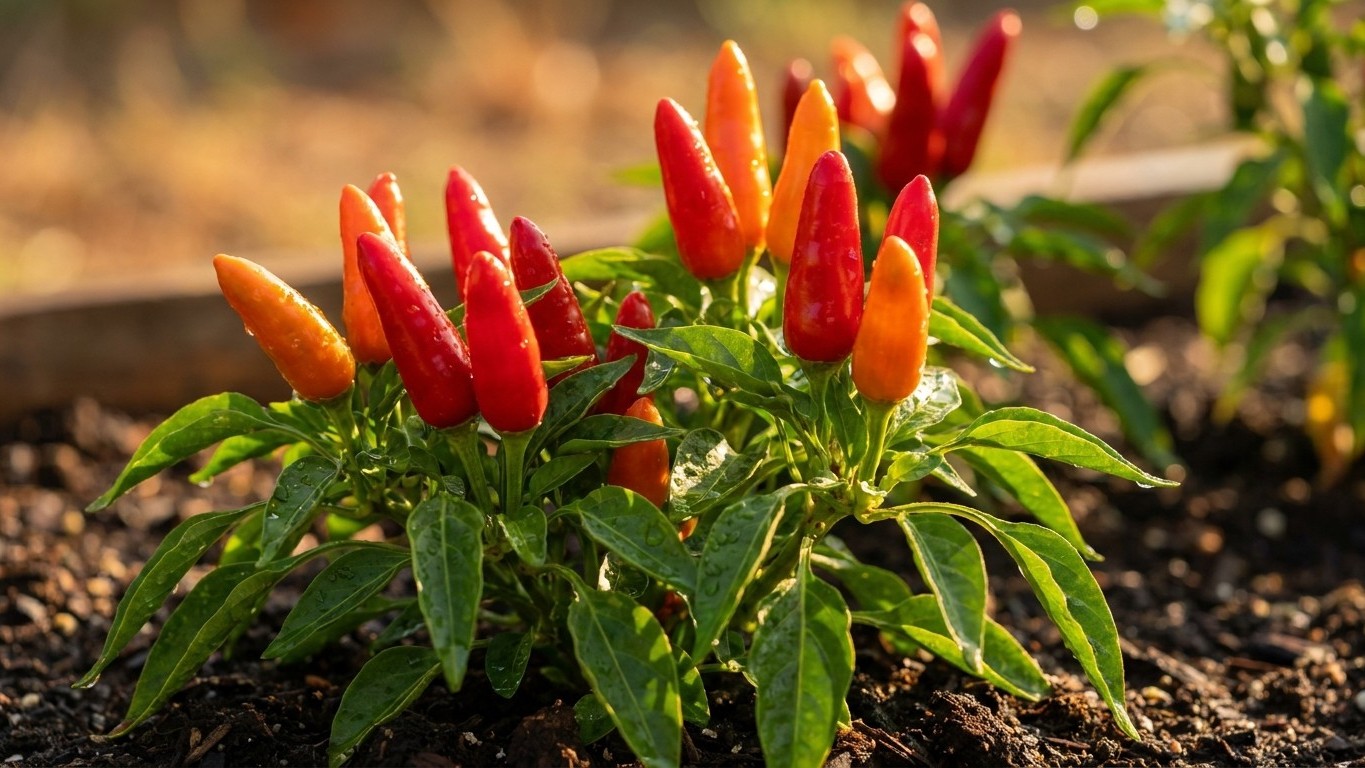

Pick peppers when the fruit is full size, firm and glossy. Clemson Extension puts that at about 70 to 85 days after transplanting. Then keep them out of the refrigerator. Clemson’s storage range is 45 to 50 °F at 80 to 90 percent relative humidity, good for two to three weeks at best, and a home fridge runs colder than that. Below about 45 °F, peppers pit and go soft. The harvest date, though, gets set months earlier, by when you sowed and by what the weather does to the flowers.
The short answer
Heat and cold at flowering
Connecticut’s reference station, Bridgeport, averages 6.2 days a year at or above 90 F, according to NOAA NCEI Climate Normals. That is a count of summer heat load, not an average temperature. Utah State University Extension says pepper fruit set fails when days climb above 90 F, so those 6.2 days are the hot-end risk. It is a small number, roughly one working week spread across a whole summer. For most Connecticut gardeners, heat is not the factor that decides when peppers ripen.
An average hides clusters, though. Two hot days in a row while blossoms are open can drop more flowers than a dozen scattered ones in August. Bridgeport also sits on Long Island Sound, so your yard may run hotter or cooler than the station.
The other end of the range gets forgotten. Utah State is explicit that fruit set fails at both ends: nights below 55 F as well as days above 90 F. This site does not carry summer night minima, and nights cannot be guessed from latitude or from how cold the winters are. A tomato-and-pepper bed in a hollow can run several degrees colder at dawn than one on a sunny slope a hundred yards away. A cheap min/max thermometer set at plant height, read each morning through bloom, will tell you more about your fruit set than any regional average. If it shows nights under 55 F while flowers are open, expect blossom drop and consider row cover until the nights warm. The longer story is in Why Peppers Fail to Set Fruit in Connecticut.
Picking and storing
Once fruit sets, the clock Clemson gives is 70 to 85 days after transplanting. A pepper left on the plant past full size keeps getting more color and sweetness, but it also stays exposed to weather and to whatever is chewing on it (see What Eats Pepper in Connecticut, and When). Cut the stem with pruners instead of yanking, since branches snap easily.
Then comes the mistake nearly everyone makes. Peppers are a warm-season crop, and their tissue is injured by cold even without freezing. The recommended storage temperature of 45 to 50 °F is warmer than a domestic refrigerator. Below roughly 45 °F, the skin develops sunken pits, the flesh softens, and the pepper rots faster than it would have on a cool shelf. That damage is called chilling injury, and it often does not show until the pepper warms up again on the cutting board. The two to three weeks Clemson quotes is a ceiling under ideal conditions, not a promise.
For the full growing picture, the parent guide is Growing Peppers in Connecticut.
When to start seed here
Peppers are slow. Utah State says transplants need 8 to 10 weeks indoors, and they go out only after frost is past and the soil has reached 60 F. Work backward from the transplant date and you get your sowing date. The arithmetic is short enough to redo for any county.
- Find your transplant date. It is the later of two dates: the last spring frost and the day your soil reaches 60 F. At Bridgeport, NOAA NCEI freeze probabilities put the last spring frost between April 2 and April 12. Bridgeport is a coastal station and the mildest part of the state, so inland and northwest Connecticut freeze later in spring. The soil test is separate from the frost date, and a probe thermometer a few inches down tells you when it is met.
- Subtract 8 to 10 weeks. Take the transplant date and count back 56 days for the short end and 70 days for the long end. That gives you a sowing window, not a single day.
- Run a worked example. Say your soil hits 60 F on May 20 (a made-up date, not a Connecticut norm). Eight weeks earlier is March 25, ten weeks earlier is March 11. Sow between those two dates.
- Add the harvest window. Clemson’s 70 to 85 days after transplanting, applied to that same May 20, lands between July 29 and August 13. That is when the first mature fruit could be ready, assuming flowers set normally.
- Check the weather at bloom. Flowers open on their own schedule, and that is when 55 F nights or 90 F days can cost you fruit. If your thermometer shows cold nights, delay hardening off rather than rushing plants into the ground.
The frost dates in this site’s data are for one station, so for a town in the Litchfield Hills or the northeast corner, treat April 2 to April 12 as the earliest plausible date and check your own records for a later one. The same goes for the end of the season: this site does not publish a fall frost date for your town, so find your local one and plan to pick everything before it arrives. A frost can end the harvest in a single night.
Starting too early backfires too. A seedling that sits indoors well past 10 weeks gets root-bound and leggy, and one that flowers in the tray is spending energy it needs for roots. Pinch off those early blossoms before transplanting.
What goes wrong here
Connecticut’s summers are short on extreme heat but full of swings, with cool nights and humid spells, so the failures tend to follow a pattern. Each one below comes with its own remedy.
- Blossom drop in a hot spell or a cool night. Flowers fall off without setting fruit when days pass 90 F or nights dip below 55 F. Bridgeport averages 6.2 days a year at or above 90 F, so the cool end is often the likelier culprit, and you will only know by watching your own nights. Remedy: a min/max thermometer at plant height, row cover on cold evenings, and light shade cloth during a heat wave. Do not fertilize heavily in response; extra nitrogen grows leaves, not fruit.
- Sunscald where the sun is strong. Fruit exposed to direct sun develops pale, papery patches that later turn sunken and tan. It happens most when plants lose leaves to disease, pests or overzealous pruning. Remedy: keep the canopy intact, avoid stripping foliage, and drape shade cloth over plants with thin cover during bright, hot stretches. Pick damaged fruit; the healthy part is usually still edible.
- Blossom-end rot. A dark, leathery patch forms on the bottom of the fruit, usually on the first peppers of the season. It comes from the plant not getting enough calcium to the fruit, most often because watering swings between dry and soaked. Remedy: water deeply and evenly, mulch to hold moisture steady, and avoid heavy nitrogen. Adding calcium to soil that already has plenty rarely fixes it, and a soil test will tell you whether any is needed.
One more problem comes after harvest, and it is entirely avoidable. A pepper put into a cold refrigerator can look fine at first, then pit and soften within days. Store whole peppers somewhere cool and humid, near 45 to 50 °F if you can manage it, and use them within the two to three weeks Clemson gives as a maximum.
Common questions
Should I pick peppers green or wait for color?
Both are edible, so it depends on what you want. Green fruit can be picked once it reaches full size and feels firm. Waiting for the color change means leaving the pepper on the plant longer, which exposes it to more weather and more pests. This site holds no day count for the color change, so judge by the fruit itself.
Where do I keep picked peppers if not the fridge?
Aim for Clemson’s range of 45 to 50 °F with 80 to 90 percent relative humidity. A cool cellar or an unheated room may come close, but check with a thermometer instead of guessing. If you cannot hit that range, store them somewhere cool and use them quickly. Two to three weeks is the best case, not the norm.
How can I tell chilling injury from ordinary spoilage?
Chilling injury shows as small sunken pits in the skin and soft, watery flesh, and it often appears after the pepper returns to room temperature. Ordinary spoilage typically starts with a wrinkled, shriveled skin or a mold spot. If a pepper pits within a day or two of leaving the fridge, the cold is the likely cause.
Does 6.2 days above 90 F mean heat is not a concern in Connecticut?
It means heat is rarely the main limit, at least at the Bridgeport reference station. It does not mean heat never matters. A hot spell that lands when your plants are in bloom can still drop flowers, and your yard may run hotter than a coastal station. The cool end, nights under 55 F, is the half this site cannot measure for you, so keep your own record.