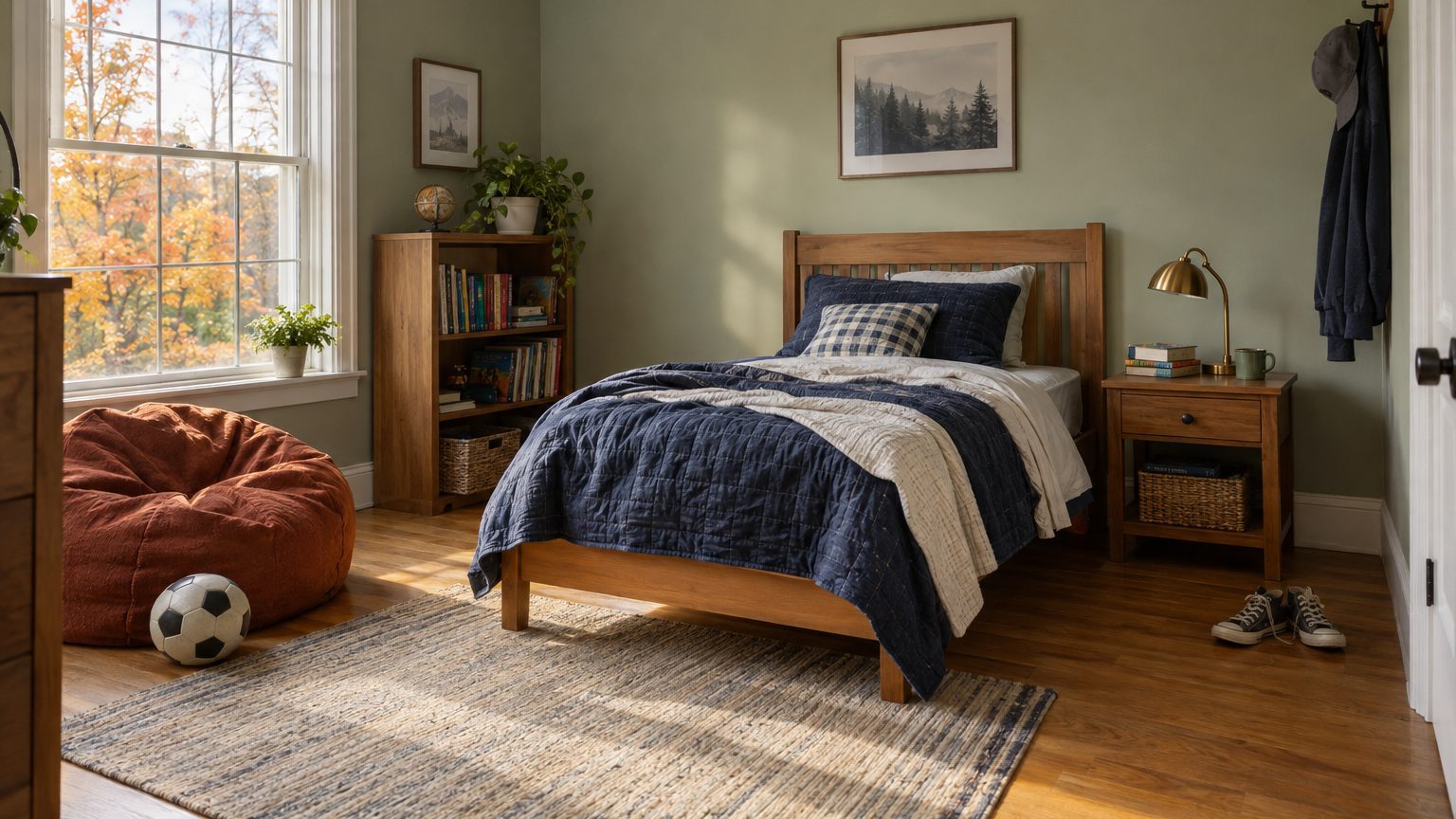

The best boys room paint colors beyond blue are muted greens, warm earth tones like clay and ochre, and deep neutrals such as charcoal or greige. Which one works depends less on the child than on the window. A color that looks calm in a south-facing room can turn gloomy in a north-facing one, and the reverse is also true. Pick the hue by the light, the depth by the age, and the finish by how much wall-leaning, ball-tossing and sticker-peeling the room will see.
Blue became the default for a reason. It is safe, it reads as calm, and almost every paint line has a dozen versions. But a room painted at age four often has to serve a fourteen-year-old, and that long runway is where the obvious choice starts to wear thin. This guide is part of a broader look at room color by occupant and light, so you will find the same logic in the Decor section, applied to other rooms.
Five color families worth a real look
Green comes first, and it is the strongest alternative. It sits in the same cool-to-neutral zone as blue, so it feels restful, but it handles changing light better. Sage and gray-green hold steady from morning to evening. Deeper olive and forest shades suit older kids who have outgrown anything that looks like a nursery. A green with a little gray in it also plays nicely with wood floors, which tend to run orange or yellow in many American homes, particularly oak.
Earth tones are the second option. Think clay, terracotta, warm tan and soft rust. These colors have exploded in popularity over the past few years, partly because they make a room feel enclosed and snug rather than airy and sterile. A muted terracotta on all four walls can look bold for a seven-year-old and still look deliberate for a seventeen-year-old. The trick is staying on the dusty side. Bright orange-reds read as a theme, and themes expire.
Third, charcoal and other deep neutrals. A dark gray or a gray with a green or brown undertone can look surprisingly grown-up and hides scuffs better than any white. Dark colors also absorb light, so they need a window that earns its keep or bulbs that do the work. In a small room with one small window, going dark can make the walls feel as if they are closing in. In a large room with good daylight, it can feel like a cozy den.
Fourth, warm yellows and ochres. These are tricky, because a yellow that looks buttery on a chip can look like a highlighter across 380 square feet of wall. Pull the saturation way down. A muted wheat or a slightly gray gold gives you the sunny effect without the glare. This family does especially well in rooms that face north, where light is cool and the walls need some help.
Fifth, and often overlooked, are the soft neutrals with personality: greige, warm putty, mushroom, and pale stone. They are not exciting on a paint chip. On a wall, though, they give a kid room to change taste every year by swapping bedding, posters and rugs, which is exactly what children do. If you suspect your son will have strong opinions at twelve, this is the lowest-regret path.
Let the window pick the shade
Direction matters more than most people admit. A color in a store aisle is seen under flat fluorescent light. At home, the same color is lit by a window that changes every hour, and the compass direction sets the baseline.
North and east light
North-facing rooms get cool, even, slightly bluish light all day. It makes cool colors look colder and can drain a gray into something close to concrete. Warm up the palette here: a clay, a warm tan, a wheat yellow, or a green that leans toward olive instead of mint. East-facing rooms have the opposite problem across the day. Mornings are warm and golden, afternoons turn cooler and flatter. A boy who gets up early and does homework late will experience both. A mid-tone green or a warm neutral handles the swing without drama.
South and west light
South light is bright and warm for most of the day, which is forgiving. Almost any color holds up, and deep shades like forest green or charcoal can be pulled off without feeling heavy. West-facing rooms are the quirky ones. They look fairly neutral until late afternoon, then flood with amber light that can push a beige toward orange and a terracotta toward fire-engine. If the room faces west, test your sample at 5 or 6 p.m., because that is when it will look its most extreme. It is also when most kids are actually in their rooms.
A practical way to do this: paint two-foot squares on at least two different walls, not just the one you like best. Look at them in the morning, at midday, in the evening, and under lamp light at night. Painting a sample on poster board and moving it around works too, and it saves you from a patchwork wall you will have to prime over.
Bulbs count as much as windows. Warm white bulbs (around 2700K) bring out the warmth in greens and earth tones. Bulbs near 5000K, sold as daylight, will make the same paint look cooler and sharper, which can be fine for a desk corner and harsh for a bedroom. Pick the bulb before you pick the final shade.
Built to last from age 5 to 15
Most of the staying power of a kid’s room comes from depth rather than hue. Every paint color has a light reflectance value, or LRV, a scale from 0 (absorbs everything) to 100 (reflects everything). It is printed on the back of many paint chips and listed on most manufacturers’ websites. Colors in the 40 to 60 range, the true mid-tones, are the sweet spot for a child’s room. They hide fingerprints and dings better than very pale shades, yet they do not swallow light the way a color under 15 will. If a room has a single small window, aim toward the higher end of that range.
Sheen is the second lever. Flat paint hides wall imperfections but marks easily and does not take scrubbing well. Eggshell and satin are the usual compromise for kids’ rooms, because they wipe down without throwing glare. Semi-gloss belongs on trim and doors, where hands land most often. Many paint makers now sell washable matte formulas, which can look better than eggshell on slightly wavy walls, but check the label for scrub ratings before you commit.
Then there is the question of how much of the room to color. One approach that ages well: paint all four walls a quiet shade, then add personality through a single deeper wall behind the bed or a painted door. When tastes change, you repaint one wall instead of the whole room. A full-room commitment to something as strong as dark olive is fine if your son is sixteen and asked for it. For a six-year-old, a milder shade gives you more room to adapt.
Quantity matters for budgeting. A 12-by-12-foot room with 8-foot ceilings has roughly 384 square feet of wall before subtracting doors and windows. One gallon typically covers 350 to 400 square feet per coat, so two coats on a room that size means about two gallons. Dark colors often need a tinted primer or an extra coat, especially if you are covering a lighter shade, so plan for a third gallon if you are moving from pale yellow to deep green.
Shared rooms, open lofts and other special cases
Two brothers sharing a room rarely agree on color, which is an argument for the soft neutrals and the muted greens. A shared room works best when the walls are the calm backdrop and each boy claims his own corner with a bedspread, a bulletin board, or a painted headboard shape. If the room opens onto a hall, a landing or a family area, the same principles from Open Plan: The Hard Part Is Where to Stop apply: decide where one color ends and the next begins at a natural break, such as a door frame or a change in ceiling plane, not mid-wall.
Teen boys, meanwhile, tend to want the room to feel less like a kid’s room, and that is where charcoal, deep green and rust come in. A reasonable middle path is a neutral base now, with an agreement that the teenager picks the accent color at around twelve or thirteen. It keeps the repaint cost modest and hands over a bit of ownership. Households with a daughter will find a parallel approach in Paint Colors for a Girl’s Room That Outlast the Phase, and many of the same undertone rules carry over regardless of who sleeps there.
One more consideration for older homes. If the house was built before 1978, the existing paint may contain lead, and the EPA requires lead-safe work practices when contractors disturb painted surfaces in homes with children under six. Sanding and scraping are the biggest risks. If you are doing the work yourself, test the old paint with a kit or hire a certified inspector before you touch a wall, and use a damp-wipe approach rather than dry sanding. Nursery-age rooms are where this matters most.
Last, a small nuance that trips up nearly everyone: wet paint looks different from dry paint. Most colors dry slightly darker, and some shift undertone as the finish cures. Give your test swatch a full 24 hours before you judge it, and look at it again the next evening before buying the gallons.