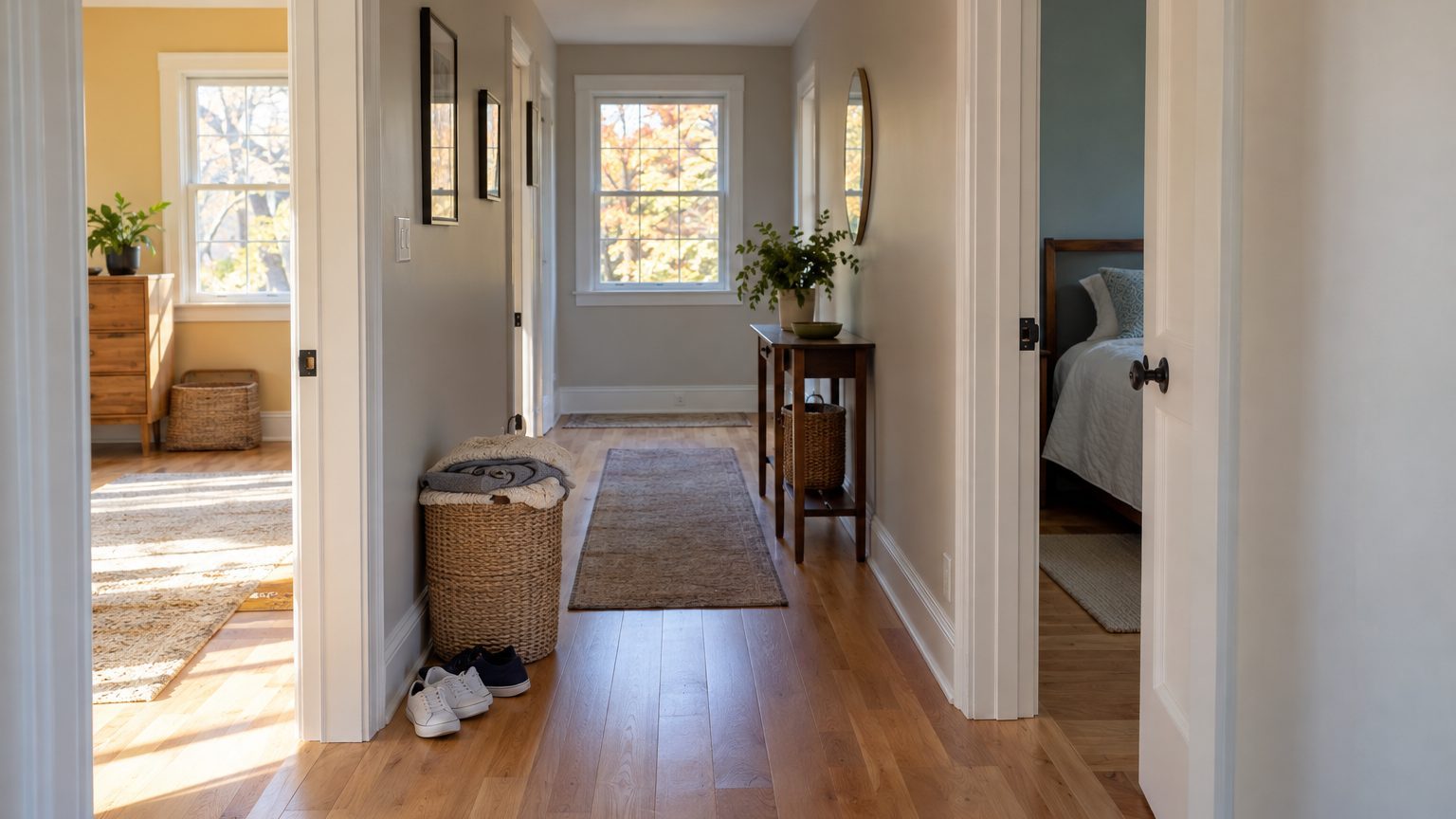

Pick a hallway color that stays pleasant as a glimpse, holds up to hands and shoulders, and works with whatever light the space actually gets. In practice that usually means a mid-light to light tone with a slightly warm undertone, in a satin or eggshell finish you can wipe down. Dark and saturated colors can work too, but they ask more of your lighting and your prep. A hallway is not a room you sit in. People pass through it carrying laundry baskets, groceries, and sleeping toddlers, so it gets judged differently than a bedroom or living room.
A color you see for three seconds
Nobody studies a hallway wall. You see it in passing, usually while looking at something else: the open door at the end, the light switch, the kid who is somewhere he shouldn’t be. That changes what matters. Fine undertone differences between two similar beiges, the kind that sends people into a paint aisle spiral in a living room, tend to disappear at walking speed. What registers is value (how light or dark the color is), how warm or cool the overall impression feels, and whether it clashes with the rooms on either side.
The neighbors are the real constraint. A hallway is a connector, and every open door frames a slice of another room’s color. A cool gray hallway next to a golden-yellow kitchen and a blue-green bedroom produces a stack of competing temperatures in a single sight line. The simplest fix is to choose a hallway color that sits in the middle of what it connects, a soft neutral that can borrow warmth from one door and coolness from another without picking a side. If you already worked through an open layout, the same logic is covered in Open Plan: The Hard Part Is Where to Stop, where the question is where one color ends and the next begins. A hallway has the same problem in a tighter format.
One test is worth doing before you buy anything. Stand at each end of the hallway and look toward the other end, then stand in each doorway and look out. Those are the real viewing angles. A color that looks calm from the middle can feel heavy from the far end, where the wall becomes a flat backdrop to everything else you see.
Continuity beats variety
Long hallways tempt people to change color halfway, or to paint a single accent wall at the end. Sometimes that works, but it usually reads as an interruption. A hallway is already a visual tunnel, and breaking it into segments tends to make a narrow space feel narrower. Building codes in most of the country (the International Residential Code sets a 36-inch minimum width for hallways) treat three feet as acceptable, which tells you how tight many of them are. In a space that narrow, a single continuous wall color, with the ceiling and trim doing the contrast work, is the calmer choice.
If you want something more than one color, put the variation on the vertical plane instead. A deeper tone below a chair rail or a picture-rail line, with a lighter tone above, adds interest without chopping up the length. The lower band also happens to land where the wear is, which brings us to the second half of the title.
Where hands, bags, and vacuums leave their marks
Walk through your own hallway and notice what you touch. The light switch, obviously. The wall at hand height when you steady yourself on a stair or turn a corner. The corners, which take a beating from vacuum cleaners, strollers, and suitcases. And the bottom foot or so, where shoes, pet claws, and backpacks leave scuffs. Wear in a hallway is not random. It concentrates in three bands: roughly 30 to 48 inches off the floor for hands and bags, the bottom 12 inches for kicks and wheels, and the first few inches around any corner or door frame.
Finish matters more here than in almost any other room. Flat paint hides wall flaws best but burnishes and marks easily, and it can be hard to clean without leaving shiny patches. Satin and eggshell cost you a little visibility of imperfections and give you a surface that tolerates a damp cloth. For hallway walls, most painters lean toward eggshell or satin, and semi-gloss is the usual choice for baseboards and door casings that take direct contact. Look for products that state scrub resistance on the label or technical data sheet. Many manufacturers test against the ASTM D2486 scrub method, though how they report it varies, so compare within a brand line rather than across brands.
Color interacts with finish and wear in ways people overlook. Pale walls show dark scuffs and fingerprints clearly. Deep colors show pale chalky rubs and dust. Mid-tones with a touch of gray in them, soft greiges, muted sages, dusty blue-grays, tend to be the most forgiving because they sit between both kinds of marks. That is a general tendency, not a guarantee, and a sample patch rubbed lightly with a dry cloth tells you more than any chart.
Prep and cure time deserve a mention because hallways get repainted in a hurry. Paint can feel dry within hours, but most manufacturers say it takes a few weeks to fully cure, sometimes up to 30 days. Scrubbing a freshly painted hallway at day three is how people take the finish right off. Wait, and in the meantime, blot instead of rub. A decent primer over patched drywall or bare repairs also matters, since hallway walls often carry years of nail holes and old picture hooks that flash through topcoat as dull spots.
Light is the variable you can’t see until night
Most hallways have no windows. Light comes from a ceiling fixture or two, maybe a skylight, and whatever spills from adjoining rooms. That means the color you pick at the store, under daylight-mimicking tubes, will behave differently at 7 p.m. with a single warm bulb overhead.
Light reflectance value, or LRV, is the number to look for on a paint chip or in the manufacturer’s color details. It runs from 0 (absolute black) to 100 (pure white) and tells you how much light a color bounces back rather than absorbs. A rough working rule: in a windowless or low-light hallway, colors with an LRV above about 60 keep the space feeling open, while colors below 30 or so will read as dark unless you add light on purpose. Many popular warm whites and pale neutrals fall in the 70s and 80s. Deep navy and charcoal can drop below 10.
That doesn’t rule out dark hallways. A deep, saturated color can look rich and deliberate in a hallway precisely because nobody lingers there, and the dimness is part of the effect. The catch is that it needs more light, not less, to avoid looking like a cave. Wall sconces, a flush-mount fixture with a wide spread, or a row of recessed lights make a difference. If you go dark, paint the ceiling and trim in the same color or a close relative, which blurs the edges and makes the walls recede instead of closing in.
Bulb choice changes everything. A bulb around 2700K to 3000K gives the warm white most people expect at home, and a high color rendering index (CRI 90 or above is a common benchmark for good color accuracy) keeps paint colors close to what you saw on the chip. A cool 5000K bulb turns a warm beige green-gray and a soft white into something clinical. Swap the bulbs before you decide the paint is wrong.
Test properly. Paint a sample on poster board or a large swatch at least two feet square, and tape it up at both ends of the hallway and near a doorway. Look at it in the morning, in the afternoon, and after dark with the hallway light on. Do it over two days if you can. Hallway color is the one place where the evening version, not the daytime one, is what you live with most.
Matching the color to the kind of hallway you have
Not all hallways behave alike, and the advice shifts a little depending on the setup. Here are the common ones.
- Narrow and windowless: a light warm neutral with an LRV in the 60s or 70s, satin finish, and a slightly deeper trim or door color for definition.
- Long with several doors: one continuous color that sits between the adjoining room palettes, with doors painted either the wall color or a single consistent accent.
- Hallway with a window or skylight at one end: more freedom, since the natural light lets mid-tones and even deeper shades hold up. Check the color at both ends, because the far end will look darker.
- Kids’ hallway: durable eggshell or satin in a mid-tone, since the lower half of the wall will see more contact than the upper. A scrubbable finish pays off here more than anywhere else in the house.
Families with children sharing a bedroom have a version of this problem too. When the room’s color is already a compromise, as covered in Two Children, One Room, Two Opinions, the hallway is where a calm neutral earns its keep, because it doesn’t compete with either child’s side. For the broader picture of how color decisions change room by room, the Decor section collects the rest of the series.
Renters have a narrower set of options, and a different priority. Most leases require repainting or returning walls to a neutral, so a soft warm white or pale greige in a washable finish is usually the safest bet. If you want more, you can add color through large framed art, a runner, or a painted door (check your lease first), none of which touches the walls.
On the ceiling, white is the safe call, but in a low-light hallway a ceiling a half-step lighter than the walls, or the same hue at a higher LRV, bounces more light downward than stark white sometimes does. It’s a small adjustment, and a sample board will show you whether it earns its place.
One last practical detail: bring the trim into the conversation early. Baseboards, door casings, and the frames around passthroughs make up a surprising share of the visible surface in a hallway, often more than the wall itself when you count every door. A semi-gloss trim in a soft white against a mid-tone wall gives the eye a rhythm to follow as you walk, and it’s also the easiest surface to wipe clean. Doors that stay closed most of the day can be painted the wall color so they disappear. Doors that are usually open show their edges and inside faces, so those edges deserve the same care as everything else.
Paint stores will tell you a gallon covers around 350 to 400 square feet. A typical 3-foot by 20-foot hallway with 8-foot ceilings has roughly 320 square feet of wall before you subtract doors, so one gallon of wall paint usually does a coat with a little left over, and a second coat means buying a second gallon or a smaller can for the touch-ups you will inevitably need after the first suitcase comes through.