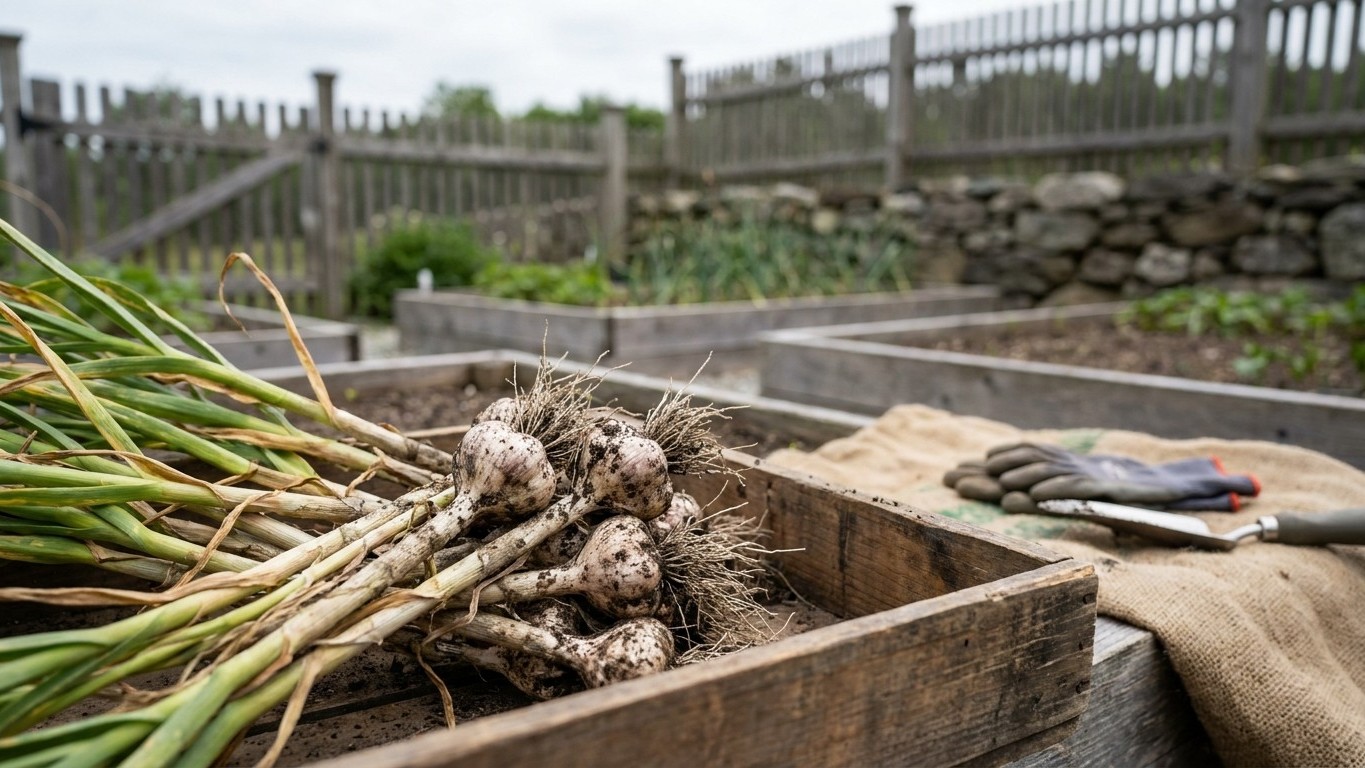

Garlic in Delaware gets attacked in four waves, and each one follows a stage of the crop rather than a date on the wall. Soil pests chew on cloves in fall. Voles and mice tunnel under winter mulch. Thrips and leek moth larvae show up with spring warmth. Bulb mites and nematodes ride along into storage and into next year’s seed. Garlic goes in during autumn and comes out the following summer, so a clove spends most of a year in the ground, and the threat changes with every season.
The short answer for Delaware
The first fall frost at the state’s reference weather station falls between October 26 and November 7, per the NOAA NCEI 1991-2020 Climate Normals (the 30-70% probability band for a 32°F freeze, measured at an airport station). That window is also when most Delaware gardeners plant, so it is where the pest calendar begins.
Treat those dates as a midpoint, never a safe date. In one year out of two the frost arrives later, which leaves the soil warm and the pests active longer. The figure also describes an airport, not your yard. Suburban and rural gardens often see the first fall frost one to two weeks earlier, and more at elevation.
Behind that anchor, the threats arrive in a fairly predictable order:
| Wave | Season | Who is feeding | What you see |
|---|---|---|---|
| 1 | Planting through early winter | Wireworms, grubs, other soil insects | Hollowed or missing cloves, patchy emergence |
| 2 | Winter dormancy | Voles, mice, squirrels | Dug-up cloves, runways under mulch |
| 3 | Spring into early summer | Onion thrips, allium leaf miner (leek moth), slugs | Silvery streaks, tunneled leaves, ragged edges |
| 4 | Harvest and storage | Bulb mites, curl mites, stem and bulb nematodes | Soft or shriveled bulbs, twisted leaves, bad seed stock |
The mechanism is simple. Cloves are most exposed in the weeks between planting and rooting, when they are a buried snack with no defenses. Once roots anchor the clove and the ground cools, the soil insects slow down. Rodents are the winter problem. Soft-bodied spring pests come after the leaves expand, and the mites and nematodes are the ones you may carry in yourself, on seed garlic. Plant a week too early or too late relative to frost and you change how long each of those exposures lasts. For the full planting math, see When to Plant Garlic in Delaware: Counting Back From the First Frost.
Working it out for your own garden
A state is not one climate, and the reference station is one point on the map. Elevation shifts dates, the Delaware Bay and the Atlantic coast shift them, and so do cold pockets in low fields. Roughly two weeks either way is a fair swing to expect. The pest calendar moves with them, so it is worth redoing the arithmetic for your own ground.
Start with the anchor: October 26 to November 7. Now subtract for your site. If you garden inland on open rural land, take off the one to two weeks that non-airport sites commonly lose. October 26 minus 14 days is October 12. November 7 minus 7 days is October 31. So a rural inland garden might reasonably expect its first frost somewhere from mid-October to the end of the month. That is a working estimate, not a promise, and a late frost year will overshoot it.
From that adjusted date, work through the pest windows in order:
- Planting day. Count back from your own first frost, using the planting calendar linked above, and pick a date that gives cloves time to root before the ground freezes.
- Soil-insect window. This runs from planting until the soil cools down hard. In a warm, late-frost fall it stretches out, so inspect a few cloves if seedlings fail to show.
- Rodent window. Starts when you mulch and ends when the mulch comes off. Wait to mulch until the ground has chilled, and pull it back in spring as growth begins.
- Spring window. Begins when leaves are up and temperatures climb. Check leaves weekly for streaks and tunnels.
- Storage window. Starts at harvest in summer and covers the cure. Sort out soft or discolored bulbs before they touch anything else.
The same logic works backward from a bad year. If frost came three weeks later than expected, soil insects had three more weeks of warm feeding. If a cold snap arrived early, cloves planted late had little time to root, and that is when rodents find them most easily. Keep a simple note of your planting date, first frost and what you found at harvest. After two or three seasons you will have a local pest calendar better than any statewide table.
One honest limit: the facts used here give the first fall frost only. This article does not publish spring dates, soil-temperature thresholds or insect emergence dates, and nothing here should be read as those numbers. For pest timing that precise, local scouting beats any averaged figure.
What changes across Delaware
Delaware is small, but its three counties do not behave alike. The reference station sits in New Castle County, in the north, where the land rolls up toward the Pennsylvania line and the soils lean heavier. Gardens on those slopes and away from the Delaware River tend to cool earlier in fall. Cold air also pools in low spots, which can put a frost date ahead of the airport’s. Northern gardeners are also closest to Pennsylvania, so pests that move south through the Mid-Atlantic, allium leaf miner among them, tend to show up here first. Ask extension whether it has been confirmed in your area before assuming either way.
Kent County, in the middle, is mostly flat farmland. Frost dates there often land near the reference range, but open fields without windbreaks can lose a week or so to radiational cooling on still nights. Flat ground and agricultural neighbors also mean wireworm and grub pressure in beds cut from former sod or pasture.
Sussex County, in the south, runs ahead of the others in warmth. The Atlantic Ocean, the Inland Bays and the Delaware Bay hold heat into fall, so coastal gardens frost later than the airport figure, sometimes well past the November 7 end of the window. That means a longer stretch of active soil insects after planting and a bigger risk of cloves sending up top growth too early. Sandy coastal soils also drain and warm quickly in spring, so thrips and other spring feeders can get going sooner than in the north.
Delaware has no large lake to bend the climate and little real elevation, so most of the swing comes from the coast, from latitude north to south, and from local cold pockets. Variety choice interacts with all of this, since some types handle wet springs and cold snaps better. The state guide to Garlic Varieties That Suit Delaware Winters covers that, and the broader overview at Growing Garlic in Delaware ties the three regions together.
The mistakes this climate punishes
Delaware sits in a middle zone. Winters are cold enough that garlic wants the chilling period, yet falls are long and often warm. That combination makes particular errors expensive here.
Planting too early into warm soil
A warm October invites an early start. But cloves planted well ahead of frost grow a tall green shoot before winter, and that tender growth can burn in a hard freeze and attracts early chewing. Soil insects also get a longer feast on cloves still in warm ground. Since the frost date is a midpoint and falls later in half of all years, planting “before frost” can mean planting into weeks of mild weather. Anchor on your adjusted frost date instead, and let cloves root rather than race upward.
Choosing the wrong type or the wrong seed
In a mild-winter state like Florida, the trap is planting a hardneck that never gets enough cold, a problem covered in When to Plant Garlic in Florida: Counting Back From the First Frost and Garlic Varieties That Suit Florida Winters. Delaware has the opposite exposure. Its winters are cold enough for hardnecks, so the bigger danger is poor seed. Grocery-store bulbs can carry mites or nematodes, and once stem and bulb nematodes infest a bed, you cannot spray them away. Buy clean seed garlic and discard soft or discolored cloves.
Mulching too soon and replanting in the same spot
Heavy straw laid over warm soil in October gives voles a ready-made shelter right when the cloves are tender. Mulch after the ground has chilled and keep it loose. Likewise, planting garlic where onions, leeks or garlic grew last year lets soil-borne problems build up. Rotate to a different bed, and wait several seasons before returning. Wet Delaware springs, finally, keep slugs busy and foliage damp, so thinning crowded rows and clearing debris matters more here than in a dry climate.
Checking this against your county
The figures here describe one reference station, not your garden. For county-level frost dates, local pest reports and soil testing, contact University of Delaware Cooperative Extension. Agents can tell you which pests are active in your county this season and which varieties and seed sources are dependable.
Common questions
What is the most common garlic pest in Delaware?
No Delaware-specific ranking is published here, so no pest can be named as the most common without inventing a statistic. Gardeners most often report trouble from soil insects, voles, onion thrips and, on the bulb side, mites and nematodes. Scouting your own beds is more reliable than any average.
When should I start watching for pests?
From planting day. Cloves are most vulnerable between planting and rooting, which runs from your planting date toward the first frost (October 26 to November 7 at the reference station, often earlier for suburban or rural gardens). Check again at spring green-up and at harvest.
Can I stop voles from eating my garlic?
You can lower the odds. Hold off mulching until the ground has chilled, keep mulch loose rather than packed, and clear tall grass and debris near the bed. Bury cloves at a proper depth, and consider a wire barrier below and around the bed in vole-heavy areas.
Is store-bought garlic safe to plant?
It is a gamble. Grocery bulbs are not bred for local conditions, and they may carry mites or nematodes that remain in your soil for years. Seed garlic from a reputable grower costs more, but one infested bed can cost you the ground itself, not just a season’s crop.