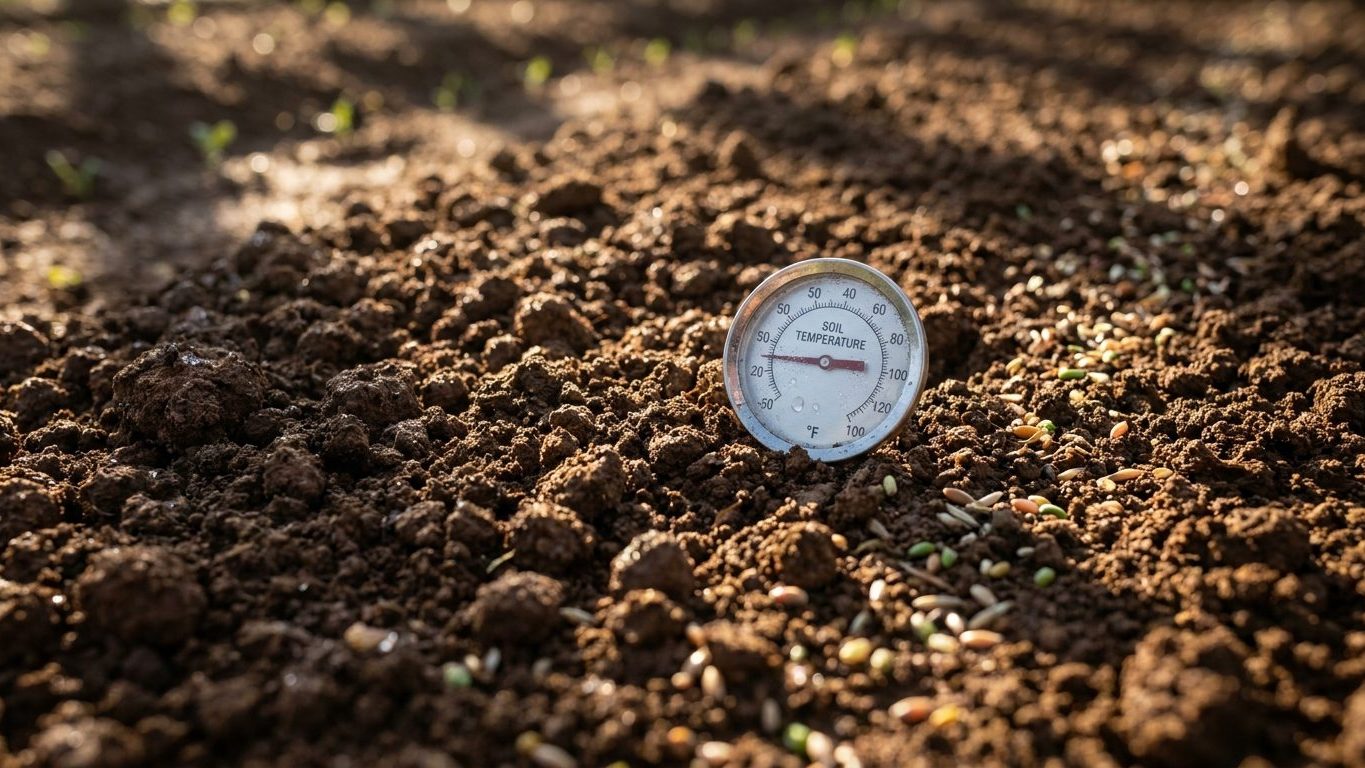

In Delaware, the soil is generally workable for a spring cover crop planting once you’re past the last spring frost window, typically the week of April 3 to April 14 near Wilmington, though many gardeners in cooler pockets wait another week or two before soil temperature actually supports fast germination.
When the soil is warm enough in Delaware
Everyone wants a single date. The honest answer is that frost dates and soil readiness aren’t the same thing, and treating them as interchangeable is how a lot of spring cover crop seed rots in cold, wet ground.
According to NOAA’s 1991-2020 Climate Normals for station USW00013781 (Wilmington), the last spring freeze at 32°F falls somewhere between April 3 and April 14, based on the 30-70% probability band for that station. That’s not a promise. It’s a range built from three decades of data, meaning some years the last freeze lands earlier, some years later, and the station itself sits at an airport, where pavement and open exposure tend to record milder minimums than a shaded backyard a few miles inland. Suburban and rural gardens in the same county often see that final frost show up a week or two later than the airport figure suggests, so treat April 14 as a floor, not a target date.
Here’s the part that actually matters for cover crops: soil warms on its own schedule, independent of the air. A frost-free morning doesn’t mean the top four inches of ground have shaken off winter. Legumes like clover and vetch, along with grasses like oats or annual ryegrass, germinate reliably once soil temperature climbs past a threshold that usually happens one to three weeks after that last frost date has passed, not on the same day. Gardeners who seed the instant frost risk clears often see spotty germination, then blame the seed, when the real issue was cold soil slowing everything down.
A simple habit works better than a calendar date: push a soil thermometer two inches down, first thing in the morning, for a few days running. Once that reading holds steady rather than swinging wildly between a warm afternoon and a cold dawn, the ground has stabilized enough for spring-sown cover crops to take.
Seeding rate is where a lot of guides get generic and wrong. How much seed you put down depends on species, whether you’re broadcasting or drilling, and the seed source’s own germination rate, all of which vary too much for a blanket number to be useful. Delaware’s Cooperative Extension service maintains current, tested recommendations for the state, and that’s the right place to confirm rate before you buy seed, not a general gardening article.
How long the season lasts here
Stack the two frost windows together and you get the real length of the growing season, the number that actually decides how many cover crop cycles fit between now and next spring.
Using the same NOAA station, the last spring frost falls April 3 to April 14, and the first fall frost falls October 26 to November 7. Do the subtraction across the tightest combination (April 14 to October 26) and you get roughly 195 frost-free days. Stretch it to the widest combination (April 3 to November 7) and it’s closer to 218 days. Either way, Delaware’s frost-free window runs somewhere between six and a half and seven and a half months, which is generous by Mid-Atlantic standards and gives gardeners real flexibility in how they schedule cover crops around vegetable beds.
What that window makes possible
A season this long supports more than one cover crop cycle if you plan it. A gardener can seed a quick spring cover, terminate it by mowing or cutting before the summer vegetable planting, then follow up with a second cover crop seeded in late summer for fall and winter coverage, all inside the same frost-free stretch. That’s a genuine advantage over shorter-season states farther north or at higher elevation, where a single sowing is often all the calendar allows.
It also changes how you think about transplanting into a bed that just hosted a cover crop. With nearly seven months of open season in many years, there’s room to let a cover crop’s root mass break down properly before transplanting into that same ground, rather than rushing a termination and planting into roots that haven’t finished decomposing. If you’re stacking sowings through the year, the site’s succession sowing guide walks through how to sequence cover crops with vegetable plantings without leaving gaps in coverage.
The caveat worth repeating: these are airport-station dates. A garden in a low-lying, rural part of New Castle or Sussex County can see frost arrive a week or two earlier in fall and linger a week or two later in spring than these figures suggest, which shrinks the usable window somewhat. Check your own county’s typical frost pattern against these numbers rather than assuming they apply exactly to your yard.
Heat and water in Delaware
No days-above-90°F count or summer rainfall figure is available for this reference station in the data behind this page, so rather than guess, let’s focus on what genuinely decides which cover crops survive in Delaware, and that’s winter, not summer heat.
For cover crops, the question that matters most isn’t how hot July gets. It’s two things: when the first fall frost arrives, which sets the last date a cover crop can still be seeded and establish before cold shuts growth down, and how cold the coldest month actually gets, which decides whether a species survives the winter as a living plant or dies back into a dry mulch on its own.
Delaware’s coldest month, per NOAA’s 1991-2020 Climate Normals for the Wilmington reference station, has a mean daily minimum of 25.6°F. That figure is not the record low and not a monthly average, it’s the typical overnight low across the coldest month, and it’s the number that actually predicts winter survival for cover crop species. Under the USDA Plant Hardiness Zone Map (2023, built on 1991-2020 normals), Delaware spans zone 7a to 8a, a range built on average annual extreme minimum temperature, with Wilmington itself sitting toward the milder end of that range.
Put those two numbers together and you get a useful split. A mean minimum around 25.6°F is cold enough to knock back tender annuals but not cold enough to reliably kill hardier grasses on its own. That means a species like oats, which dies back cleanly to a frost-killed mulch in colder zones, may instead limp through a mild Delaware winter as a semi-living plant, turning what should have been a self-terminating cover crop into something that needs to be mowed or cut by hand in spring before it turns into a weed problem in the bed. Meanwhile, truly hardy species like cereal rye or crimson clover handle this winter without difficulty and are counted on to survive into spring specifically so they can be terminated deliberately, by mowing, crimping, or cutting, once they’ve built enough biomass.
That’s the practical takeaway for anyone planning termination timing here: check whether a species is expected to winterkill at a mean minimum around 25.6°F before counting on frost to do the termination work for you, because in Delaware, it might not.
Which cover crops suit Delaware
Reasoning from species type, rather than brand names or specific varieties, gets you further here than any seed catalog will.
Delaware’s frost-free window of roughly 195 to 218 days is long enough to support both an early-terminating spring cover and a longer-season fall cover, so gardeners aren’t locked into a single sowing the way shorter-season states are. That flexibility favors including a fast-establishing legume, something in the clover or vetch family, which fixes nitrogen through its root system and contributes it to the soil gradually as the plant’s biomass breaks down after termination, rather than delivering a fixed, quantifiable amount on any set schedule.
Given the mean winter minimum of 25.6°F, species that are only marginally winter-hardy need a plan for what happens if they don’t die back cleanly on their own. That’s less a seed-selection problem and more a termination-timing one: know going in whether you’ll be mowing, crimping, or cutting a stand that survives into spring, versus one that frost handles for you.
Why this page won’t name a variety
Naming a specific cultivar here would be the wrong kind of specificity. Trial performance for cover crop varieties, disease resistance, winter survival rates, biomass output, is tested locally, county by county and often field by field, and those results shift from one growing season to the next. A variety that performs well in a university trial plot in Kent County isn’t guaranteed to behave the same way in a home garden forty miles south. The University of Delaware’s Cooperative Extension service maintains current, region-specific variety trial data and seeding guidance, and that’s the resource worth consulting before buying seed, not a general article covering the whole state. You can find their current guidance at the Delaware Cooperative Extension site.
What this page can responsibly offer is the shape of the decision: a legume for nitrogen contribution and quick establishment, a hardy grass or grain if you want reliable winter survival through to a deliberate spring termination, and a clear read on your own frost timing and winter lows before you commit seed to the ground.