
Herbs do well across Delaware once you match the plant to two things: the state’s short-to-moderate frost-free window and its mild but real winter cold. Most annual culinary herbs thrive from mid-spring through fall, while perennial types depend heavily on which USDA hardiness zone your particular yard falls into.
When the soil is warm enough in Delaware

Every gardener wants a single date to circle on the calendar, but soil temperature doesn’t work that way. At Wilmington’s reference weather station (USW00013781), NOAA’s 1991-2020 Climate Normals put the last spring frost somewhere between April 3 and April 14, based on the 30 to 70 percent freeze-probability band. That’s a two-week window, not a single day, and it’s a probability, not a promise.
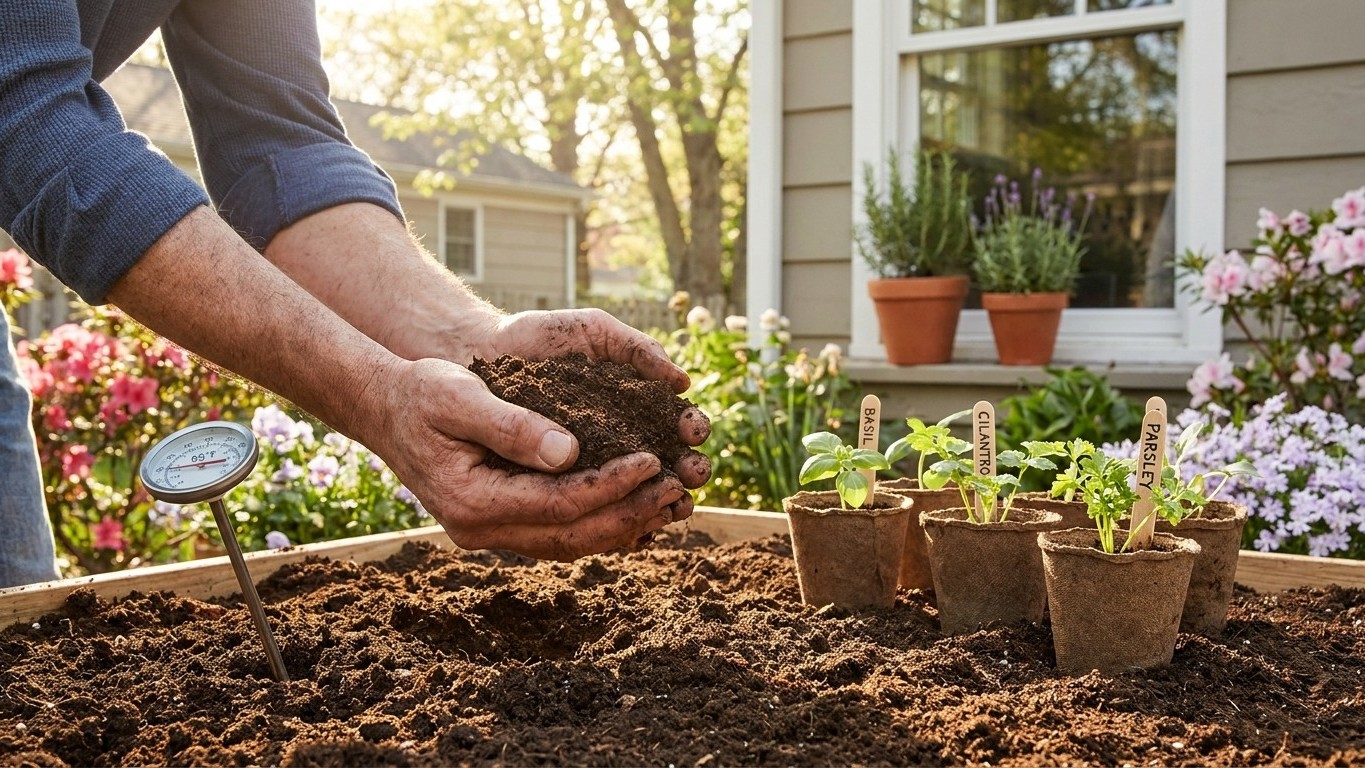
Frost dates are useful as a starting point, but herbs don’t actually respond to frost. They respond to soil temperature, and soil warms up on its own schedule after the air stops freezing. A basil transplant set into cold, damp ground in early April, even on a frost-free afternoon, will often just sit there and sulk while the roots wait for warmth that hasn’t arrived yet. Hardier herbs like parsley, chives, and cilantro tolerate cooler soil and can go in closer to the early end of that frost window. Tender, heat-loving types like basil and most tropical herbs do better waiting until the soil has had a couple of extra warm weeks to catch up.
One more caution worth repeating: the Wilmington airport station is a reference point, not a guarantee for your specific address. Suburban yards and especially rural properties away from the coast typically see their last spring frost land later, and their first fall frost arrive earlier, sometimes by one to two weeks. Higher-elevation spots inland run even further behind the airport’s numbers. Check your own county extension office or a local frost record before betting a tray of seedlings on the state average.
A few widely grown herbs, including certain mint relatives and some Mediterranean species, carry long-standing reputations as home remedies. This page doesn’t evaluate those claims one way or the other; it sticks to what it takes to grow the plant in a garden bed or a pot. And a quick safety note that applies to every herb guide on this site: never harvest an unfamiliar plant from the wild based on a resemblance to a garden herb. Several toxic look-alikes exist for common kitchen herbs, and the risk isn’t worth it even if you’re right nine times out of ten.
How long the season lasts here
Put the two NOAA windows together and Delaware’s frost-free season runs, at its tightest, from around April 14 to around October 26, a stretch of roughly 195 days. Take the more generous ends of both windows, April 3 for the last spring frost and November 7 for the first fall frost, and the season stretches to about 218 days. Either way, that’s somewhere around six and a half to seven months of workable growing time at the reference station, though your own yard may run shorter on both ends for the reasons noted above.
That length changes what’s realistic to plant and how. A season pushing past six months gives fast-maturing annual herbs like cilantro, dill, and basil enough room for more than one sowing. Cilantro in particular bolts quickly once summer heat sets in, so gardeners in Delaware often get a spring crop and then a second one seeded in late summer for a fall harvest, rather than trying to keep a single spring planting going all season.
A season on the shorter end of that range, closer to 195 days, makes the first sowing matter more, because there’s less slack to recover from a bad start. It also changes the transplanting calculus: with less time to spare, a gardener has more reason to start slow-germinating herbs like parsley or rosemary indoors, and to check the root system of a purchased transplant carefully before setting it out, since a rootbound seedling loses valuable weeks re-establishing itself once it’s in the ground.
For a full breakdown of how to plan a second or third sowing around these windows, the site’s succession sowing guide walks through spacing out plantings so the harvest doesn’t all land, and end, at once.
Heat and water in Delaware

Summer heat itself rarely limits herb growing here. Most kitchen herbs, whether Mediterranean natives like thyme and oregano or tender annuals like basil, actually prefer warm, sunny conditions and tend to underperform in cool, cloudy stretches rather than hot ones. The bigger question for anyone planning a permanent herb bed in Delaware isn’t how hot the summer gets. It’s how cold the winter gets, because that single number decides which herbs can live outdoors year-round and which ones need to spend the cold months in a pot on a windowsill.
Delaware sits in USDA Hardiness Zone 7a to 8a, based on the 2023 USDA Plant Hardiness Zone Map built from 1991-2020 climate normals. That’s a statewide range, and it matters where in it your property falls. At the Wilmington reference station specifically, the coldest month’s mean daily minimum temperature runs about 25.6°F. That’s not the record low for the winter, and it’s not a single freak night. It’s the average low across the coldest stretch of an ordinary year, which is exactly the figure that determines whether a perennial herb survives the winter outdoors or needs to come inside.
A mean minimum in the mid-20s puts genuinely woody, cold-hardy perennials like chives, oregano, thyme, and most mints in a position to survive outdoors through an average Delaware winter, particularly with a layer of mulch over the root zone. Rosemary sits closer to the edge: many varieties handle Zone 8 winters without much trouble but struggle or die back hard at the colder end of Delaware’s 7a range, especially in an exposed, windy spot. Bay laurel and other tender Mediterranean or tropical herbs generally don’t survive an outdoor Delaware winter at all and need to be grown in containers that come indoors before the first hard freeze.
None of this means summer moisture doesn’t matter. Humid Mid-Atlantic summers can bring the kind of damp, still air that favors fungal problems on herbs planted too close together, powdery mildew on basil being a common complaint in home gardens. Good airflow between plants and watering at the soil line rather than overhead does more for herb health here than any amount of extra fertilizer.
Which herbs suit Delaware
Reasoning from the numbers above points toward a fairly clear shortlist, organized by type rather than by variety, since variety trials are a job for the state’s own extension service, not for a general guide like this one.
- Cold-hardy perennials for outdoor beds: chives, oregano, thyme, and most mints, which tolerate the mid-20s winter minimum typical of the Wilmington area and can stay in the ground year after year with mulch protection.
- Borderline perennials worth watching: rosemary, which survives many Delaware winters but can suffer or die at the colder end of the 7a-8a range, particularly without wind shelter.
- Fast annuals suited to the season length: basil, dill, and cilantro, all quick enough to fit one or two full cycles inside the roughly 195-to-218-day frost-free window.
- Tender herbs better off in containers: bay laurel and other tropical or Mediterranean species that need to come indoors before the first fall frost arrives.
A humid Mid-Atlantic summer also makes disease tolerance worth weighing before flavor or growth habit for anyone who’s had trouble with mildew in the past, since a resistant type of basil or a well-spaced planting of oregano will outlast a disease-prone one regardless of how it tastes.
This page deliberately stops short of naming specific cultivars. The types above tell you what’s realistic to grow in Delaware’s climate, but which named variety of thyme or which basil selection performs best in trial gardens changes from year to year and depends on local disease pressure this page has no way to track. The University of Delaware Cooperative Extension runs exactly those trials and publishes results specific to Delaware’s counties, which makes it the right next stop for anyone ready to pick actual varieties rather than plant types.