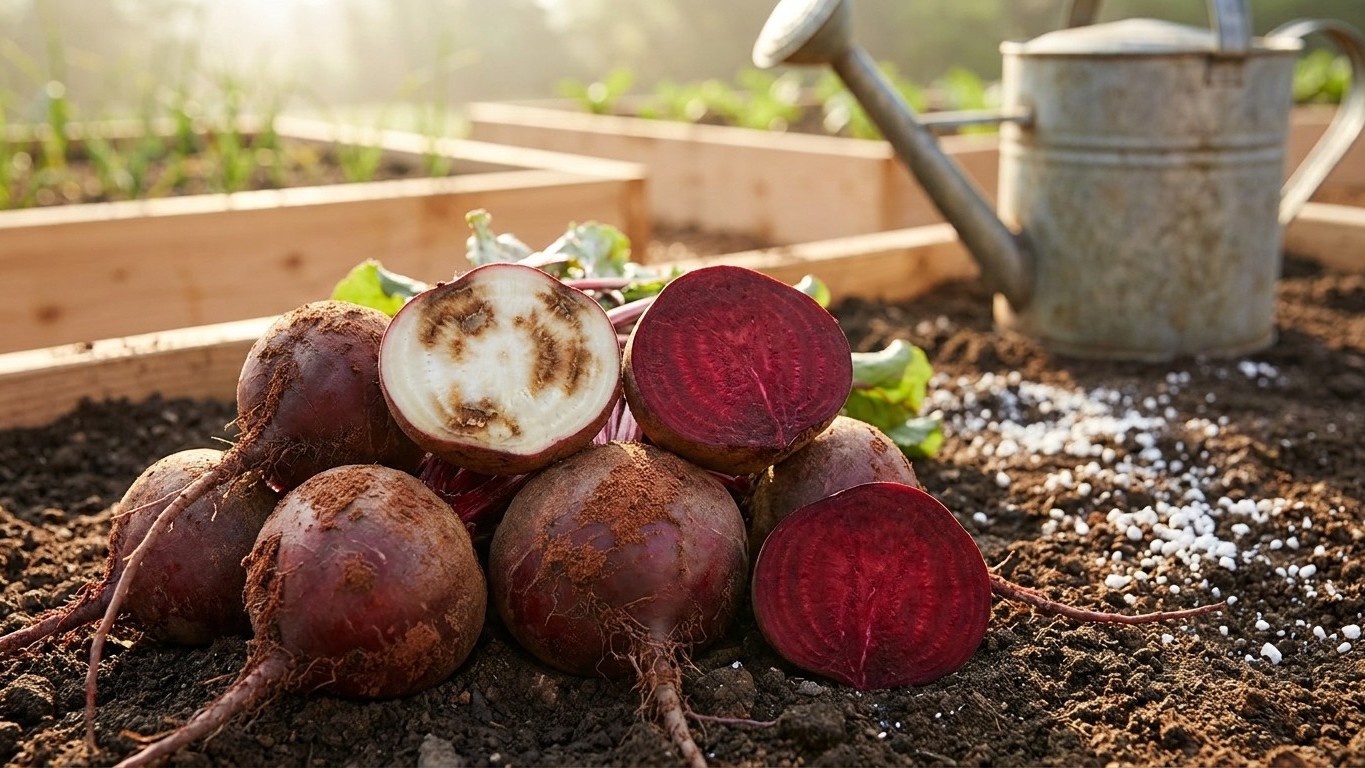

Pull beets 60 to 80 days after seeding, counted from the day the seed went into the ground. They are sown in place, so no transplant date resets the clock. In the Charlotte area, a March sowing lands the harvest between May and early June, ahead of the heat that turns roots woody. Storage is where gardeners overcorrect: topped roots keep best at 33 to 36 F. Colder than that brings more black spot and rot, not longer life.
The short answer
North Carolina’s state soil is the Cecil series, an Ultisol. That means an old, heavily weathered and leached soil, naturally acid and low in nutrients. USDA’s representative values for its surface horizon read 68 percent sand, 20 percent silt and 13 percent clay, with a surface pH of about 5.5 and organic matter near 0.8 percent. It is well drained. For a beet, that is a mixed deal. Utah State University Extension describes the ideal as deep, sandy, well-drained soil rich in organic matter, so the texture and drainage fit. The organic matter and the nutrient reserve do not. A sandy, well-drained surface sheds water quickly, which matters because a beet’s trouble starts with thirst.
Treat all of that as a starting point. A state spans hundreds of soil series, and the figures describe the ground USDA picked to represent North Carolina, not a worked garden bed. River bottoms, mountain slopes and any lot a builder has scraped or filled can differ completely. The pH of about 5.5 is the series’ number, not yours. A soil test gives you your own, and it is the only thing that can. The same Extension source says to amend with no more than 1 inch of composted organic matter per 100 square feet, which is a ceiling, not a target. Anyone wanting the full picture of what a root meets underground can read Beet Soil in North Carolina: What the Root Will Meet.
Heat is a separate problem from thirst
The number of days a year Charlotte passes 90 F is not published in the data behind this page, so no count appears here. What the Extension source does give is a lower line: heat above 85 F combined with water stress makes the root woody. Every 90 F day clears that bar, and Piedmont summers have plenty of hot weather. A beet left in a sandy bed into that stretch is the one that comes out tough and fibrous.
Woodiness and bolting are different failures with different timing. Bolting, or premature flowering, comes from water stress in the first six weeks. Woodiness comes later, from heat plus water stress as the root sizes up. Keeping the bed “watered” covers neither precisely. The first is a spring problem and the second is a late-season one, which is why the harvest date matters as much as the sowing date.
The six weeks that decide it here
Charlotte’s last spring freeze falls between March 23 and April 5, according to NOAA NCEI climate normals (the 30 to 70 percent probability band for a 32 F freeze). Sowing two to three weeks ahead of that puts seed in the ground in early to late March. The first six weeks, the stretch when water stress causes bolting, then run from March into early May. That is the window to protect.
What that spring tends to do
Piedmont springs swing. Cool, damp stretches give way to warm, dry spells, and then the pattern flips again. No single weather pattern can be promised for any given year. But the swing is the point: a run of dry days in April, arriving after a wet March, is ordinary. On a sandy, well-drained surface like the Cecil series, the top few inches can go from damp to dry quickly. The bolting risk sits in those dry spells, not in the cold itself, and it is highest for seed sown at the earlier end of the window, whose six weeks stretch deepest into the unsettled part of spring.
The practical response is plain. Check the soil by hand rather than by calendar, and keep the moisture steady through the six weeks. A mulch layer slows the drying on a soil that sheds water. Later sowings carry a different trade, since their six weeks run into warmer weather and their roots mature closer to the heat line.
Doing the harvest math
Take the 60 to 80 days on the seed packet and count from seeding. An early March sowing finishes around early May at the short end. A late March sowing at the long end finishes in early to mid June. The packet’s days to maturity vary by variety, and the source behind this page names five varieties without giving any data on them, so nothing here ranks one over another. The size at which to pull is also not published in those figures. The packet and the heat are the guide: if a hot spell is approaching and the roots are near the packet’s number, pulling them is safer than waiting.
The calendar shifts with geography. Charlotte sits in the Piedmont. The Blue Ridge mountains to the west run several weeks later in spring, and the coastal plain runs earlier, so the whole window slides with it. For a wider look at the crop, see Growing Beets in North Carolina.
What goes wrong here
Most failures come from the soil’s tendency to shed water, the heat arriving on a fixed schedule, or storage advice borrowed from other crops. Each one below carries its fix. Insect and animal damage is a separate subject, covered in What Eats Beet in North Carolina, and When.
- Bolting after a dry April. Water stress in the first six weeks triggers premature flowering. On a fast-draining sandy surface, check moisture often through that window and mulch to slow evaporation.
- Woody roots from late heat. Heat above 85 F combined with water stress toughens the root. Sow early enough that the packet’s 60 to 80 days finish before the hottest weather, and pull rather than leave roots standing into summer.
- A storage setting that is too cold. USDA Agricultural Handbook 66 says black spot and rot increase at 32 to 34 F compared with slightly warmer conditions. Aim for 33 to 36 F at about 98 percent humidity for topped roots. For pits and cellars, the same source says stay between 31 F and 41 F.
- Storing roots with the tops on. Bunched beets, leaves attached, hold only about 10 to 14 days at 32 F and above 98 percent humidity. Top them first if you want them to last longer.
- Saving the wrong roots. Large roots keep much better than small ones because they lose water and shrivel more slowly. Store the big ones and eat the small ones first.
- Overfeeding a thin soil. With organic matter near 0.8 percent on the mapped surface, the instinct is to pile on compost. Utah State University Extension caps it at 1 inch of composted organic matter per 100 square feet, so stay under that and let a soil test guide the rest.
Common questions
How do I know when a beet is ready to pull?
Start with the days to maturity on the seed packet, counted from seeding. For beets that range is generally 60 to 80 days. The sources behind this page give no size cutoff, so use the packet count plus the weather: if heat above 85 F is coming and your roots are close to the number, pulling is the safer call.
Can I start beets indoors and transplant them to shorten the wait?
Beets are sown in place, so the count always runs from seeding. A transplant does not restart or shorten it, and nothing in the sources here supports the method.
Is a colder refrigerator or cellar better for storing beets?
No. USDA Agricultural Handbook 66 reports more black spot and rot at 32 to 34 F than at slightly warmer temperatures. The target for topped roots is 33 to 36 F at about 98 percent humidity. For pits and cellars, stay between 31 F and 41 F.
Which beets should I store, and which should I eat now?
Store the large roots, since they keep much better, and eat the small ones first because they shrivel faster. Remove the leaves before storing. Bunched beets with tops attached last only about 10 to 14 days.