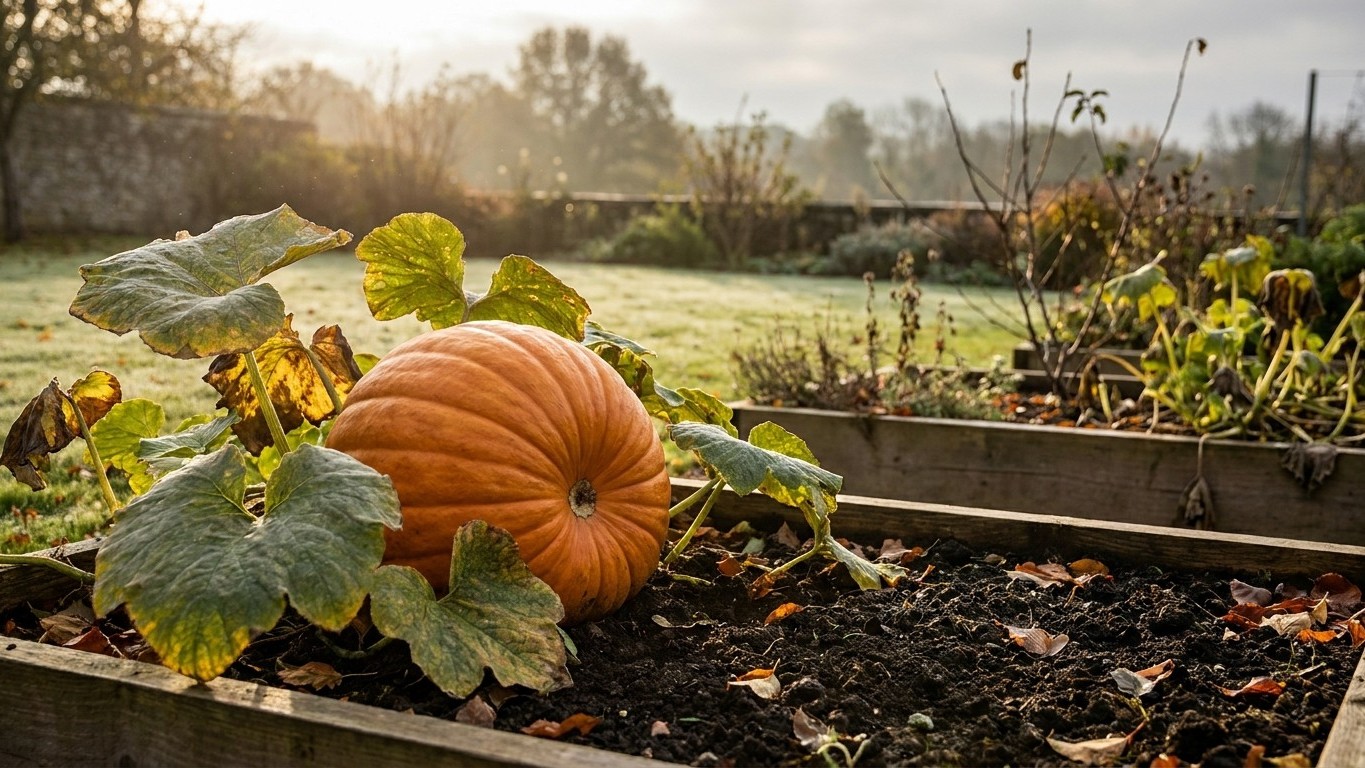

In most parts of Delaware, a pumpkin planted on a normal schedule ripens with real margin before frost. The catch is that pumpkins need 45 to 55 days to mature counting from the day they flower, not from the day the seed goes into the ground. Get the flowering date right and Delaware’s season carries the rest with room to spare. Get it wrong, and October hands you a green, frost-nipped fruit instead of a jack-o’-lantern.
The short answer
Delaware’s first fall frost typically lands somewhere between October 26 and November 7, based on NOAA’s 1991-2020 Climate Normals for station USW00013781. That’s not a single date but a band, and the width of that band matters just as much as its position when you’re planning backward from it, which is the whole question behind Will Pumpkins Ripen Before Frost in Delaware?
Utah State University Extension puts pumpkin maturity at 45 to 55 days after flowering. Run that math against Delaware’s frost window and you get two different answers depending on which end of each range you land on. Pair the earliest frost date with the longest maturity window (the toughest combination) and the last safe flowering date falls around September 1. Pair the latest frost date with the shortest maturity window (the kindest combination) and flowers opening as late as September 23 could still finish. That spread, roughly September 1 to September 23, is the real window for this state, and it’s wide because both the frost date and the maturity length are themselves ranges, not fixed points.
Treat the earlier end of that window as the one to plan around. Nobody knows in July which kind of fall they’ll get, and a flower that opens September 1 is safe under either scenario, while one that waits until September 20 only works if the season cooperates. There’s also a practical wrinkle: the frost dates above come from an airport weather station, and gardens away from that station, particularly inland and away from any moderating water, tend to see their first frost arrive one to two weeks earlier. If your yard sits in a low spot or well outside the immediate coastal strip, it’s worth mentally sliding that whole window a week earlier as a cushion, rather than planning right up against September 23.
None of this changes when you plant seed. It changes when you need to see the first female flowers open, which is a date you track by watching the vine, not the calendar.
When to sow here
The last spring frost in Delaware falls, on average, between April 3 and April 14, per the same NOAA 1991-2020 Climate Normals dataset. That date tells you when the air stops threatening frost. It says nothing about the soil, and pumpkin seed answers to soil temperature, not air temperature.
For a full breakdown of When to Sow Pumpkins in Delaware, pumpkins go in once the soil reaches 65°F, according to Utah State University Extension. Bare, uncovered soil in this region generally takes several weeks longer than the last-frost window to climb that high, since dirt holds cold far longer than the air sitting above it. That lag is the piece most home gardeners miss: they watch the thermometer on the porch and assume the ground has caught up, when it hasn’t.
- Note the last-frost window for your area: April 3 to April 14 at the reference station, and possibly a bit later once you’re away from that immediate location.
- Expect bare soil to need a few additional weeks beyond that frost window before it reaches 65°F, since soil warms on its own slower clock.
- If you use a row cover or dark mulch to pre-warm the bed, plan on that buying about two weeks, letting you sow that much sooner than uncovered ground would allow.
- Confirm 65°F with an actual soil thermometer pushed a few inches down before sowing, rather than trusting the calendar alone.
- From sowing, count forward to the first female flowers, not backward from frost. The flowering date, not the sowing date, is what starts the 45-to-55-day maturity clock described above.
Getting the sowing date right doesn’t guarantee flowering falls inside the safe window from the section above. It only sets the earliest realistic starting line each spring, which is the piece of the calculation that’s fully in the gardener’s control.
What goes wrong here
- A late flower that never colors. If the first female flowers don’t open until late September, there may not be enough of the 45-to-55-day window left before the fall frost band arrives. The fruit keeps swelling but stalls out green because frost cuts the ripening process short. Track flowering weekly starting in August, and if bloom runs late, plan on using the green fruit for cooked squash rather than counting on a carved pumpkin.
- A fruit caught by frost before it finishes. A freeze can blacken foliage and halt color development even on a pumpkin that looks nearly done. Once the calendar moves into the fall frost window, watch the extended forecast and harvest early rather than gambling on a few more days on the vine.
- A vine that dies back before the rind hardens. Disease, drought stress, or simple exhaustion can take down the leaves weeks before the shell has thickened enough to store well. Keep vines watered through late summer, and skip overhead watering as fall approaches, since wet foliage late in the season speeds decline.
- Pest pressure that stunts the vine before fruit ever sets. Squash bugs and cucumber beetles can weaken Delaware pumpkin patches enough to delay or prevent flowering altogether. Identification and control for both pests are covered on their own pages on this site rather than repeated here: see squash bugs in Delaware and cucumber beetles in Delaware.
Checking this against your own county
Every frost date in this article comes from a single weather station, and Delaware, small as it is, doesn’t warm and cool uniformly across it. Coastal areas tend to hold heat a little longer into fall than inland spots, and a garden in a low-lying frost pocket can see its first freeze arrive well before a neighbor’s a mile away on higher ground.
For a reading closer to your own soil, contact the University of Delaware Cooperative Extension. Their county offices track local frost patterns and can tell you whether your area typically runs ahead of or behind the airport-based dates used here, which is the adjustment that actually decides how late you can afford to let a pumpkin flower.
Common questions
Can I still plant pumpkins in July in Delaware?
Only if you’re using a fast-maturing plan and accept the risk. Working from the 45-to-55-day-after-flowering rule, flowers need to open by roughly early September at the latest to have a safe margin, which leaves little slack for a July sowing to flower, set fruit, and finish before frost.
Does a warm October push the safe window later?
It can, since the fall frost date itself is a range (October 26 to November 7) rather than a fixed day. But that range already accounts for typical year-to-year variation, so treating the earlier end as your planning target is safer than counting on a late-arriving frost.
Should I pick pumpkins before the first frost or after?
Before. Utah State University Extension recommends harvesting with the stem attached and getting fruit in before frost hits, rather than waiting to see how a freeze affects a nearly ripe pumpkin.
Does soil temperature matter more than air temperature for sowing?
Yes. The 65°F threshold from Utah State University Extension is a soil measurement, and soil in Delaware typically reaches that mark weeks after the last spring frost has already passed, not on the same day.