
Pennsylvania gardens get a decent amount of summer rain on paper, but the timing and the heat that comes with it decide whether that rain actually reaches root depth. The short answer: water deeply once or twice a week, at the base, in the morning, and check the soil with your finger before you trust the sky or the calendar.
What changes here

Two numbers set the terms for every watering decision in this state. The driest summer month, June, averages 4.04 inches of rain. And the reference station near Philadelphia logs 24.0 days a year at or above 90F. Put together, that means the wettest-seeming month of summer still isn’t a guarantee against heat stress, because a handful of those 90-degree days can land in the same three-week stretch and pull moisture out of the topsoil faster than a single storm can replace it.
Run the arithmetic and it looks close, almost reassuring. A vegetable bed or a new perennial wants roughly an inch of water a week. June has about 4.3 weeks in it, so 4.04 inches divided across the month works out to roughly 0.94 inch per week arriving from the sky, only a sliver short of the target. July (4.38 inches) and August (4.29 inches) land in the same range. On paper, Pennsylvania looks like a place where the garden hose could almost stay in the shed.
The catch is distribution, not volume. That 4.04 inches rarely falls in four neat one-inch doses. It’s far more likely to arrive as one or two heavy thunderstorms and a stretch of nothing in between, the kind of week where the total rain gauge number looks fine but the bed spent five days bone dry. On sandy soil, a downpour drains through the root zone within hours, leaving nothing for the dry stretch that follows. On heavy clay, the same storm can pond on the surface and run off before it soaks in, or it can sit and stay wet for a week, which creates the opposite problem: roots that never get the oxygen they need. Either way, the monthly average of 4.04 inches tells you what the sky usually delivers over 30 days, not what the roots in your specific bed felt on any given Tuesday. A rain gauge staked next to the garden, checked weekly, settles the question a monthly normal can’t.
How to water when it matters
The method that works in this climate is deep and infrequent, delivered at the base of the plant, done in the morning. Each piece of that has a reason tied to what the plant is actually doing underground. Deep watering pushes moisture down past the top couple inches, which trains roots to follow it downward instead of clustering near the surface where June’s heat load dries them out fast. Watering at the base rather than overhead means the leaves stay dry, which matters because wet foliage sitting overnight is exactly what fungal disease needs to take hold. Morning watering gives the plant hours of sunlight to use what it just absorbed before evaporation and heat (remember, 24 days a year hit 90F or higher) start pulling moisture back out of the soil.
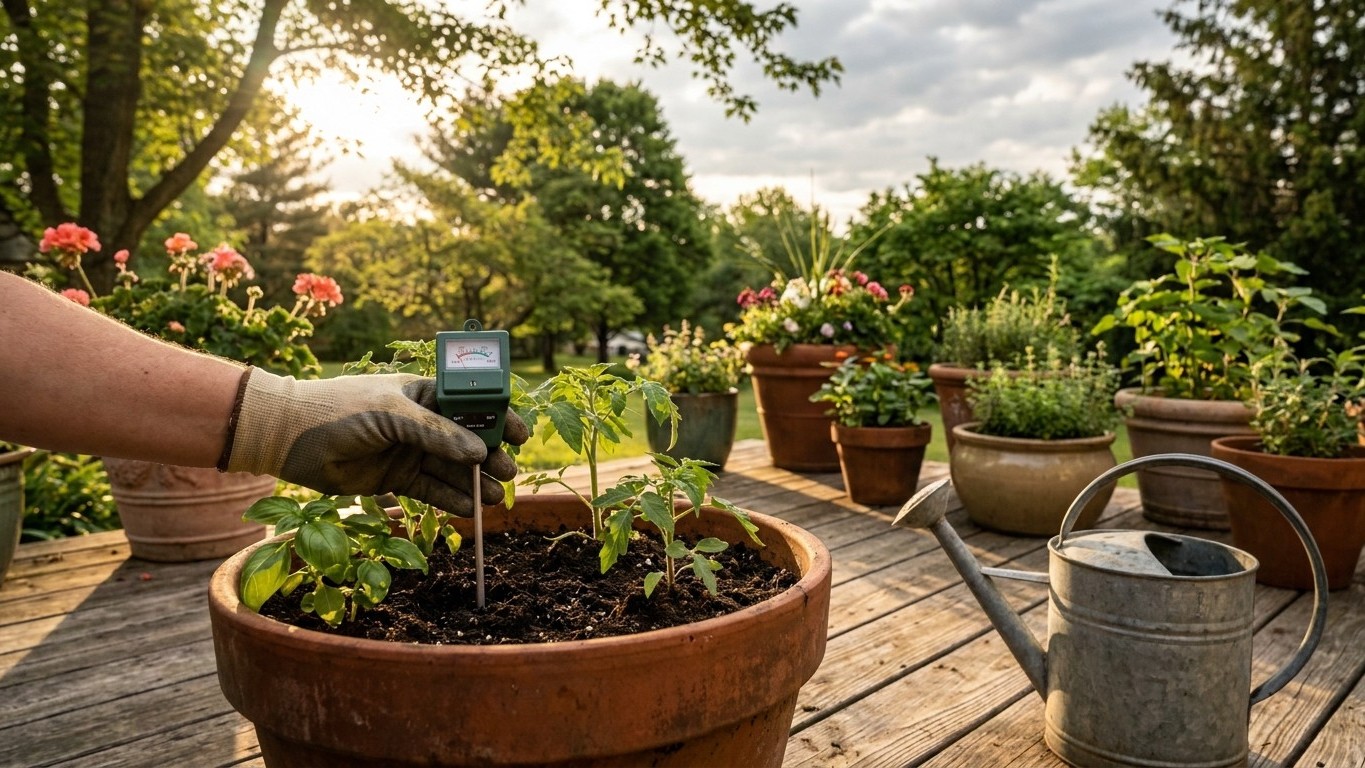
Checking the soil beats checking the calendar. A finger pushed two inches into the bed, or a trowel pulled up for a quick look, tells you more than any watering schedule taped to the shed wall. If it’s dry at that depth, water. If it’s still damp, wait, even if it’s been four days since the last soak.
Soil texture changes the rhythm more than it changes the method. Sandy ground holds little water and drains fast, so it asks for shorter, more frequent soakings, sometimes every two to three days in a hot stretch. Heavy clay holds a week’s worth of moisture in reserve, but watering it again before it’s had a chance to dry invites root rot and starves roots of oxygen. Neither soil type changes the goal, which is moisture at root depth, not a puddle on top.
- Start with about 1 inch of water per week as a baseline for an established bed, delivered in one or two sessions rather than daily sips.
- Check soil moisture two inches down with a finger or trowel before each watering, and skip the session if it’s still damp.
- Water at the base of the plant, using a soaker hose, drip line, or watering can aimed at the soil rather than a sprinkler aimed at the leaves.
- Water in the early morning, ideally before 9 a.m., so the plant has the full day to use the moisture before evening.
- Adjust the frequency for your own soil: shorten the interval on sandy ground, lengthen it on clay, and treat the 1-inch figure as a starting point to verify against what your finger finds in the dirt.
What goes wrong
“I water a little every day so it doesn’t dry out”
A daily light sprinkle wets only the top half-inch of soil and never reaches where the roots actually live. Roots respond by staying shallow, chasing the moisture where it lands, which leaves them exposed the moment a 90-degree day (and this state logs 24 of them a year on average) bakes that top layer dry. The plant ends up more fragile, not less, than one watered deeply twice a week.
“I water in the evening so it has all night to soak in”
Evening watering wets the leaves and then leaves them wet for eight or more hours in the dark, which is close to ideal conditions for fungal disease. Powdery mildew and other leaf fungi thrive on foliage that stays damp overnight. Morning watering gives the sun a chance to dry the leaves within hours instead.
“It rained yesterday, so I don’t need to water”
A summer thunderstorm can drop a heavy amount of rain in twenty minutes and still only wet the top half-inch of soil, especially if the ground was already dry and hard. The rest runs off before it soaks in. Checking with a finger two inches down, rather than assuming the storm did the job, is the only way to know if the root zone actually got fed.
“I don’t bother with mulch”
Bare soil left uncovered loses moisture to evaporation almost as fast as it’s applied, particularly on the hotter days this state sees each summer. A layer of mulch, two to three inches, slows that loss and keeps the soil at a more even moisture level between waterings, which matters most in the stretches when rain skips a week entirely.
Local help
Penn State Extension is the state’s land-grant resource for garden and landscape questions, from soil testing to plant selection for local conditions. Find county offices and guides at extension.psu.edu. Watering restrictions vary by municipality and water provider and can change with drought conditions, so check with your local water utility for current rules before setting up an automated system.
Common questions
How much rain does Pennsylvania get in a typical summer?
About 12.7 inches across June, July and August combined, with June being the driest of the three at 4.04 inches, based on 1991-2020 climate normals from the reference station.
How many hot days should I plan around each year?
The reference station near Philadelphia averages 24.0 days a year at or above 90F, which is the main driver of extra watering demand beyond what rainfall alone provides.
Is one inch of water a week enough for a Pennsylvania garden?
It’s a reasonable starting point for many beds, but it should be checked against your own soil with a finger or trowel rather than followed as a fixed rule, since sandy and clay soils hold that inch very differently.
Should I water on a schedule or based on the soil?
Based on the soil. A calendar can’t tell you whether a recent storm actually soaked the root zone or just wet the surface, but two inches down with a finger will.