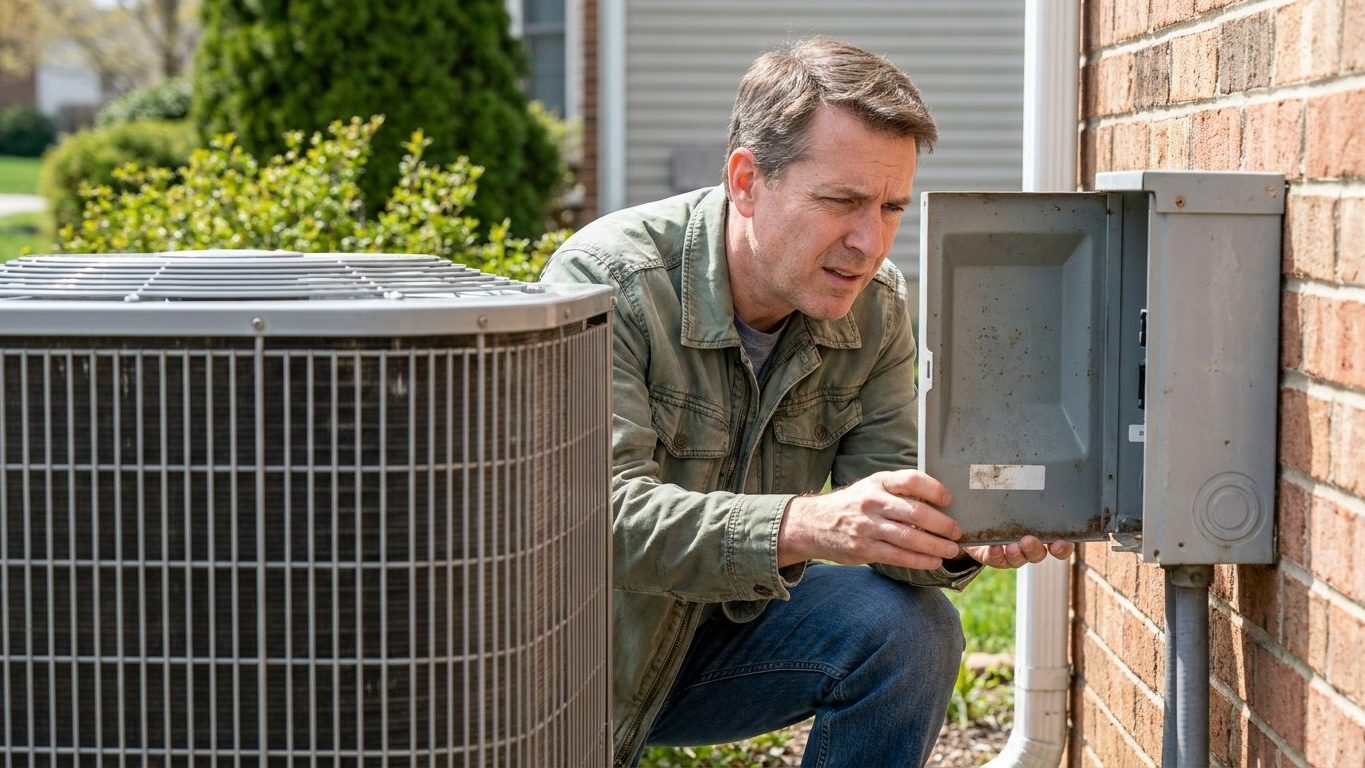

Most of the time, central air that won’t turn on has a cause you can check yourself in under ten minutes, without tools and without spending a dime. The fixes cluster around three things: power that never reached the unit, a safety switch doing its job, or a control board waiting out a timer. Work through the list in order before you call anyone.
Seven things that cost nothing

The order matters here. Each step below either fixes the problem outright or rules out a cause, so working top to bottom saves you from guessing.
- Thermostat mode and setpoint. Confirm it’s set to COOL, not OFF or HEAT, and that the target temperature is set at least a couple degrees below the current room temperature. A thermostat sitting in HEAT mode from a cold snap months ago is a surprisingly common culprit.
- Thermostat batteries. If the display is dim, blank, or frozen, swap the batteries before touching anything else. A dead thermostat can’t call for cooling no matter what else is working.
- The indoor unit’s own power switch. Air handlers and furnaces typically have a light-switch-style disconnect mounted on or near the unit, sometimes looking exactly like a wall switch. It’s easy to bump off during storage or cleaning nearby.
- The outdoor disconnect. Next to the condenser (The Outdoor Unit), there’s usually a small metal or plastic box with a pull-out block or lever. This is a service disconnect, and it’s meant to be pulled during maintenance, so check that it’s fully seated.
- Both breakers. This is the one people miss most. The indoor air handler and the outdoor condenser almost always run on separate breakers in your electrical panel, not one shared breaker. It’s entirely possible for one to trip while the other stays on, meaning the system half-powers and does nothing. Check both, not just the one labeled “AC.”
- The condensate float switch. A small plastic switch sits in or near the drain pan and cuts power to the system when it senses water backing up. If it’s tripped, the system isn’t broken, it’s Protecting your ceiling. More on this below.
- The air filter. A filter clogged with dust can choke airflow badly enough that some systems shut themselves down as a protective measure. The U.S. Department of Energy’s ENERGY STAR program is specific about this: “Inspect, clean, or change air filters once a month in your central air Conditioner, furnace, and/or heat pump.” Once a month, for all three pieces of equipment, not just during cooling season.
If you’ve gone through all seven and the system still won’t respond, you’ve at least eliminated the free, obvious causes, and that information is useful to whoever you call next.
The switch that shuts it off on purpose
Almost no consumer guide mentions this one by name, but it explains a real share of “central air won’t turn on” calls. Most central systems include a condensate safety switch, sometimes called a float switch, sitting inside the drain pan under the indoor coil or inline with The Condensate Drain line itself. Its only job is to cut power to the system the moment water rises higher than it should.
That’s not a malfunction. That’s the switch doing exactly what it was installed to do. Central air conditioners pull a surprising amount of moisture out of the air on a humid day, and all of that water has to drain out through a small line, usually PVC, running to a floor drain or outside. When that line clogs, algae, dust, and debris build up over time, water backs up into the pan, the float rises, and the switch opens the circuit before the pan overflows into your ceiling or a closet below.
Look for the switch near the indoor coil, often a small white or gray box with a float arm inside a clear or white plastic housing, sometimes mounted directly on the drain pan and sometimes spliced into the drain line a few feet downstream. If the pan is holding standing water, or the drain line looks slow or slimy at the outlet outdoors, the switch has almost certainly tripped for a legitimate reason.
Resetting the switch or bypassing it isn’t the fix. The water is still backed up, and it’ll trip again, or worse, it won’t and the pan will overflow. The actual fix is clearing whatever is blocking the drain line so water can flow freely again. For the specific steps on flushing a clogged condensate line safely, see the condensate drain guide on this site.
Delays, lockouts and what not to do while waiting
Two behaviors get mistaken for a broken system constantly, and both are just the control board doing its job.
The first is an anti-short-cycle delay. Any time the system loses power, whether from a breaker trip, a thermostat adjustment, or a brief outage, most compressors won’t restart immediately. The control board holds off for a few minutes as a built-in protection, since Restarting a compressor against residual pressure can shorten its life. If your air just came back on and you flipped the thermostat and nothing happened, that pause is very likely just the delay running its course.
The second is a control lockout. If the system tries to start and fails a few times in a row, some control boards lock out further attempts for a set period rather than keep hammering away at a fault. This is more common after a series of power blips or a marginal electrical issue, and it usually clears on its own after enough time passes, though it can also indicate a real problem worth investigating if it keeps happening.
Here’s the part worth saying plainly: switching the thermostat between OFF, COOL, and HEAT repeatedly while you wait is one of the more reliable ways to actually damage a compressor. Every mode change resets timers and can force additional start attempts on a component that’s already stressed. The rule is simple. Set the thermostat to COOL at your target temperature, leave it alone, and wait out the delay, typically a matter of minutes, not hours. If nothing has happened after a reasonable wait, move on to checking the free items above rather than toggling the thermostat over and over.
Where this stops being yours
Most of what causes a no-start is something you can check safely. Two situations are hard stops, and there’s no shame in handing them off, because they involve either recurring electrical faults or components that store energy.
The first is a breaker that trips again after you’ve reset it. A breaker tripping once can be incidental. A breaker that trips a second time, especially right after reset, is telling you there’s a fault drawing more current than the circuit is rated for, and resetting it repeatedly just to see if it “sticks” risks damage or worse. Stop there and call a technician.
The second is anything inside the outdoor unit’s electrical compartment, the panel you’d access by removing screws on the condenser cabinet. Components in there, particularly the run capacitor, hold an electrical charge even after the unit is unplugged and the breaker is off. There’s no home test or discharge trick worth attempting here. This is a job for someone with the right tools and training, full stop.
Refrigerant falls into its own category entirely. Refrigerant is not a consumable that gets “used up” during normal operation, the way gasoline or oil would be. A system that’s low on refrigerant has a leak somewhere in the sealed system, and simply adding more without finding and fixing that leak means paying to refill the same leak again down the road. Any refrigerant work, including diagnosing whether a system is low, belongs to a licensed technician.
When you do call, having a few details ready speeds things up considerably. Be prepared to say what you observed (no cool air, a burning smell, unusual noise), which of the free checks above you’ve already ruled out, and whether the outdoor unit’s fan and compressor were running or completely silent when you last checked. That last detail alone often points a technician toward the right diagnosis before they even arrive.
Common questions
Why does the indoor blower run but no cold air comes out?
This usually points toward the outdoor unit, since the indoor fan and the outdoor condenser run on separate circuits and separate breakers. If the blower runs but the air isn’t cool, check the outdoor disconnect and outdoor breaker first, since it’s common for the indoor half of the system to keep working while the outdoor half has lost power.
How long should I wait before assuming it’s actually broken?
Give it a few minutes after any power interruption to clear a normal restart delay. If you’ve gone through the free checks in order, including both breakers and the condensate switch, and there’s still no response after that wait, it’s reasonable to call for service rather than keep waiting.
Can a dirty filter really stop the whole system?
Yes. A severely clogged filter restricts airflow enough that some systems will shut down to protect the equipment. This is exactly why ENERGY STAR recommends inspecting or changing filters once a month across your central air conditioner, furnace, and heat pump, not just when the system seems to be struggling.
Is it safe to reset the breaker myself if it trips?
Resetting a tripped breaker once is a normal first step. If it trips again right away or trips repeatedly, stop resetting it and call a technician, since that pattern points to a fault that needs proper diagnosis rather than a simple flip of the switch.