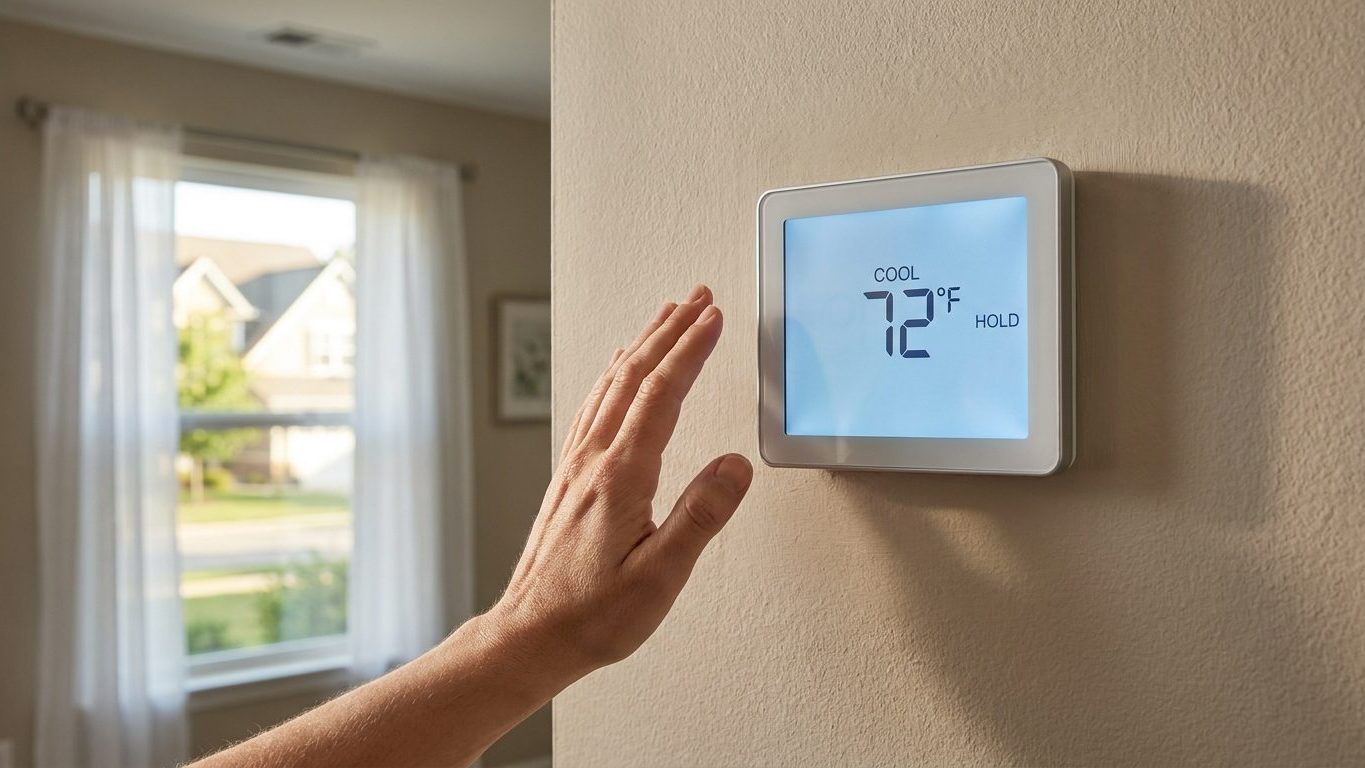

Air conditioning that won’t come back on after a power outage is usually fine. Most central systems build in a startup delay to protect the compressor, so the first minutes of silence are normal, not a fault. If the system still hasn’t run after that delay, the cause is almost always a tripped breaker, a reset thermostat, or a safety switch, not a broken system.
The first thing to do is wait
The instinct after an outage is to flip the thermostat off and on, or switch between cool and heat, trying to force a response. That’s the wrong move. Central air conditioners are built with a delay, often several minutes and sometimes longer depending on the equipment, before the compressor is allowed to restart. That pause exists because the refrigerant pressure inside the system needs to equalize before the compressor is asked to work again.
Restart it too soon, against pressure that hasn’t settled, and the compressor strains. Do that repeatedly, cutting power and restoring it, toggling modes, cycling the thermostat, and you’re not troubleshooting. You’re wearing down the one part of the system that’s the most expensive to lose and the least forgiving of shortcuts.
What the delay actually looks like
After the power comes back, set the thermostat to cool, pick a temperature a few degrees below room temperature, and leave it alone. You may hear the indoor blower start almost right away. The Outdoor Unit, where the compressor lives, is the part that waits. That’s expected. Nothing is wrong simply because the outdoor fan hasn’t kicked in during the first few minutes.
The rule here is simple and worth repeating because impatience is the most common way homeowners turn a non-issue into a real repair: set it once, walk away, and give it the time it needs. If the system still hasn’t started after a reasonable wait, that’s the signal to move to the next step, not to keep resetting the thermostat.
Then the checks
If the waiting period has passed and the outdoor unit still isn’t running, work through the list in order. Each step rules out something simple before you consider anything more serious.
- The thermostat. A power cut can wipe a programmable thermostat’s clock and schedule, or drain batteries that were already weak. A thermostat running on the wrong time will follow yesterday’s program at today’s hour, which can look exactly like a system that isn’t responding, when really it’s just waiting for a time slot that hasn’t arrived yet. Check the display, confirm the time and date, and replace batteries if the screen looks dim or blank. This site’s thermostat guides walk through resetting a schedule and reading common display icons if you need the full steps.
- The indoor switch. Central systems usually have a power switch near the furnace or air handler, often looking like a household light switch mounted on or near the unit. It’s easy for this to get bumped, and easy to forget it exists.
- Both breakers. Indoor and outdoor units typically run on separate circuits, so check the breaker panel for both. A power surge during an outage’s restoration can trip one without the other, and if you only look at one you’ll miss it.
- The outdoor disconnect. Most outdoor condenser units have a small disconnect box mounted on the wall beside them, with a pull block or a switch inside. It’s a common place for a breaker-style reset to have tripped as well.
- The condensate float switch. If a storm caused flooding or heavy rain alongside the outage, check whether the condensate line’s safety float switch has tripped. It’s designed to shut the system down when water backs up, and it won’t reset on its own until the water clears.
Working down this list in order matters, because each check takes seconds and rules out the most common, most fixable causes before anything else gets blamed.
When the outage itself did damage
Sometimes the honest answer is that the outage was hard on the equipment. A sudden loss of power, followed by an equally sudden restoration, particularly if the power flickered or surged rather than cutting cleanly, can be rough on sensitive components. A system that still won’t run several hours after the delay has passed, with the thermostat set correctly and every switch and breaker checked, may have lost a control board, a capacitor, or a contactor to that surge.
At this point, the useful thing is observation, not testing. Notice whether the indoor blower runs when the thermostat calls for cooling. Notice whether the outdoor fan turns at all, even briefly. Listen for a hum from the outdoor unit that doesn’t turn into a full startup. Look at the control board or the thermostat for a blinking light, since many systems use blink patterns to signal a specific fault. None of this requires opening a panel or touching a component. It just requires paying attention to what the system is or isn’t doing.
One point is worth repeating plainly: a run capacitor holds an electrical charge even after the power is off, and that charge doesn’t disappear the instant you flip a breaker. The electrical compartment on the outdoor unit stays closed. What you’re gathering here is information to describe accurately to a technician, not a diagnosis to act on yourself.
It’s also worth remembering that refrigerant isn’t something a system uses up like fuel. A system that seems low on refrigerant has a leak somewhere in the line, not a running total that’s simply been depleted by normal use. If a technician mentions refrigerant level at all, the conversation is really about finding and sealing a leak, not “topping off” the system the way you’d add oil to a car.
If you are running on a generator
Storm season brings a version of this problem that has nothing to do with the Air Conditioner itself and everything to do with how power is being supplied. If you’re running a portable generator while utility power is out, the safety rule comes first and it isn’t negotiable: a portable generator is never run inside a home, a garage, or any enclosed space, even with doors and windows open for ventilation. It needs to sit well away from the house, with the exhaust pointed away from doors, windows, and vents. This site’s carbon monoxide guide covers the full safety guidance in detail, and it’s worth reading in full before a generator ever gets fueled up.
Past the safety issue, there’s a practical one. Central air conditioning is one of the largest single loads a home asks of a generator, because the compressor draws a heavy surge the moment it starts. Many portable generators simply aren’t built to start one, even if they can power lights, a refrigerator, and a few other circuits without trouble. Trying to force it, especially trying repeatedly after a failed start, isn’t just frustrating. It’s hard on the generator, and it’s hard on the air conditioner’s own components at the same time.
This isn’t a situation where a rule of thumb helps much, because the two answers you need come from two different labels: the air conditioner’s own data plate, and the generator’s rated output. Comparing those two numbers, not guessing based on a home’s square footage or a generator’s size in general terms, is what tells you whether the pairing will work. If they don’t line up, running the rest of the home’s essential circuits and leaving the air conditioner off until utility power returns is the safer, and often the only workable, choice.
Common questions
Why won’t my AC turn on right after the power comes back?
Most systems have a built-in delay, often several minutes and sometimes longer, before the compressor is allowed to restart after a power interruption. This protects the compressor from starting against pressure that hasn’t equalized yet. If the delay has passed and it’s still not running, move on to checking the thermostat, switches, and breakers.
Is it safe to keep resetting the thermostat if the AC doesn’t start?
No. Repeatedly switching modes or cycling power is one of the more common ways a compressor gets damaged. Set the thermostat once, to cooling and a temperature below room level, and leave it alone through the restart delay before checking anything else.
Could the power outage have damaged my air conditioner?
It’s possible. A sudden power loss followed by a surge on restoration can affect a control board, a capacitor, or a contactor. If the system still won’t run after the delay and every switch and breaker checks out, that’s worth describing to a technician, along with what you observed: whether the blower ran, whether the outdoor fan moved, and whether any light was blinking.
Can I run my central air conditioner off a portable generator during an outage?
Only if the generator’s rated output matches what the air conditioner’s data plate requires, since the compressor’s startup draw is one of the largest loads in a typical home. Many portable generators can’t handle it. Compare the two labels directly rather than guessing, and never run a generator inside a home or garage under any circumstances.